
Competitive Edge Insurance
  • Construction
  • Business
    • Health and Wellness Insurance
    • Cyber Liability
    • Bonding
    • General Business Insurance
    • EIDL Insurance Requirements
  • Personal Lines
    • Auto Insurance
    • Boat Insurance
    • Homeowners Insurance
  • About Us
  • Resources
    • Articles and Insights
    • Trusted Advisors
  • Contact
  • Menu Menu
  • LinkedIn
  • Instagram
  • Facebook
  • Youtube

Insurance Trends in 2022: What to Watch For

in General Business Insurance, News

Competitive Edge Insurance is a commercial insurance brokerage that specializes in hard-to-place risks. This includes businesses that are in chaos or crisis with high-risk exposures such as construction and development, property investors and flippers, and those with excess losses or claims.

In 2022, we’re observing a noticeable change in favor of insurance buyers. In turn, we are optimistic for many segments of the commercial lines market in the coming year. Welcome to “Insurance Trends in 2022: What to Watch For.”

Let’s dive in.
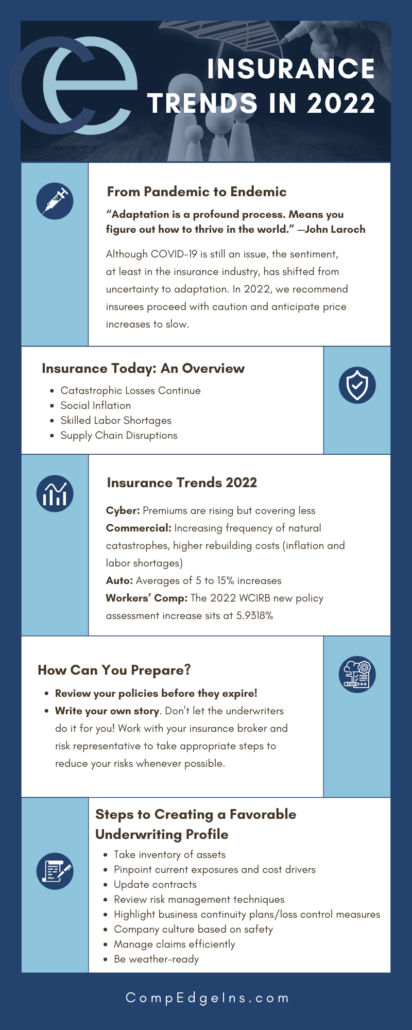
From Pandemic to Endemic

“Adaptation is a profound process.  Means you figure out how to thrive in the world.” —John Laroch

As we well know, COVID-19 is an ongoing issue. In fact, variants have led many to expect that COVID-19 is here to stay.

Regardless, the sentiment, at least in the insurance industry, has shifted from uncertainty to adaptation.

For the past 10 quarters, rate increases have averaged 10%. Capital in the reinsurance market has increased by 30% which provides support against a large loss event, catastrophe, economic turmoil, and/or adverse claims.

In 2022, we recommend insurees proceed with caution. Additionally, we anticipate price increases to slow. Please note, however, the word “slow” in this sentence. Increases are expected to slow, not create a downward trend in pricing.

Today’s World of Insurance: An Overview

As we know, the past 18 months have been nothing short of eventful. This considered, what are we observing in the insurance world today? Here are a few elements.

  • Catastrophic Losses Continue
  • Social Inflation
  • Skilled Labor Shortages
  • Supply Chain Disruptions

Did you know that according to a study from the Society for Human Resource Management, nearly 90% of businesses are having a hard time filling open positions?

Next, let’s dive into each insurance sector a bit deeper: cyber, commercial property, auto, and workers’ compensation.

Cyber Insurance

When it comes to cyber insurance, premiums are rising but covering less.

What’s Causing Insurance to Increase?

  • Cyber extortion jumped by 150% in a year
  • Companies are more likely to rely on outside attorneys to handle cyber response (in order to contain potential lawsuits)
  • Every claims category has increased in the past year; cases of malicious breaches and unintentional disclosure increased by 18%
  • Cyber coverages are expected to rise sharply, 40% to 50% for optimal risks and 50% to 100% or more for less optimal risks, seeing as ransomware attacks continue to crowd the cyber insurance market

Additionally, executives do not have the knowledge to properly insure their companies from cyber risk. Here are some statistics from Munich RE to paint a picture for you:

  • “81% of C-level respondents think their company is not adequately protected against cyberthreats
  • 35% are considering taking out an insurance policy and will very likely do so
  • Only 34% of C-level respondents have been in contact with their insurers
  • One out of four C-level respondents was totally unaware of the opportunities that cyber solutions offer
  • 17% of C-level respondents still do not have an overview of the cyber insurance products on the market”

The bottom line? C-level executives, while they may be concerned about cyber threats, do not have an understanding of what insurance products and services are available to them.

Commercial Property

What Elements Are Driving Rates?

  • Increasing frequency of natural catastrophes, as well as the severity of those events
  • Higher rebuilding costs due to price inflation of materials and labor shortages

Today, however, commercial property markets are stabilizing. Additionally, increased rates are slowing while capacity is increasing.

We can also anticipate more favorable terms for clients who mitigate risk. Property owners who have been working hard to mitigate risk and decrease claims can see more favorable terms and conditions, and possibly lower rates.

This benefits commercial insurance buyers that maintain quality risks with strong data to back them up. However, rates will continue to be impacted by the location of the risk.

Companies in areas at high risk of natural catastrophes, such as tornadoes, hurricanes, hailstorms, and wildfires, are seeing the highest rate increases, as well as non-renewals and even difficulty in securing coverage. For example, in wildfire areas of California and wind zones of Florida, rates have increased by over 20%.

Auto Insurance

Rates have gone up and up. But what’s driving the increase?

What’s Causing Auto Insurance Rates to Increase?

  • An increasing amount of accidents and deaths caused by distracted driving
  • Higher medical costs for accident victims
  • Rapidly climbing repair costs for vehicles exacerbated by the disrupted supply chain for parts and paucity of skilled and trained labor

As a result, we expect to see averages of 5-15% increases in both commercial and personal auto insurance in 2022.

Workers’ Compensation Insurance

Workers’ compensation is a mixed bag.

There’s a base that’s put into play by The Workers’ Compensation Insurance Rating Bureau of California (WCIRB), which is our rating and statistical bureau for data. The WCIRB gives us the trends and where to go.

The state fund has announced rate increases, the 2022 WCIRB new policy assessment increase sits at 5.9318%.

Beginning January 1, 2022, new assessment levels took effect for the six workers’ compensation surcharges administered by the California Department of Industrial Relations (DIR). The six will total 5.9318% in 2022, compared to 3.9590% in 2021.

For more information on rate increases between 2021 and 2022, visit the graph below.

How Can You Prepare?

Let’s talk about risk management.

First things first, review your policies before they expire!

It is estimated that commercial properties were undervalued for underwriting purposes by more than 30% in November 2021 policies annually.

To rectify undervaluation, more frequent, in-depth property risk appraisals—that take into account more extreme weather events, potential supply chain hurdles, and inflation trends—are recommended.

Second, write your own story. Don’t let the underwriters do it for you! Work with your insurance broker and risk representative to take appropriate steps to reduce your risks whenever possible. This will make you more attractive to underwriters.

Below is simply an outline of factors that owners can address to influence the most favorable underwriting profile, which leads to the most favorable terms, conditions, and pricing:

  • Take inventory of assets
  • Pinpoint current exposures and cost drivers
  • Update contracts to the current environment
  • Review existing risk management techniques
  • Highlight business continuity plans and loss control measures in place
  • Build a company culture focused on safety
  • Manage claims efficiently
  • Be weather-ready

Additionally, to reduce negative consequences from supply chain crunches and labor shortages in the aftermath of a catastrophe, “risk managers and property owners should consider entering agreements with builders before an event occurs to ensure the availability of materials and manpower for the restoration job.”

Underwriters are more critical now than ever on property, asking in-depth questions on what you’re doing to control your risks; not only to employees but to tenants and visitors.

Read on for more on how to prepare as well as what to expect from workers’ compensation policy renewals this year.
https://compedgeins.com/wp-content/uploads/2022/02/Insurance-Trends-in-2022-What-to-Watch-For-1.png 628 1200 https://compedgeins.com/wp-content/uploads/2026/08/Comp-Edge-ONLY-Color-Logo-300x59.jpg 2022-02-27 10:34:002022-02-25 10:52:41Insurance Trends in 2022: What to Watch For

Workers’ Compensation Coverage for Independent Contractors

in News

As an employer, you’re likely familiar with workers’ compensation coverage being purchased to protect your employees. When you decide to work with an independent contractor or 1099 worker, however, the question arises of whether or not your current coverage limits will include coverage for your 1099s as well.

Let’s take a look at workers’ compensation coverage for independent contractors.

What is Workers’ Compensation?

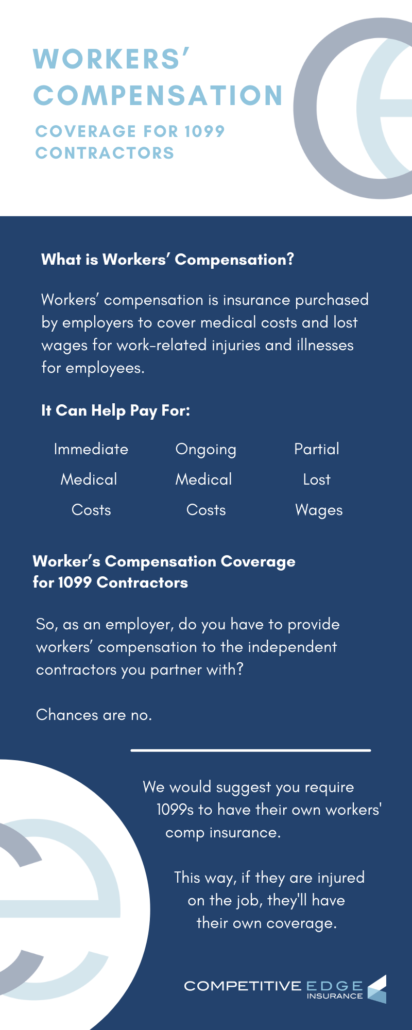
Workers’ compensation coverage is insurance, purchased by employers, to cover medical costs and lost wages for work-related injuries and illnesses for employees. It is required by law in California and lack of proper coverage can result in fines and even criminal exposure. 

Worker’s compensation coverage can help pay for:

  • Immediate medical costs (i.e. emergency room expenses)
  • Ongoing medical costs (i.e. physical therapy)
  • Partial lost wages while the employee is unable to work

Who Needs It?

Laws and requirements regarding workers’ compensation vary on a state-by-state basis. The policy, however, is required in almost every state for businesses with employees.

In California, for example, “all California employers must provide workers’ compensation benefits to their employees under California Labor Code Section 3700,” according to the Department of Industrial Relations.

Who Qualifies as an Independent Contractor?

1099 workers are self-employed independent contractors.

An independent contractor is, in simple terms, “is a self-employed person or entity contracted to perform work for—or provide services to—another entity as a nonemployee,” according to got1099. An independent contractor is also sometimes referred to as a freelancer, a gig worker or an outsourced service provider.  

Unlike traditional employees, independent contractors do not work regularly for an employer but work as required. 

A key part of being classified as an independent contractor, according to the IRS, is that the person who hires an independent contractor can only “control or direct… the result of the work and not what will be done and how it will be done.”

Assembly Bill 5 (AB-5)

Assembly Bill 5, also referred to as AB-5, or the Gig Work Bill, is a federal law that passed in January 2020. AB-5 introduced further regulations for independent contractor classification.  

Under AB-5, the ABC test is used to set the standard for worker classification. All workers are considered W-2 employees unless they meet all three of the following criteria:

  1. “The worker is free from the control and direction of the hiring entity in connection with the performance of the work, both under the contract for the performance of the work and in fact;
  2. The worker performs work that is outside the usual course of the hiring entity’s business; and
  3. The worker is customarily engaged in an independently established trade occupation or business of the same nature that is involved in the work performed.” 

Long story short, employers cannot hold control over independent contractors. The worker has the freedom to work when they choose, and how they choose within the parameters of their contractual agreement.

Worker’s Compensation Coverage for 1099 Contractors

So, as an employer, do you have to provide workers’ compensation to the independent contractors you partner with? Chances are no. 

According to Gusto, you don’t typically have to cover independent contractors under your workers’ compensation policy. “That’s because they’re not technically considered employees of your business. The line separating independent contractors from employees isn’t always clear, though.”

We’d recommend speaking with trusted financial personnel, like an accountant, to determine if the person is a 1099 contractor or a W-2 employee.

Whether or not you have to provide workers’ compensation for independent contractors, however, also depends on where you conduct your business. Remember, each state has its own laws when it comes to workers’ compensation. Be sure to do your research.

Require 1099s to Have Their Own Insurance

In the likely case that you are not required to provide workers’ compensation insurance for the independent contractors that you hire, we would strongly suggest that you require any 1099 workers to prove that they have their own workers’ compensation insurance.

This way, if they are injured on the job, they’ll have their own coverage and will not trigger a claim on your policy and cost you money. 

Working with 1099s Who Don’t Have Their Own Insurance

On the other hand, if an independent contractor doesn’t have their own workers’ compensation insurance, you must account for this financially as an employer. 

Logically, if you hire a 1099 worker who doesn’t have their own workers’ comp insurance, your own insurance carrier may charge you higher rates in order to account for the coverage of these additional workers.  

If your 1099 has not provided proof of Workers’ Compensation coverage and they were to get injured while working for you, your insurance carrier would look at the role tehy perform and assess additional coverage charges based on the fee structures for that category of work.  This can result in a heft upcharge.  So, be sure to check with your 1099s to ensure they have their own coverage (not only Worker’s Compensation but General Liability as well). 

As always, be sure to ask independent contractors for a Certificate of Insurance (COI) when hiring 1099s. Read on to learn more about the importance of COIs.

https://compedgeins.com/wp-content/uploads/2022/01/Workers-Compensation-Coverage-for-Independent-Contractors-.png 628 1200 https://compedgeins.com/wp-content/uploads/2026/08/Comp-Edge-ONLY-Color-Logo-300x59.jpg 2022-02-20 07:00:002022-01-26 12:03:01Workers’ Compensation Coverage for Independent Contractors

How Much Should Business Insurance Cost?

in News

As a business owner, it’s crucial that you know all of your expenses upfront. One of these expenses includes your business’s insurance. As a business owner, how much cash should you prepare to put toward protecting your business? More specifically, how much should business insurance cost? Let’s discuss.

Why Do I Need Insurance?

Insurance is a necessity for all businesses, especially small businesses. But why? Well, the fact of the matter is that accidents happen. As The Hartford puts it, “business insurance helps pay for damages you’d otherwise have to cover out-of-pocket.”

In addition to protecting your business and providing benefits to employees, having business insurance helps reduce stress while saving time and money.

There are many types of insurance to consider as well, including:

  • General Liability Insurance
  • Workers’ Compensation Insurance
  • Cyber Liability Insurance
  • Commercial Property Insurance
  • Business Income Insurance
  • And more

The types of insurance that you must have vary on a state-by-state basis.

Below is what Competitive Edge Insurance founder, Brenda Jo Robyn, considers as “must-haves.”

Insurance ‘Must-Haves’

Employment Practices Liability Insurance (EPLI)

Employers must have Employment Practices Liability Insurance (EPLI). Did you know that non-litigated vs. litigated cases can rack up over $500,000 in costs? EPLI insurance typically pays for litigation if you ever went to court with one of your employees.

General Liability

If you work with cities, federal governments, and/or government agencies, general liability insurance is required for your contracts. It is also required if you are operating a franchise. If you have a lease, it is also typically required by the property owner. 

General liability insurance is typically more contractually required rather than on a federal level.

Commercial Auto Policy

Car accidents are not cheap by any means. In fact, did you know that car accident claims can be as high as $75,000?

If employees are using cars to do their job, a commercial auto policy is necessary. (Yes, this includes tasks as simple as running to the post office!)

If they’re using their own car they also need that coverage.

As a business owner, be sure to set up policies and procedures to check employees’ insurance. Remember, when necessary, employee insurance kicks in first. Your business’s commercial auto policy would kick in on top of that. 

Workers’ Compensation Insurance

ALL California employers are required to provide workers’ comp for all employees. This means whether they’re in the office, out in the field, or in their homes working, workers’ compensation must be provided.

In the case of hiring an independent contractor, Brenda Jo recommends always requiring any 1099 workers to have their own workers’ compensation insurance.

This way, if they are injured on the job, they’ll have their own coverage.

How Much Should Business Insurance Cost?

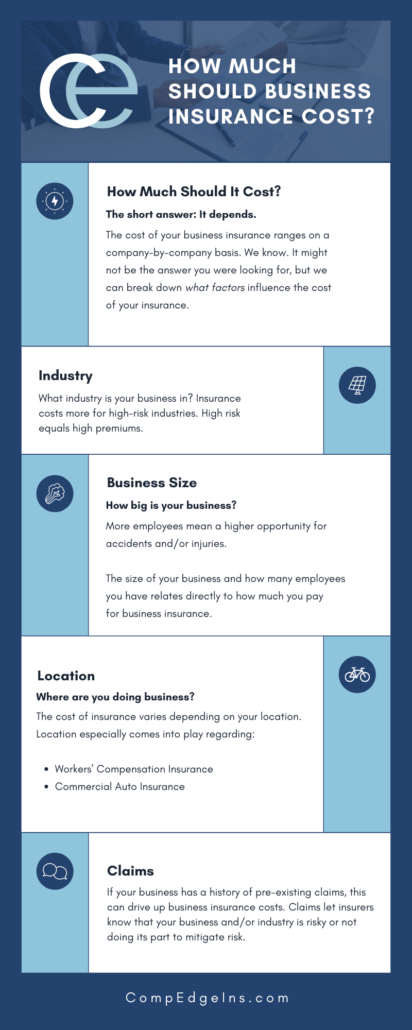
As a business owner, how much should you be spending on business insurance? The cost of your business insurance ranges on a company-by-company basis. The price of insurance depends on the size as well as the nature of a business.

So the short answer is, it depends.

We know. It might not necessarily be the answer you were looking for; however, we can break down what factors influence the cost of your insurance.

Insurance Costs: Factors to Consider

As a general rule of thumb, your business’s insurance costs can cost between 10-30% of your predicted gross sales. However, this is not a hard and fast rule.

Below we’ve listed some factors that influence the costs of your business insurance.

Industry

First things first, what industry is your business in? Simply put, insurance costs more for high-risk industries. High risk equals high premiums.

For example, it would cost more for a construction company to receive the same insurance coverage as a marketing firm.

High-risk insurance addresses companies whose coverage was either terminated because of a claim, those who are new and cannot get coverage because of industry risk, or those who have experienced drops in revenue or industry disruption such that carriers are broadly refusing coverage.

These high-risk areas include:

  • Construction
  • Health and Wellness
  • Cyber Liability Risk
  • Bonding
  • General Liability
  • Workers’ Compensation
  • Cannabis
  • And more

Business Size

How big is your business? Business insurance for a small company, compared to a large company will, of course, be less expensive. More employees mean a higher opportunity for accidents and/or injuries.

The size of your business and how many employees you have directly relates to how much you pay for business insurance.

Location

Where are you doing business? The cost of insurance varies depending on your location. Location especially comes into play with regards to:

  • Workers’ Compensation Insurance
  • Commercial Auto Insurance

Claims

If your business has a history of pre-existing claims, this can drive up your business insurance costs. Claims let insurers know that your business and/or industry is risky or even worse, that your business is not doing its part to mitigate risk.

Sales

Insurers look at your sales to determine the cost of your general liability insurance. The reason is that the more clients or customers that you have, the higher chances that someone will be injured or upset in some manner.

Coverage and Deductibles

A final element to consider is under what circumstances your policy will payout and how much they will pay. This affects overall business insurance costs.

To note, lower deductible equaled increased costs in your business insurance policy.

Here to Help

Business insurance will vary in price from one insurer to the next depending on the factors we’ve listed above. At Competitive Edge, we specialize in insuring high-risk businesses. We build your case to the carrier to ensure that you get the right coverage at the best price based on your real-world conditions.

To learn more about how to protect your business, read our blog post ‘What is Risk Mitigation?’

https://compedgeins.com/wp-content/uploads/2022/01/How-Much-Should-Business-Insurance-Cost-1.png 628 1200 https://compedgeins.com/wp-content/uploads/2026/08/Comp-Edge-ONLY-Color-Logo-300x59.jpg 2022-02-06 07:00:002022-02-22 10:28:20How Much Should Business Insurance Cost?

CATEGORIES

RECENT POSTS

  • Cyber Security Image by Anderson Piza at Envato Elements | Licensed
    6 Current Cyber Threats Companies Face: How to Stay Safe
  • Insurance Form Image by rfaizal707 at Envato ElementsEnvato Elements by rfaizal707
    Understanding the Hard Insurance Market and Its Impact on You
  • Black and White Photo of a man writing a contract
    EPLI: Does Your Construction Business Need It?

CONNECT WITH US

VIDEO POSTS

  • City view of commercial buildings, including skyscrapers surrounded by trees
    How to COPE in an Inflationary Environment
  • Coronado bridge aerial view
    Get to Know Our Founder: Her Rotary Involvement
  • Insurtech holographic image with man using ipad
    The Coverage Pitfalls of Insurtech
LET’S TALK

WANT TO KNOW HOW MUCH YOU COULD BE SAVING ON YOUR INSURANCE COSTS?

WANT TO KNOW HOW MUCH YOU COULD BE SAVING ON YOUR INSURANCE COSTS?

LET’S TALK

Connect With Us

Competitive Edge Insurance

LIC #0H31982

P: 619-259-5459
F: 619-377-0144

830 Orange Ave Suite L Coronado, CA 92118

Privacy Policy

Hours of Operation

Monday – Friday 8:00AM – 5:00PM

Saturday Closed

Sunday Closed

© Copyright 2021- Competitive Edge Insurance Services

site design by digitalstoryteller.io

© Copyright 2021- Competitive Edge Insurance Services
site design by digitalstoryteller.io

Scroll to top

This site uses cookies. By continuing to browse the site, you are agreeing to our use of cookies.

Accept settings

Cookie and Privacy Settings


How we use cookies

We may request cookies to be set on your device. We use cookies to let us know when you visit our websites, how you interact with us, to enrich your user experience, and to customize your relationship with our website.

Click on the different category headings to find out more. You can also change some of your preferences. Note that blocking some types of cookies may impact your experience on our websites and the services we are able to offer.

Essential Website Cookies

These cookies are strictly necessary to provide you with services available through our website and to use some of its features.

Because these cookies are strictly necessary to deliver the website, refusing them will have impact how our site functions. You always can block or delete cookies by changing your browser settings and force blocking all cookies on this website. But this will always prompt you to accept/refuse cookies when revisiting our site.

We fully respect if you want to refuse cookies but to avoid asking you again and again kindly allow us to store a cookie for that. You are free to opt out any time or opt in for other cookies to get a better experience. If you refuse cookies we will remove all set cookies in our domain.

We provide you with a list of stored cookies on your computer in our domain so you can check what we stored. Due to security reasons we are not able to show or modify cookies from other domains. You can check these in your browser security settings.

Google Analytics Cookies

These cookies collect information that is used either in aggregate form to help us understand how our website is being used or how effective our marketing campaigns are, or to help us customize our website and application for you in order to enhance your experience.

If you do not want that we track your visit to our site you can disable tracking in your browser here:

Other external services

We also use different external services like Google Webfonts, Google Maps, and external Video providers. Since these providers may collect personal data like your IP address we allow you to block them here. Please be aware that this might heavily reduce the functionality and appearance of our site. Changes will take effect once you reload the page.

Google Webfont Settings:

Google Map Settings:

Google reCaptcha Settings:

Vimeo and Youtube video embeds:

Other cookies

The following cookies are also needed - You can choose if you want to allow them:

Privacy Policy

You can read about our cookies and privacy settings in detail on our Privacy Policy Page.

Privacy Policy
Accept settings