
Competitive Edge Insurance
  • Construction
  • Business
    • Health and Wellness Insurance
    • Cyber Liability
    • Bonding
    • General Business Insurance
    • EIDL Insurance Requirements
  • Personal Lines
    • Auto Insurance
    • Boat Insurance
    • Homeowners Insurance
  • About Us
  • Resources
    • Articles and Insights
    • Trusted Advisors
  • Contact
  • Menu Menu
  • LinkedIn
  • Instagram
  • Facebook
  • Youtube

Cannabis or Hemp Insurance — What’s the difference?

in Cannabis, News

The cannabis industry is only going to continue to grow.  As we’ve seen in the past election, more and more states are making cannabis legal. The industry’s regulatory changes continue to evolve and it will become more difficult for businesses to avoid risk exposure. 

As you learn to navigate the risk exposure aligned with the cannabis industry, it’s important that you have a risk management plan in place. This risk management plan would mean understanding the industry’s unique needs as a whole and understanding the specific needs of your specific company. 

To get you started, here are a few coverage options that will start your risk mitigation process.

Cannabis & Hemp Product Liability

Cannabis and CBD products require a custom product liability policy for their manufacturers, retailers, distributors, cultivation, facilities, and more! This coverage applies to any business working to bring a product to market. It helps to defend your company against claims and allegations and to pay damages if your business is found liable if an incident were to occur.

These claims can vary, but some of the most common in the cannabis industry include:

  • Bodily injury or property damage caused by a product misuse
  • Product-related/manufacturing defects that result in some kind of loss
  • Inhaled, edible, and infused products that may have caused illness.
  • Faulty/misused equipment (which includes vape cartridges, batteries, and lighters)
  • Marketing/Labelling misrepresentations

Product Liability insurance is essential to your cannabis coverage. Similarly, you may want to consider product recall insurance that would cover the costs of removing a defective product and prevent third-party claims. 

Workers Compensation

Workers compensation coverage is essential to any business. As you hire employees, there is the added risk of potential injury on the job. In the cannabis industry, this risk can be heightened. At Competitive Edge we offer final audits, claims, inspections, and loss control to all of our clients who utilize our workers compensation coverage. 

General Liability Insurance

General liability insurance provides coverage for various different types of claims. A few of these claims might include:

  • Personal injury
  • Bodily injury
  • Property Damage

Cannabis Crop Insurance

WIthin the cannabis industry, you may need coverage for your cannabis crop. This coverage ensures your crop remains protected during every step of the growth and harvesting process. 

Cannabis Bonds

Our in-house bond department has over 25 years of experience in handling various types of bonds. No bond is too small or large for us to handle. 

Commercial Auto

Your commercial auto insurance covers both comprehensive and collision. Meaning your work vehicle is covered regardless of fault. Personal auto insurance just won’t cut it. 

In the cannabis industry, relying on personal auto insurance to cover the cargo within your vehicle can be costly. If your cannabis shipment is lost or damaged in an accident commercial auto insurance will cover it. 

It’s also  important to note that courier services that ship your product may leave you exposed to additional costs. Couriers only cover cargo on-board to a maximum dollar limit and that dollar amount is shared by all cargo owners, therefore your portion of the payout may be far less than the value of your loss. 

Equipment Breakdown Insurance

In the event that you experience a loss of business income due to equipment breaking, equipment breakdown insurance covers the cost. This coverage also ensures you are protected if you experience a data compromise, property damage, or if you need reputational recovery. 

Cyber Insurance

Cyber jackers are specifically interested in the cannabis industry due to the large amount of personally identifiable and protected health information they collect, and the limited cyber security protocols in place. 

As a cannabis grower, you should limit the amount of people who have access to your research and development process. You should also ensure your proprietary information is only in the hands of those who need it. 

Some people use their own servers to store their information, as the risk of a breach is too high. 

While cannabis businesses are difficult to insure, and this may continue as long as cannabis remains illegal at the federal level, there are still a few options you begin to implement to protect your business. 

Enlist in a trusted expert who has experience insuring this high risk industry. Contact Brenda Jo and her team at Competitive Edge to learn more! 
https://compedgeins.com/wp-content/uploads/2021/06/iStock-1147128047.jpg 1294 2316 https://compedgeins.com/wp-content/uploads/2026/08/Comp-Edge-ONLY-Color-Logo-300x59.jpg 2021-07-11 13:38:002021-11-01 16:21:11Cannabis or Hemp Insurance — What’s the difference?

Small Business Insurance: A Guide

in General Business Insurance, High-Risk Insurance, News

I’m a small business, do I really need insurance?

In short, yes. Insurance is needed for all transactions of business where outside parties are involved—big and small. Even though it might be tempting to opt-out of insurance, the risk is much greater (and expensive) if you’re not insured. 

The Risk

Picture this.

Your small yoga studio is starting to thrive as COVID-19 restrictions lift. More people are signing up for classes. Hooray, this is good news! Then a too-complicated pretzel move goes haywire and now you’re being sued for malpractice. And to top it all off, you don’t have insurance.

In retrospect, you wish you would’ve gotten Health and Wellness Insurance. Again, the risk is far greater than paying for small business insurance. 

Types of Small Business Insurance

Insurance jargon can be intimidating, which is why we’re here at Competitive Edge to help! 

There are SO many options of coverage to look into as a small business: 

  • Health & Wellness
  • Construction
  • Cyber Liability
  • Surety Bonding
  • Worker’s Compensation
  • General Business 
  • Umbrella
  • Executive Coverage

Insurance is not one-size-fits-all. As a small business, there are differences between the type of coverage that might work best for you. This can differ depending on what state you reside in, what industry you’re trying to insure, and more.

Even if your business is made of a small group of employees, business insurance is essential. If anything happens in office (injury, wrongful termination, emotional neglect), you will instead pay for it out of pocket. 

Still not convinced? 

Our team is dedicated to your safety, security and ongoing success.  Our clients stay with us for decades because we have their business’ best interests at heart and the depth of knowledge and experience to protect and insure them no matter what the market conditions. Contact Competitive Edge today for more details about small business insurance!

https://compedgeins.com/wp-content/uploads/2021/06/iStock-1257975650.jpg 1322 2266 https://compedgeins.com/wp-content/uploads/2026/08/Comp-Edge-ONLY-Color-Logo-300x59.jpg 2021-07-04 13:19:002021-11-01 16:22:21Small Business Insurance: A Guide

Property Investors: Risk Guide

in General Business Insurance, News

Let’s set the scene – you’re a property investor or landlord. One of your tenants in your residential property overflowed their bathtub, causing damage not only to their apartment but also their neighbor’s personal property. Or, perhaps your tenant creates smoke damage as a result of a carpet installation gone wrong. As a property investor, the first question that likely pops into your mind is: Am I responsible for paying for this? Is my tenant? As a property investor, owner, or landlord, what should you know to mitigate risk? Luckily, we’ve created this guide to help.

Why You Should Negotiate Coverage as a Property Investor

Why should you ask tenants to name you as an additional insured? Well, considering the headache scenarios listed above, it becomes clear as to why you, as a property investor, might want to negotiate coverage with your tenants.

When a property investor, owner, or landlord allows a tenant to use their property, there is always the risk of receiving blame if an injury or damage occurs. Another hypothetical: Let’s say you’re the owner of Acme Corporation (hi, Looney Tunes!). In one of your stores, a customer slips on a loose piece of tile and tries to sue Acme Corporation, stating that as a result of your failure to maintain the premise, you’re liable for their injury.

You, however, know that these claims are not uncommon and have prepared accordingly by including an additional insured provision in your tenant’s lease. This additional provision requires your tenants to list you, Acme Corporation, as an additional insured.

Because plaintiffs assume landlords, property owners, and investors have “thick wallets,” they are often targets for such lawsuits. As a result, these individuals need to take extra care to protect themselves.

Tenant’s Legal Liability Coverage

The tenant’s legal liability (TLL) coverage can cover losses and damages. According to Insuranceopedia, tenants’ legal liability coverage is “insurance for loss or damage of a property resulting from an action of a person renting space at that property.” Tenant’s legal liability coverage, when purchased by a tenant, covers “the cost of the loss or damage caused by the tenant.” An A-rated commercial insurance carrier is typically who underwrites this type of coverage.

Why Invest in Tenant Legal Liability?

The Horton Group describes TLL as “a win-win for the owner and tenant.” But why? Tenant Legal Liability “is one policy [with] virtually no paperwork that can adequately protect all your properties in a state – inexpensively.”

Working as a master commercial insurance policy under the property owner, investor, or landlord’s name, “tenants are [also] named as additional insureds thus providing coverage for both parties.”

The icing on the cake? Tenant legal liability coverage is easy to administer, typically costing just a small monthly fee between $8 to $12 for tenants.

What Doesn’t TLL Cover?

First, it’s important to note that a tenant’s legal liability coverage is different from coverage that insures a tenant’s personal possessions, also called tenant’s content insurance content policy or renters’ insurance.

In many cases, when it comes to TLL coverage, the coverage only extends to fire, smoke, or leakage damage. Coverage, however, can be obtained on all risks but only through the use of a deductible. Tenants can obtain additional coverage to protect themselves against bodily injuries that might occur on your premises.

So, what does tenant’s legal liability coverage fail to cover? TLL does not cover damage that results from wrongful acts, intentional damage, or claims for a tenant’s personal possessions. These damages, however, could potentially be covered on a Commercial Property Insurance policy.

It’s Time to Best Mitigate Your Risk

There are a variety of different scenarios in which enforcing tenant’s legal liability coverage might prove beneficial. Whether your property is commercial or residential, vacant or filled, industrial, multifamily, and so on, mitigating risk as a property owner is of the utmost importance. And as the adage goes, better safe than sorry.

At Competitive Edge, we take time where others may gloss over details. We make sure to learn about your business as a whole because articulating who you are, as more than a series of profit and loss statements, allows carriers to confidently cover you and your business. Connect with us today to see how we can help you.

https://compedgeins.com/wp-content/uploads/2021/05/iStock-695968212.jpg 1483 2022 https://compedgeins.com/wp-content/uploads/2026/08/Comp-Edge-ONLY-Color-Logo-300x59.jpg 2021-06-27 15:34:002021-11-01 16:24:41Property Investors: Risk Guide

How to Measure Your Company’s Cybersecurity Risk

in Cyber Insurance, News

With the increase of cyber attacks on the rise, companies every day worry they will become the next victim. According to Cybersecurity Ventures, the number of cyberattacks has nearly doubled since 2019 and quadrupled since 2016 — with a cyberattack incident occurring every 11 seconds in 2021. 

At Competitive Edge, we believe all businesses are vulnerable to cybercrimes, not only large tech corporations. Global cybercrime losses are estimated at $400 billion per year. But not to fret — there are preventative measures your company can take, starting with learning how to measure your company’s cybersecurity risk.

Be Weary of Third-Party Risk

According to a recent study, 59% of companies experience a breach because of a vendor or third party. Although most companies have a variety of security regulations in place, many still fall susceptible to third-party or vendor risk.

The biggest challenge considering third-party risk is gaining real-time data. For example, most companies evaluate third-party risk through an assortment of questionnaires, assessments, or tests. This assortment of data gathering makes it difficult to see beyond just the snippet of information provided, and beyond into the ever-changing terrain of cybersecurity risk.

We recommended evaluating and refreshing what cybersecurity metrics and Key Performance Indicators (KPIs) your company is currently tracking. There are many tools that can help  evaluate third parties’ risk prior to onboarding—but the diligence shouldn’t stop there. Continue to monitor your third parties and vendors even after they’ve onboarded to ensure they are upholding best safety practices. 

Don’t let third-party risk slip through the cracks!

Define your Company’s Strategy for Measuring and Communicating Risk

Data, data, and more data! When it comes to analyzing cybersecurity risk, it can be difficult to know where to focus your efforts. Risk-based reporting, however, is your best bet. Risk-based reporting, “as opposed to comprehensive, compliance-based, or incident-based reporting… is the approach best suited to reducing your organization’s exposure to cyber threats,” according to BitSight.

Risk-based reporting focuses on the big picture—not the small blips—and forces you to use context to deliver reports, delving into data concerning:

  • “Past performance
  • Risk concentration
  • Industry benchmarks
  • Financial quantification
  • Cybersecurity frameworks”

Furthermore, the phrase, “stay in your own lane,” does not apply to companies when measuring cybersecurity risk! In fact, we recommend you look to your competitors to gain further context on your own stance in terms of cybersecurity risk. By measuring your own risk in comparison to similar companies or competitors, you might take more pointed action about where your team’s focus is needed to stay safe.

Make Your Data Digestible

Now, you’ve done all the work, but how can you make it clear and easy to understand? Security ratings are the most widely used and understood language when delving into cybersecurity risk. Ensure that all company team members understand the data and what efforts will be made as a result to combat the risk and why.

Measures You Can Take to Stay Secure

The consequences of poor cybersecurity are catastrophic. Geospatial World says, “The best cybersecurity strategies are ones that are proactive in nature. Being able to respond to and recover from an instance of hacking is important, but stopping the incident before it even starts is what saves your organization more time, money, and pain in the long run.” To avoid these consequences, Competitive Edge recommends you:

  • Keep a tight rein on who has access to company information
  • Conduct employee background checks
  • Create individual accounts for employees
  • Of course, not only to have strict cybersecurity policies, procedures, and practices but to enforce them

Cybersecurity is the type of threat you don’t want to put off dealing with until it’s too late. That’s where we come in! Talk to our experts at Competitive Edge today to measure your company’s cybersecurity risk and see how you can obtain proper coverage. 

Don’t risk it.

https://compedgeins.com/wp-content/uploads/2021/05/iStock-1276687348.jpg 1298 2308 https://compedgeins.com/wp-content/uploads/2026/08/Comp-Edge-ONLY-Color-Logo-300x59.jpg 2021-06-20 15:16:002021-11-01 16:25:16How to Measure Your Company’s Cybersecurity Risk

Why Bondability Is Important for General Contractors

in Bonding, Construction, News

Congrats! You have bondability, or at least we hope you do as a general contractor… When it comes to the construction industry, there is a high risk involved. When a general contractor has bondability, it means they’re capable of passing an insurance company’s background check of sorts, so a bond can be issued.

Although a client might save a chunk of change by choosing a contractor who isn’t bondable, choosing a general contractor who is bondable is key to their project’s success and safety. The bottom line: Choosing a contractor with bondability is something that clients do to protect themselves during construction.

At Competitive Edge, we understand bondability. We build your case to the carrier to ensure that you get the right coverage at the best price based on your real-world conditions. So, here are three reasons why it’s important for you, as a general contractor, to be bondable. 

Bondability Shows Clients That You’re a Safe Option

Whether or not a general contractor has bondability tells you a lot about them. Having bondability shows clients that you’re a safe option to work with! If you don’t have bondability or if your bonding capacity is minimal (typically under $250,000), many clients might view this as an indication of problems you might have faced in the past.

Contractors who are not bondable can give off the impression that they’re inept at finishing a project, keeping up with their finances, or that they take on too many projects at once. It isn’t typical for a client to jump into work with a contractor whose background they aren’t familiar with.

When a contractor has bondability, it gives off the impression that you’re serious about your work, as a surety company must thoroughly investigate, review, and consider a contractor’s relevant information before bonding them.

Bondability Protects a Client’s Financial Investments

As a contractor, you should be bondable to give yourself and your clients financial peace. Picture this: You’re a client who has hired a non-bonded contractor. Fast forward months or years down the road, and your contractor has decided to not complete their work on your project. For you, a client whose contractor is not bondable, your financial investment is torn. A client can be out millions depending on the size of the project if they decide to choose a contractor who isn’t bondable.

General contractors have bondability because it gives clients financial protection—on the off chance that you don’t finish your work. Contractors, in large projects especially, are typically bonded so if their work does not get completed, the bonding company can step in to pay to complete the project.

As a good general contractor, you want to prioritize bondability to protect your clients as well as your reputation.

Bondability Demonstrates Professionalism

When a contractor takes the necessary steps to achieve bondability, it demonstrates that they take their work seriously. Being bondable also shows that a contractor values their clients and has their interests at heart as well.

Mike Lechner, a bonding agent at Guy Hurley, says, “Bonding capacity is an indicator of a contractor’s character, experience, and financial viability underwritten by a professional third party.”

Needless to say, a contractor who does not pursue bondability often lacks the skills to efficiently complete a project. Even if a client’s project does not need a bond cost-wise, be prepared to be asked if you are bondable. Bondability, in fact, is a quick and easy pre-qualification tool that many clients use. And, of course, you don’t want to miss out on work as a result!

Simply put: Clients want to work with professionals who yield low risk. Our team at Competitive Edge can help you be that contractor if you’re not already. If you are a general contractor who is considering bondability, contact us today at Competitive Edge to learn more.

https://compedgeins.com/wp-content/uploads/2021/05/iStock-157191789-scaled.jpg 1649 2560 https://compedgeins.com/wp-content/uploads/2026/08/Comp-Edge-ONLY-Color-Logo-300x59.jpg 2021-06-13 14:58:002021-11-01 16:25:52Why Bondability Is Important for General Contractors

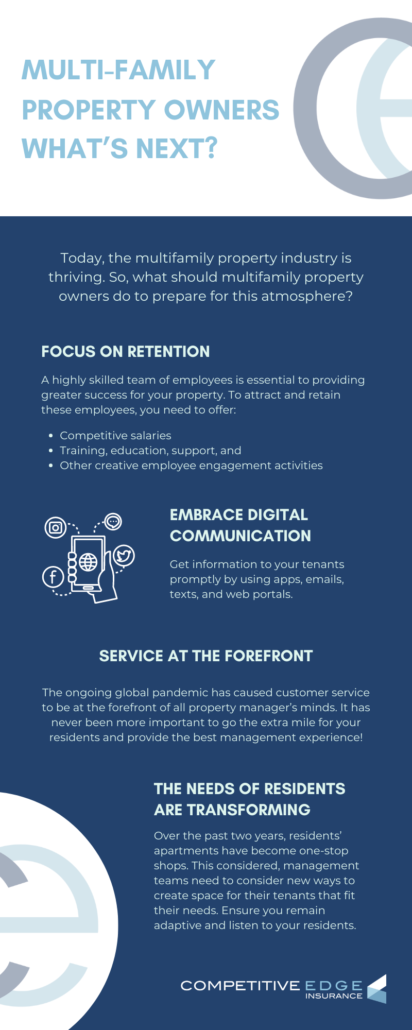
Multifamily Property Owners, What’s Next?

in News

In 2020, the multifamily real estate industry hit more than a few challenges—including rental applications dropping 10% overall. During this time, multifamily property owners needed to think creatively about ways to transform these numbers.

Today, the multifamily property industry is thriving. It’s a great place to deploy capital for those looking for stable returns and a hedge against inflation. Moreover, CBRE reports that multifamily construction will remain elevated as well as high occupancy levels.

So, what should multifamily property owners do to maintain this thriving atmosphere? Let’s discuss.

FOCUS ON RETENTION

Currently, there is an excess of demand for highly skilled employees, as there is a surplus of multifamily opportunities. A highly skilled team of employees is essential to providing greater success for your property.

To attract and retain these employees, you need to offer a few things, including:

  • Competitive salaries
  • Training, education, support, and
  • Other creative employee engagement activities (like appreciation days, flexible work hours, and other fun office events!)

When you have a capable and professional team managing your tenants, it leads to greater resident satisfaction and long-term resident retention.

DON’T SHY AWAY FROM DIGITAL COMMUNICATION

Although many of us have had it with Zoom, don’t completely write digital communication off of your list!

Increased information and communication are especially essential to your success. It has become easier than ever to transition to digital forms of communication.

Get information to your tenants promptly by using tools like:

  • Apps
  • Emails, and
  • Texts

(See, it doesn’t only need to be Zoom!)

If you haven’t already, you might also consider implementing a web portal.

Web portals allow residents to:

  • Make payments
  • Submit maintenance requests
  • Review upcoming events, and
  • Participate in resident discussion boards

Self-guided and virtual tours will also live in your web portal and are essential to providing options for potential prospects to view properties. 

SERVICE SHOULD BE AT THE FOREFRONT OF EVERYTHING YOU DO

The ongoing global pandemic has caused customer service to be at the forefront of all property manager’s minds. Good service will help demonstrate value and increase satisfaction within your property.

Timely and efficient communication is key. To ensure your residents remain happy, you should also consider accelerating response times and prioritizing maintenance requests. It has never been more important to go the extra mile for your residents and provide the best possible management experience!

THE NEEDS OF RESIDENTS ARE TRANSFORMING

Over the past two years, residents’ apartments have become one-stop-shops: Offices, gyms, and sleeping quarters all in one. This need for multi-purpose space has caused residents’ immediate needs to change.

Property management teams need to consider new ways to create space for their tenants that fit their needs.

This may mean providing access to better high-speed internet, offering reservation-based conference rooms, or establishing outdoor wellness spaces.

Ensure you remain adaptive and listen to your residents. After all, resident feedback provides great insight on how to improve experiences, which can result in increased retention and satisfaction.

ECONOMIC UNCERTAINTY REMAINS

Over the past two years, recent changes in income and employment status have brought economic uncertainty for many residents; delinquency remains top-of-mind for commercial property owners.

This considered, it’s important to prepare for the risk of increased delinquencies.

As multifamily property owners look to the future, it’s important to understand what may come. There are a few ways you can remain proactive in your approach to the coming year. It’s also extremely important to ensure you remain risk-free.

Multifamily property owners

Interested in learning more? Read on for our article “Property Investors: Risk Guide.”

https://compedgeins.com/wp-content/uploads/2021/05/Copy-of-COMP-EDGE-Feature-Image-Risk_May10.png 924 1640 https://compedgeins.com/wp-content/uploads/2026/08/Comp-Edge-ONLY-Color-Logo-300x59.jpg 2021-05-16 07:00:002022-07-22 09:52:05Multifamily Property Owners, What’s Next?

Cyber Liability Coverage for the New Era of Ransomware

in Cyber Insurance, General Business Insurance, News

With cybercrimes on the rise, it’s time to look not only at your practices but also your cyber liability coverage.

Read more
https://compedgeins.com/wp-content/uploads/2021/05/COMP-EDGE-Feature-Image-Cyber_May10.png 924 1640 https://compedgeins.com/wp-content/uploads/2026/08/Comp-Edge-ONLY-Color-Logo-300x59.jpg 2021-05-10 07:56:282021-11-01 16:33:01Cyber Liability Coverage for the New Era of Ransomware

Commercial Real Estate and the Pandemic

in California, News

Consider new ways to serve your clients. Aid clients in developing their return to work programs. As tenants continue to understand how they will take their next steps, they may be looking to upgrade to more space. Consider how you can help each of your tenants to achieve their long-term goals.

Read more
https://compedgeins.com/wp-content/uploads/2016/07/corporate-buildings-m.jpg 1155 1732 https://compedgeins.com/wp-content/uploads/2026/08/Comp-Edge-ONLY-Color-Logo-300x59.jpg 2020-09-03 00:58:182021-11-01 16:37:03Commercial Real Estate and the Pandemic

Cyber Coverage—How Necessary Is It?

in Cyber Insurance, News

Working Remotely is the ‘New Normal’– How Can Cyber Insurance Help You?

In July, we all saw the ramifications of a well-performed hack. Twitter experienced the most catastrophic security breach in its company’s history. With Elon Musk, Barack Obama, Joe Biden, Bill Gates, and other high-profile Twitter users among the hacked users. This hack caused Twitter to shut down all blue-checked accounts. This breach of security cost Twitter users more than $118,000 and the company more in their reputation in just a few short hours.

With most of business and social interaction moving toward technology-centered avenues, this can be troubling for most business owners. What will your company do if this happens to you? Has the global pandemic and stay-at-home orders made you more vulnerable to potential cyber-attacks? How can you protect yourself and your company? Let’s explore!

Consider Investing in Cyber Insurance 

Cyber insurance covers the expense incurred due to a data breach, virus, or other cyber-attacks and fraud. It can also cover legal claims that come from a security breach. As companies utilize cloud software, personal computers and laptops, and other technology-based means to store their sensitive data, their risk for a security breach becomes exponentially larger.

The Identity Theft Resource Center claims that in 2018 businesses experienced 571 breaches in security, which exposed 415 million employee and customer records. 

When you do experience a breach as a company, federal law requires you to perform an extensive list of to-dos. If you have cyber insurance coverage, your carrier will take that responsibility on.

How has your Business Become More Vulnerable?

As businesses moved to a new work-from-home model, cyberattacks increased. With most company communication done through e-mail, Slack, or other online platforms, the risk of a breach exponentially increases. This could cause a company to experience massive monetary loss and reputation damage. 

What are the signs you may be at risk of experiencing a cyber attack?

  • You are receiving requests for transactions, like direct deposits or electronic fund transfers
  • Unsolicited communications are coming through by unknown companies or people
  • Links within the email do not match; check links by rolling your cursor over the link to see if the two match with the content and the email address.
  • Requests with a high sense of urgency, asking you to complete documentation immediately.
  • Requests for usernames and passwords, or other personal details like banking information.

What can you do to help mitigate this risk?

  • Limit your use of large email attachments and programs that put pressure on your company’s bandwidth ecosystems.
  • Do not forward emails with attachments that contain highly restricted or company confidential information to personal accounts. 
  • Avoid reading, talking about, or leaving confidential information in unsecured work-from-home areas.
  • Log-off of your work device when you’re not using it.
  • Shred sensitive documents.
  • Restart your computer regularly.

These tips along with the added security of cyber insurance should prepare your business for potential cybersecurity breaches. Learn more about how cyber insurance can help your company today. 

https://compedgeins.com/wp-content/uploads/2020/08/pexels-pixabay-60504-1-scaled.jpg 1707 2560 https://compedgeins.com/wp-content/uploads/2026/08/Comp-Edge-ONLY-Color-Logo-300x59.jpg 2020-09-03 00:54:262021-11-01 16:38:57Cyber Coverage—How Necessary Is It?

Employee Benefits Are Still Just As Important

in General Business Insurance, Health & Wellness, News
Employees who have a good health insurance program are more productive, more engaged, and more attached to their company.
As you consider your hiring practices, think of ways to incentivize the best talent to join your company aside form salary increases.
In addition to health insurance coverage, think outside the box.  Flexibility to balance work and home is the most important factor for workers ages 34 and younger… Above salary, even above health insurance and 401K.If you are a business owner, this is great news. Recommendations are the most powerful recruiting tool available, so if you can use existing benefits to sell your company, you are better off.

Health insurance bonds employees to the company. 

Churn is expensive, hiring and firing takes time and productivity away from your operations.  Great health benefits are one of the many reasons people stay at their jobs.According to the Glassdoor study, the other benefits that employees appreciate are:

  • A matching 401-k plan
  • Paid leave, including sick days
  • Family leave, this includes paternity leave
  • Employee discounts

Balancing the needs and wants of your employees with your desire for productivity can be a win win.

  • Freedom & Flexibility
  • Feedback (publicly praise, privately correct)
  • Growth
  • Autonomy and ownership
https://compedgeins.com/wp-content/uploads/2016/07/pexels-christina-morillo-1181533-1-scaled.jpg 1709 2560 https://compedgeins.com/wp-content/uploads/2026/08/Comp-Edge-ONLY-Color-Logo-300x59.jpg 2016-07-15 13:46:122021-11-01 16:40:15Employee Benefits Are Still Just As Important
Page 7 of 7«‹567

CATEGORIES

RECENT POSTS

  • Cyber Security Image by Anderson Piza at Envato Elements | Licensed
    6 Current Cyber Threats Companies Face: How to Stay Safe
  • Insurance Form Image by rfaizal707 at Envato ElementsEnvato Elements by rfaizal707
    Understanding the Hard Insurance Market and Its Impact on You
  • Black and White Photo of a man writing a contract
    EPLI: Does Your Construction Business Need It?

CONNECT WITH US

VIDEO POSTS

  • City view of commercial buildings, including skyscrapers surrounded by trees
    How to COPE in an Inflationary Environment
  • Coronado bridge aerial view
    Get to Know Our Founder: Her Rotary Involvement
  • Insurtech holographic image with man using ipad
    The Coverage Pitfalls of Insurtech
LET’S TALK

WANT TO KNOW HOW MUCH YOU COULD BE SAVING ON YOUR INSURANCE COSTS?

WANT TO KNOW HOW MUCH YOU COULD BE SAVING ON YOUR INSURANCE COSTS?

LET’S TALK

Connect With Us

Competitive Edge Insurance

LIC #0H31982

P: 619-259-5459
F: 619-377-0144

830 Orange Ave Suite L Coronado, CA 92118

Privacy Policy

Hours of Operation

Monday – Friday 8:00AM – 5:00PM

Saturday Closed

Sunday Closed

© Copyright 2021- Competitive Edge Insurance Services

site design by digitalstoryteller.io

© Copyright 2021- Competitive Edge Insurance Services
site design by digitalstoryteller.io

Scroll to top

This site uses cookies. By continuing to browse the site, you are agreeing to our use of cookies.

Accept settings

Cookie and Privacy Settings


How we use cookies

We may request cookies to be set on your device. We use cookies to let us know when you visit our websites, how you interact with us, to enrich your user experience, and to customize your relationship with our website.

Click on the different category headings to find out more. You can also change some of your preferences. Note that blocking some types of cookies may impact your experience on our websites and the services we are able to offer.

Essential Website Cookies

These cookies are strictly necessary to provide you with services available through our website and to use some of its features.

Because these cookies are strictly necessary to deliver the website, refusing them will have impact how our site functions. You always can block or delete cookies by changing your browser settings and force blocking all cookies on this website. But this will always prompt you to accept/refuse cookies when revisiting our site.

We fully respect if you want to refuse cookies but to avoid asking you again and again kindly allow us to store a cookie for that. You are free to opt out any time or opt in for other cookies to get a better experience. If you refuse cookies we will remove all set cookies in our domain.

We provide you with a list of stored cookies on your computer in our domain so you can check what we stored. Due to security reasons we are not able to show or modify cookies from other domains. You can check these in your browser security settings.

Google Analytics Cookies

These cookies collect information that is used either in aggregate form to help us understand how our website is being used or how effective our marketing campaigns are, or to help us customize our website and application for you in order to enhance your experience.

If you do not want that we track your visit to our site you can disable tracking in your browser here:

Other external services

We also use different external services like Google Webfonts, Google Maps, and external Video providers. Since these providers may collect personal data like your IP address we allow you to block them here. Please be aware that this might heavily reduce the functionality and appearance of our site. Changes will take effect once you reload the page.

Google Webfont Settings:

Google Map Settings:

Google reCaptcha Settings:

Vimeo and Youtube video embeds:

Other cookies

The following cookies are also needed - You can choose if you want to allow them:

Privacy Policy

You can read about our cookies and privacy settings in detail on our Privacy Policy Page.

Privacy Policy
Accept settings