Tel: 619-259-5459
Competitive Edge Insurance
  • Construction
  • Business
    • Health and Wellness Insurance
    • Cyber Liability
    • Bonding
    • General Business Insurance
    • EIDL Insurance Requirements
  • Personal Lines
    • Auto Insurance
    • Boat Insurance
    • Homeowners Insurance
  • About Us
  • Resources
    • Articles and Insights
    • Trusted Advisors
  • Contact
  • Menu Menu
  • LinkedIn
  • Instagram
  • Facebook
  • Youtube

EPLI: Does Your Construction Business Need It?

in Construction, High-Risk Insurance, News

In the world of insurance, there are so many acronyms to keep track of. Today, let’s chat about Employment Practices Liability Insurance (EPLI).

More specifically, we’re going to cover the industries that need EPLI as well as answer the question, does your construction business need it? If so, why?

WHAT IS EPLI?

Employment Practices Liability Insurance, or EPLI, is insurance that “provides coverage to employers against claims made by employees.”

WHAT DOES EPLI COVERAGE COVER?

Employment Practices Liability Insurance policies typically extend coverage to the following:

  • Wrongful Termination
  • Sexual Harassment
  • Wage-Related Claims
  • Claims of Unequal or Unfair Pay
  • Discrimination Claims (i.e. age, race, gender, sexual orientation)
  • Third-Party Claims

According to Amtrust Financial, the below are also common employer missteps that may be covered:

  • Failure to Hire or Promote
  • Libel, Slander, Defamation of Character, or Invasion of Privacy
  • Wrongful Infliction of Emotional Distress
  • Wrongful Discipline or Demotion

WHY IS EPLI IMPORTANT?

According to Advisen, only 32% of all construction firms with 50 to 200 employees and 20% of all firms with fewer than 50 employees have stand-alone EPLI coverage.

This statistic is low and frightening as the costs associated with EPLI claims can be shocking.

EPLI claims can be detrimental to businesses of all sizes and types. EPLI helps protect against many kinds of employee lawsuits, which is why it’s important for businesses to invest in coverage.

WHAT INDUSTRIES NEED EPLI?

The fact of the matter is that some industries are more susceptible to these types of claims than others. These industries include:

  • Healthcare
  • Professional services
  • Restaurant and food services
  • Retail, and
  • Manufacturing

An additional industry that should consider EPLI is construction. Continue reading to find out why.

DOES YOUR CONSTRUCTION BUSINESS NEED EPLI?

The answer is most likely ‘yes.’

The construction industry is known for its rapid growth and often accompanying layoffs, which can lead to a particular job being eliminated or terminated.

Additionally, due to the fluctuating nature of contract work, contractors may find themselves vulnerable to wrongful termination and potential discrimination claims.

Employees also often introduce post-employment wage and hour claims, which stem from improper overtime and breaks.

Lastly, when contractors work, they often come into contact with the public which can lead to remarks or actions that other people find objectionable. It is difficult for employers to prove these allegations due to not being present for the incidents in question.

HOW TO MINIMIZE EPLI CLAIMS AS AN EMPLOYER

So, how can an employer minimize expensive EPLI claims against their construction business?

Most importantly, study and adhere to the guidelines established by the Equal Employment Opportunity Commission (EEOC). Some of these guidelines include:

  • Clearly define employment practices and policies
  • Schedule training workshops
  • Keep your eye on your workplace
  • Let your workforce know employment practices violations will not be tolerated
  • Maintain an “open door” policy

A Final Word

EPLI is important for any business, but it’s especially important for construction companies. If you’re in the construction industry, make sure you have the right EPLI policy in place to protect your business from employment-related lawsuits.


As discussed above, hiring employees carries inherent risks. Because of this, we’ve put together a few tips on how to reduce your risk when hiring, in California specifically.
https://compedgeins.com/wp-content/uploads/2022/01/EPLI-Does-Your-Construction-Business-Need-It-1.png 628 1200 https://compedgeins.com/wp-content/uploads/2020/11/logoweb.png 2022-12-05 08:45:002024-01-02 17:57:49EPLI: Does Your Construction Business Need It?

Understanding Classifications for Workers’ Comp Dual Wage

in Construction, News, Workers' Compensation

What is happening with workers’ compensation insurance coverage in the construction industry today?

Well, according to Brenda Jo Robyn, founder of Competitive Edge Insurance, workers’ compensation rates are increasing in the construction industry.

Although rates vary by class, dual wage thresholds are going up—and what does this mean for employers? As dual wage thresholds increase, employers will be forced to pay their workers more to get them out of the higher-rated classes and into the lower-rated classes.

Interested in learning more? Click the video below to learn how to understand classifications for workers’ comp dual wage.

What is a Dual Wage Classification?

There are several classifications in The Workers’ Compensation Insurance Rating Bureau of California® (WCIRB) for workers’ compensation.

These tiers classify employees within a category into two levels. Either:

  • An apprentice, or
  • A journeyman

An apprentice is essentially a beginner in the field whereas a journeyman knows their trade.

Using actuarial data for losses, the WCIRB found that journeymen, those who know their trade, have fewer injuries—so they give them credits.

The Apprentice Classification

The apprentice wage, or lower wage, pays more per hundred dollars than the journeyman for workers’ compensation because lower-wage workers have the most claims.

Why? Simply put, they have less experience. An apprentice is more likely to hit their finger with a hammer than someone a journeyman who has been in the role for 20 years, for instance.

The Journeyman Classification

Journeyman wages, or the high wage, receive credits and therefore, pay less per hundred dollars for workers’ compensation coverage.

Why Was Dual Wage Classification Created?

The dual wage system was created, in the highest risk classes of construction, in order to avoid penalizing the entire group of construction.

Workers who are experienced journeymen are charged less for workers’ compensation per every hundred dollars than workers who are newer to the industry.

In short, the dual wage is based on their wages.

Dual Wage is Increasing

The WCIRB has suggested levels over time on where the split is that delineates who’s an apprentice vs. a journeyman. 

These levels have gone up over the years. In fact, most dual wage will increase by dollar $2 every two years.

There are 16 classes in the construction area which move back and forth. Some of them haven’t moved since 2018. For instance, for roofing, their split level is at $27 and has been that way since 2018.

Others move every couple of years. Carpentry, for example, was $35 in 2021. Now, in 2022, it’s increased to $39.

That’s a big jump! That’s $4 to move someone into the journeyman wage.

How Does a Business Owner Save Money on Their Workers’ Compensation Insurance?

So, how do you combat these raises? Risk mitigation. This includes:

  • Managing your experience modification rating (essentially the number that the WCIRB gives you to grade you for losses)
  • Maintaining a safe workplace
  • Supporting mental health awareness to reduce burnout
  • Emphasizing  proper employee training
  • Developing and distributing an employee handbook and code of ethics policy
  • Implementing a handbook auditing procedure

Interested in learning more? Read on in our article “Insurance Trends in 2022: What to Watch For.”

https://compedgeins.com/wp-content/uploads/2022/09/Understanding-Classifications-for-Workers-Comp-Dual-Wage.png 628 1200 https://compedgeins.com/wp-content/uploads/2020/11/logoweb.png 2022-09-25 07:00:002024-01-02 17:55:52Understanding Classifications for Workers’ Comp Dual Wage

Workers’ Compensation Rates are Rising: What Can You Do?

in Construction, General Business Insurance, News, Workers' Compensation

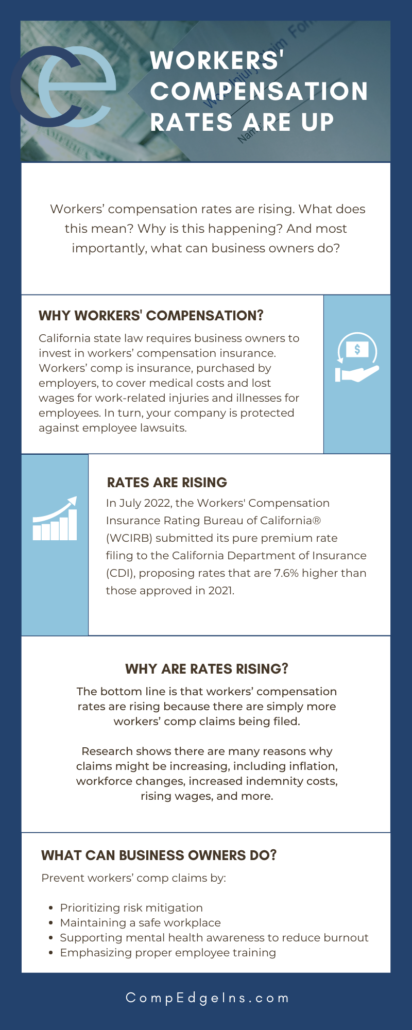
As many business owners may have noticed, workers’ compensation rates are rising. What does this mean? Why is this happening? And most importantly, what can you do as a business owner in response?

Read on to find out.

Why Workers’ Compensation?

If you’re a business owner or an individual who is planning on employing workers when starting a new business, California state law requires you to invest in workers’ compensation insurance.

Why? Employers purchase workers’ compensation insurance to cover the medical costs and lost wages for work-related injuries and illnesses of employees. In turn, workers’ compensation protects your company against employee lawsuits.

Worker’s compensation coverage can help pay for:

  • Immediate medical costs (i.e. emergency room expenses)
  • Ongoing medical costs (i.e. physical therapy)
  • Partial lost wages while the employee is unable to work

Lack of proper coverage can result in fines and even criminal exposure.

Workers’ Compensation Rates Are Rising

Over the past couple of years, workers’ compensation rates have been steadily increasing across the board. They’ve been rising by 7% on average; however, this figure depends on each industry.

Moreover, in July 2022, the Workers’ Compensation Insurance Rating Bureau of California® (WCIRB) submitted its September 1, 2022, pure premium rate filing to the California Department of Insurance (CDI).

The CDI regulates California workers’ compensation rates with the help of the WCIRB, who makes recommendations based on the state’s loss ratio.

In this July 2022 filing, the WCIRB proposed a set of increased premium rates. On average, these rates are 7.6% higher than those approved the year prior on September 1, 2021.

According to the WCIRB, the average of the proposed September 1, 2022, advisory pure premium rates is $1.56 per $100 of payroll.

Read on for the WCIRB filing.

Why Are Workers’ Compensation Rates Rising?

So, why have these premiums been increasing in the first place?

The bottom line is that workers’ compensation rates are rising because there are simply more workers’ comp claims being filed.

Research shows there are many reasons why claims might be increasing, including:

  • Medical inflation
  • Workforce changes
  • The increasing average age of the workforce
  • Increased indemnity costs, and
  • Rising wages

Moreover, as individuals have begun to return to work in person, the number of claims regarding health and safety in the workplace has increased as well. These claims typically include:

  1. Employee concerns about exposure to COVID-19 due to unsafe working conditions, or
  2. Situations where employees allege they were wrongfully denied a request for workplace accommodation or leave

What Can Business Owners Do?

With this rise in claims, what can you do to protect yourself as a business owner? You can prevent workers’ comp claims by:

  • Prioritizing risk mitigation
  • Maintaining a safe workplace
  • Supporting mental health awareness to reduce burnout
  • Emphasizing  proper employee training
  • Developing and distributing an employee handbook and code of ethics policy
  • Implementing a handbook auditing procedure

While this list only showcases a few of many ways to avoid high workers’ compensation premiums, it’s important to remember that it’s up to all employers collectively to keep their employees safe—thus, lowering the number of claims being filed annually.

How Much Risk Does Your Business Hold?

If writing your hefty workers’ compensation check has begun to pain you, at Competitive Edge Insurance, we challenge you to ask yourself a question: “Am I, as a business owner, doing everything in my power to create the safest workplace possible?”

If the answer is no (which it typically is), get in touch with our team today to learn what else you can do.

Learn more about 2022 workers’ compensation changes by reading our article “Insurance Trends in 2022: What to Watch For.”

https://compedgeins.com/wp-content/uploads/2022/08/Workers-Compensation-Rates-are-Rising-What-Can-You-Do.png 628 1200 https://compedgeins.com/wp-content/uploads/2020/11/logoweb.png 2022-08-21 07:00:002024-01-02 17:57:53Workers’ Compensation Rates are Rising: What Can You Do?

Complying with Insurance Requirements: Construction, Manufacturing, Tech Start-Ups

in Construction, News

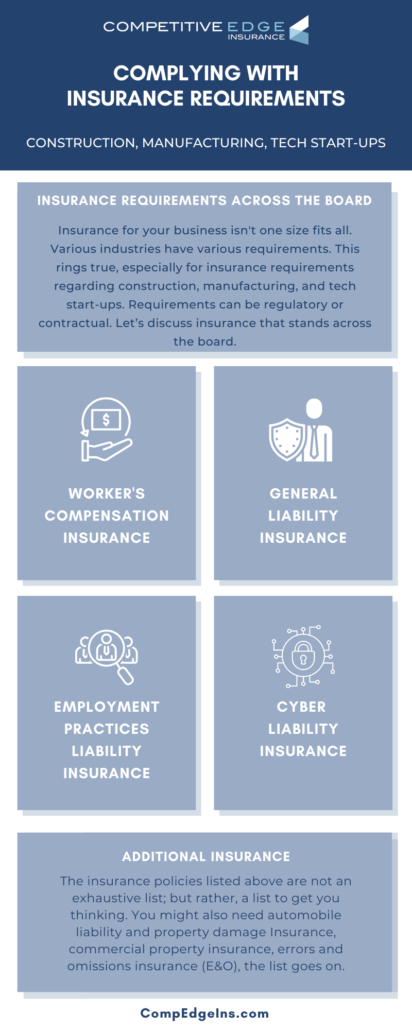
Insurance for your business isn’t one size fits all. As we’ve well learned, various industries have different requirements. This rings true, especially for insurance requirements regarding construction, manufacturing, and even tech start-ups.

Requirements can be regulatory or contractual. Moreover, depending on your industry you might need varying levels and types of insurance. Let’s discuss some aspects that stand across the board.

Workers’ Compensation Insurance

Workers’ compensation insurance, purchased by employers, is insurance that covers the medical costs and lost wages for employees who are injured during the course of work for the insured.

Workers’ compensation benefits and wages are provided in exchange for eliminating the employee’s right to file a lawsuit against their employer’s negligence.

Workers’ compensation insurance is required by law in California, and can help pay for:

  • Immediate medical costs (i.e. emergency room expenses)
  • Ongoing medical costs (i.e. physical therapy)
  • Partial lost wages while the employee is unable to work

Lack of proper coverage can result in fines and even criminal exposure. 

Workers’ compensation insurance is extra important in the construction and manufacturing settings, where accidents are more likely to occur. This considered, businesses within the construction and manufacturing industries might opt for higher levels of workers’ compensation to keep their employees and business safe.

General Liability Insurance

General liability insurance (GLI), also known as business liability insurance or commercial general liability insurance, “helps protect your business from claims of bodily injury or property damage that can come up during normal business operations.”

This is important for construction and manufacturing businesses where hands-on work is occurring but also for tech start-ups. According to Insureon, general liability insurance covers “the cost of legal fees and settlements if your company is sued for:

  • Client injuries
  • Client property damage
  • Advertising injuries, like copyright infringement, libel, and slander

General liability insurance is often required as part of a property lease, mortgage, or client contract.” Moreover, the cost of your GLI will depend on the level of risk your company faces.

If you don’t have GLI, medical expenses and property damages will need to be paid for out of pocket. Depending on the injury or event, not investing in general liability insurance could cost you your business.

Employment Practices Liability Insurance

Employment Practices Liability Insurance (EPLI) is insurance that “provides coverage to employers against claims made by employees.”

Claims can be made for an assortment of reasons, including:

  • Wrongful Termination
  • Sexual Harassment
  • Wage-Related Claims
  • Claims of Unequal or Unfair Pay Discrimination Claims (i.e. age, race, gender, sexual orientation)
  • Third-Party Claims
  • And more

The primary industries that are susceptible to EPLI claims include healthcare, professional services, restaurant, food services, retail, and manufacturing and construction.

Read on to find out if your construction business needs EPLI.

Cyber Liability Insurance

In our digital age today, more businesses than ever are falling victim to cyber-attacks. Having a cyber liability policy in place, for any business, is crucial to keeping your business and your clients safe. This stands even more true for tech start-ups that manage sensitive information and high volumes of data.

There is both first and third-party coverage available. Implementing a quality cyber liability policy can help pay for regulatory fines and penalties, credit and fraud monitoring services, crisis management and public relations, finding and addressing the security defect, and more.

Complying with Insurance Requirements

Complying with Insurance Requirements: Things to Note

The insurance policies listed above are not, of course, an exhaustive list of insurance requirements all construction, manufacturing, and tech start-ups need to meet; but rather, a list to get you thinking about insuring your business.

You might also need automobile liability and property damage Insurance, commercial property insurance, errors and omissions insurance (E&O), the list goes on.

Regardless, there are additional elements to consider regarding insuring any one of these three businesses. Let’s discuss some final things to note.

Occupational Safety and Health Administration

The Occupational Safety and Health Administration, also known as OSHA, has particular requirements regarding insurance as well as health and safety practices for a variety of industries.

Visit the OSHA website for additional information.

Certificates of Insurance

In any project, it’s important to make sure you have the proper insurance to protect yourself and all parties involved.

Every contract with a vendor or a customer will have an indemnity or insurance section of what they want to see from you as far as insurance is concerned. This includes documents that extend your policy to cover them. Those requirements are contractually driven, which means a certificate is necessary.

A Certificate of Insurance (COI) gives a summary of what coverages someone has, whether it be general liability, workers’ compensation, or property. A COI can also include a description of coverages that might be there or attached; such as additional insured status or waivers of subrogation.

Read on for more on what you need to know about certificates of insurance.

Contract Wording

A written contract is a printed document that is legally binding and details what parties can or cannot do. For this reason, the contractual language is extremely important. Contracts for construction, manufacturing, and tech start-ups might include hold harmless clauses and/or indemnification clauses.

Hold Harmless Clause

What is a hold harmless clause? According to Investopedia, “a hold harmless clause is used to protect a party in a contract from liability for damages or losses. In signing such a clause, the other party accepts responsibility for certain risks involved in contracting for the service. In some states, the use of a hold harmless clause is prohibited in certain construction jobs.”

Indemnification Clause

An indemnification or indemnity clause protects “one party from liability if a third-party or third entity is harmed in any way. It’s a clause that contractually obligates one party to compensate another party for losses or damages that have occurred or could occur in the future.”

For this reason, the wording in such contracts must be crystal clear.

With the influx of remote employees in current and previous years, it’s important to consider how workers’ compensation policies might change. Read on for more information on what workers’ compensation looks like for remote employees.

https://compedgeins.com/wp-content/uploads/2022/04/Complying-with-Insurance-Requirements-Construction-Manufacturing-Tech-Start-Ups.png 628 1200 https://compedgeins.com/wp-content/uploads/2020/11/logoweb.png 2022-05-22 19:00:002024-01-02 17:57:55Complying with Insurance Requirements: Construction, Manufacturing, Tech Start-Ups

Will Homeowners Insurance Cover a Construction Project?

in Construction, News

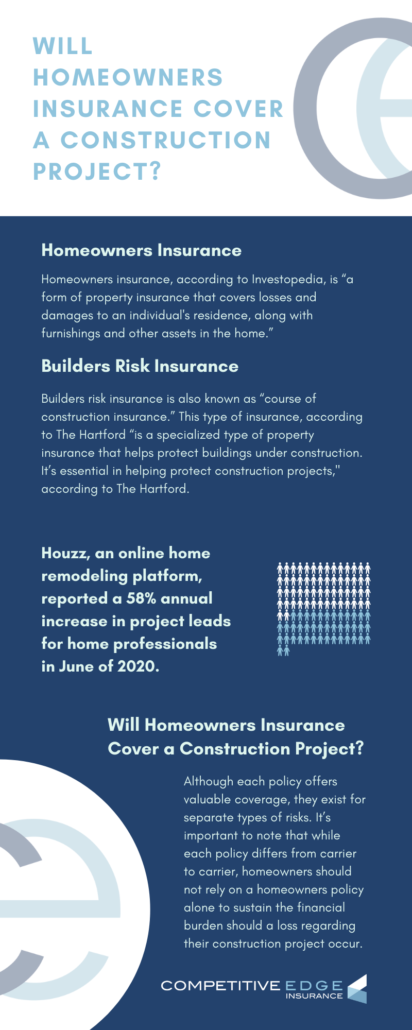
So, you want to do a renovation or some construction on your home. Well, you’re not the only one! According to various studies, home remodeling has been hotter than ever during the COVID-19 pandemic. In fact, Houzz, an online home remodeling platform, reported a 58% annual increase in project leads for home professionals in June of 2020.

We don’t blame any of you homeowners for wanting to spruce things up, especially considering all the extra time many individuals and families have been spending at home the past two years.

When tackling a construction project on your property, however, it’s important to consider the bandwidth of your homeowners insurance. Is it enough? Or, should you consider investing in builders risk insurance as well?

Homeowners Insurance vs. Builders Risk Insurance

First things first, what’s the difference?

Homeowners Insurance

Homeowners insurance is defined as “a form of property insurance that covers losses and damages to an individual’s residence, along with furnishings and other assets in the home.”

It’s important to note that every homeowners insurance policy has a liability limit. This liability limit “determines the amount of coverage the insured has should an unfortunate incident occur.”

Homeowners insurance is typically used to repair or replace your home and its contents in the event of damage.

Builders Risk Insurance

Builders risk insurance, on the other hand, is not quite the same. Builders risk insurance is also known as “course of construction insurance.”

Hence its name, this type of insurance, is a type of property insurance that protects your home, or other buildings that are under construction. This coverage is essential to protecting projects from property damage that occurs due to:

  • Fire
  • Lightning
  • Hail
  • Explosions
  • Theft
  • Vandalism
  • Acts of God, for example, hurricanes

Builders risk insurance is a crucial part of a homeowner’s risk management strategy.

Will Homeowners Insurance Cover a Construction Project?

Is your homeowners insurance enough?

Whether you’re considering a from-the-ground-up construction project, kitchen or bathroom remodeling, or even room addition, there’s nothing more important than making sure you have the proper coverage.

Although each policy offers valuable coverage, they exist for separate types of risks. It’s important to note that while each policy will, of course, differ from carrier to carrier, homeowners should not rely on a homeowners policy alone to sustain the financial burden should a loss regarding their construction project occur.

After all, if homeowners insurance and builders risk insurance both covered the same risks, there would be no need for each to exist.

As a general rule, homeowners insurance covers damage to a property already in tact; builders risk covers damage to a property that is under construction.

Obtain the Coverage You Need

By consulting with an insurance broker prior to beginning a construction project on your home, you can learn all about gaps in homeowners insurance and where you may need additional coverage depending on your unique policy.

If you’re considering a project of your own, read on to learn more about how the California labor shortage is affecting the construction industry, and if there are qualified workers available to you at all.

https://compedgeins.com/wp-content/uploads/2022/02/Will-Homeowners-Insurance-Cover-a-Construction-Project-1200-×-628-px.png 628 1200 https://compedgeins.com/wp-content/uploads/2020/11/logoweb.png 2022-03-06 07:00:002022-02-25 10:52:06Will Homeowners Insurance Cover a Construction Project?

Payment and Performance Bonds Explained

in Bonding, Construction, General Business Insurance, High-Risk Insurance, News
Payment and performance bonds

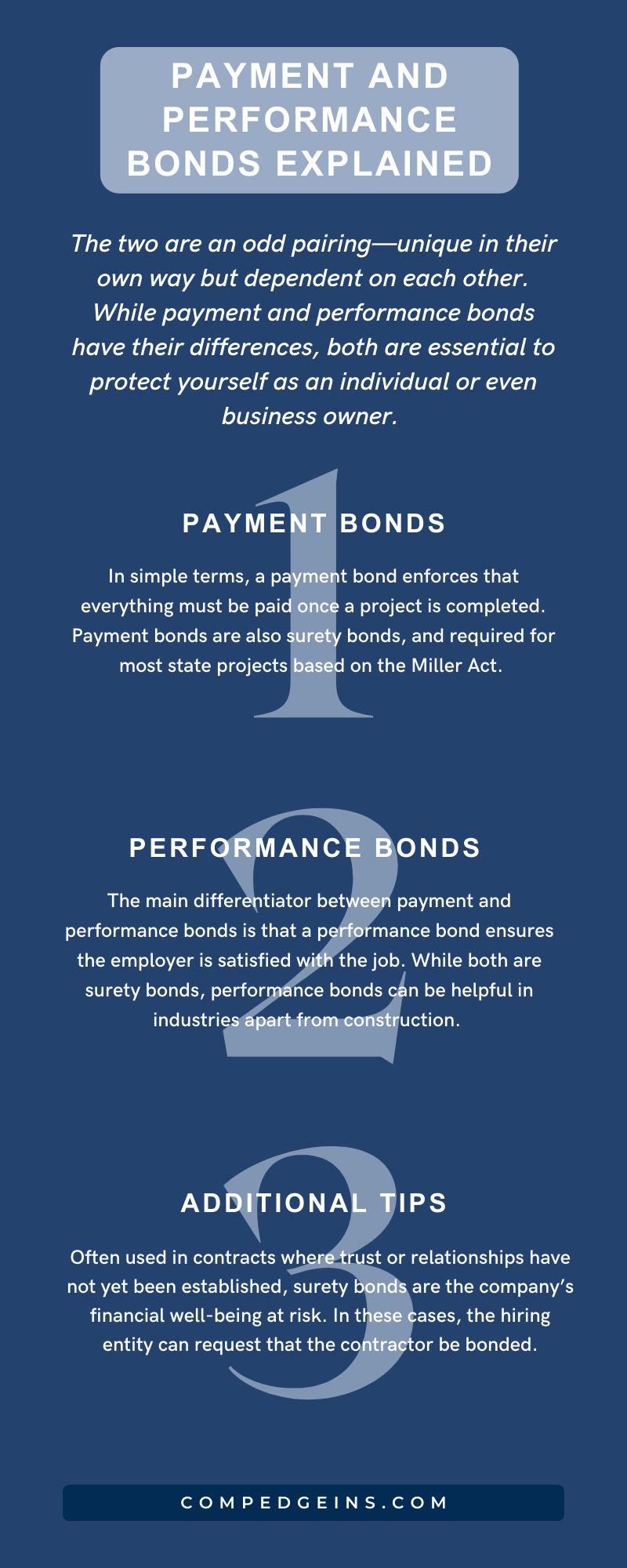
Payment and performance bonds… The two are an odd pairing—unique in their own way yet dependent on each other.

Although payment and performance bonds have their differences, both are essential in protecting yourself in the world of insurance. Let’s explore the differences below.

Payment Bonds

What is a payment bond? Simply put, a payment bond guarantees payment for subcontractors and payment for materials once a project is completed.

Payment bonds are most commonly seen in construction. Payment bonds are a type of surety bond and are required for most state projects based on the Miller Act.

Surety Bonds

What is a surety bond? 

A surety bond is a contract where one party (the surety company) guarantees the performance of certain obligations in a contract of the second party (the principal or the insured) to a third party (the obligee).

When Do You Need a Surety Bond?

Surety bonds are needed for most licenses in the state of California and other states as well. Some examples of who might need a surety bond include:

  • Contractors
  • Real estate companies and agents
  • Financial institutions
  • Janitorial staff

Why Do You Need a Surety Bond?

Licensed bonds are required in many states to do business and are put in place by the state to protect consumers.

The insured, or principal, purchases these bonds in an amount prescribed by the state to pay the obligee (the state), in case there’s a claim against somebody’s license.

The Miller Act

As previously mentioned, surety bonds are required for most state projects based on the Miller Act.

The Miller Act was passed by the U.S. General Services Administration Public Buildings Service (GSA) to explain how payment bonds protect subcontractors and suppliers.

The GSA responds to any reports of nonpayment, following the legal action needed and protected by the Miller Act.

The GSA states that “the Miller Act requires that prime contractors for the construction, alteration, or repair of Federal buildings furnish a payment bond for contracts in excess of $100,000.” 

There are legal consequences for breaking a contract through the Miller Act.

The GSA expands: “Failure by a contractor to pay suppliers and subcontractors gives such suppliers and subcontractors the right to sue the contractor in the U.S. District Court in the name of the United States.”

Performance Bonds

The main difference between payment and performance bonds is that a performance bond ensures that the employer is satisfied with the job.

While both payment and performance bonds are surety bonds, performance bonds are visible in industries outside of construction.

A performance bond, according to Investopedia, “ensures the completion of a project.” A performance bond covers the ability of the contractor to perform and finish the job as per contract requirements.

If the contractor doesn’t perform, the contract bond kicks in and helps to pay for the completion of that performance.

A performance bond involves three parties:

  • The principal: The primary contact in the performance bond; responsible for performing the contract
  • The obligee: The person receiving the obligation
  • The surety: Responsible for making sure each party complies with the performance bond obligations

A Final Note

If these bonds are used and there’s a claim on a bond, the contractor who purchased the bond has to pay that back.

This considered, surety companies look for strong financials in a company, including assets, lines of credit, and letters of credit.For more information, watch this video about surety bonds and contract bonds. There, Brenda Jo Robyn, founder of Competitive Edge, lays it all out on the table in a way that’s easy to understand.

https://compedgeins.com/wp-content/uploads/2021/07/iStock-1209272786.jpg 1414 2121 https://compedgeins.com/wp-content/uploads/2020/11/logoweb.png 2022-01-16 07:00:002022-09-16 13:10:19Payment and Performance Bonds Explained

How the California Labor Shortage Is Affecting the Construction Industry

in Construction, News

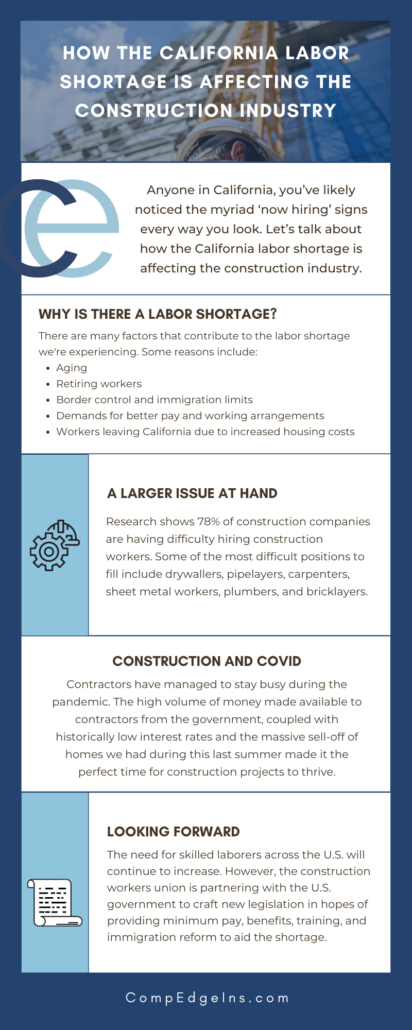
For anyone in California who has taken a stroll around town lately, you’ve likely noticed the myriad ‘now hiring’ signs every way you look. Restaurants and retail stores are experiencing obvious shortages, but the construction industry is especially feeling the deficit of ready labor right now.

Let’s talk about how the California labor shortage is affecting the construction industry.

Why Is There a Labor Shortage in California?

When asked about the California labor shortage, Brenda Jo Robyn, founder of Competitive Edge Insurance, said this:

“You can see labor shortages everywhere,” says Brenda Jo. “The shortage of skilled labor is getting tighter and tighter.”

But why? There are many factors that contribute to the labor shortage we are experiencing as a nation right now. According to economists at CNBC, some reasons include:

  • Aging
  • Retiring workers
  • Border control and immigration limits
  • Demands for better pay and working arrangements
  • Workers leaving California due to increased housing costs
  • And more

The labor shortage in the construction industry specifically, however, is not only a California issue.

A Larger Issue at Hand

According to the Associated General Contractors of America (AGC) and Autodesk, “78% of construction companies are having difficulty hiring construction workers.”

Some of the most difficult positions to fill, according to NBC San Diego, include:

  • Drywallers
  • Pipelayers
  • Carpenters
  • Sheet metal workers
  • Plumbers
  • Bricklayers

Even if a wave of individuals wanted to get into the construction field right now, it takes a great deal of time to become proficient in many of these jobs. Not to mention the time required to receive proper licensure from the California Contractors State License Board (CSLB).

But construction projects need laborers now.

Some companies have even had to turn to out-of-state workers, bringing them in for individual projects to meet demands.

The Construction Industry During COVID and Today

california labor shortage construction industry

Contractors have managed to stay busy during the COVID-19 pandemic. How? It was the perfect time for construction projects to thrive last summer considering a few elements working in combination:

  • The high volume of money made available to contractors from the government
  • Historically low-interest rates
  • The massive sell-off of homes

In fact, as soon as things were deemed “safe enough,” many homeowners and business owners jumped on the opportunity to renovate their properties. Think kitchen remodels, backyard updates, you name it.

But now, the supply can’t meet the high demand.

In an article written by Fox, contractor Michael Wolff was interviewed. “I would pay a ridiculous amount of money to get a qualified person in here. I would hire 15 people today,” said Wolff. He, like many other contractors, acknowledges that many qualified laborers have preferred to stay at home on unemployment or stimulus or work under the table.

Increased Costs

Brenda Jo of Competitive Edge elaborates on the trickle-down effect of the labor shortage. As a result, the construction industry is hiking up costs to complete projects in an efficient manner.

Brenda Jo explains: “When there’s a shortage, that means there’s a competition. When there’s a competition, wages go up in that industry or that skillset.” All in all, projects cost more.

She continues with the two options contractors are faced with. “Either the employer can’t find enough labor so the job takes longer or you contract more laborers, shortening your project time, but increasing costs,” says Brenda Jo. “There’s a fine balance between those.” And, as we’ve observed, it’s a difficult balance to strike.

The Construction Industry: Looking Forward

The need for skilled laborers across the U.S. will continue to increase in the coming years. In fact, there will be an 11% increase between 2016 and 2026, bringing an additional 747,600 industry jobs to fill.

Today, fewer and fewer children are exposed to the construction world—which, in turn, will further drag out the shortage. Only 3% of people ages 18 to 25 wanted to work in construction, according to an article done by Builder in 2017.

Moreover, “for every five workers retiring, [there is] only one coming in,” according to Robin Bartholow, Builders Exchange Workforce Development Director.

The facts considered, the shortage does not appear to be ending anytime soon. 45% of companies surveyed by AGC reported that they anticipate continuing difficulty in hiring craft and salaried workers.

According to The Los Angeles Times, the construction workers union is partnering with the U.S. government to craft new legislation in hopes of providing:

  • Minimum pay
  • Benefits
  • Training

Immigration reform is an additional solution that could allow skilled, out-of-country workers to aid the shortage, according to the San Francisco Chronicle.

For those who are not a part of the construction workers union, a higher emphasis on training and educating younger generations about careers in construction could help solve the labor shortage in the long run.

Read on to learn what to expect from changing contractor costs as a result of both labor shortages and shipping delays from Brenda Jo Robyn, founder of Competitive Edge Insurance herself.

https://compedgeins.com/wp-content/uploads/2021/11/How-the-California-Labor-Shortage-Is-Affecting-the-Construction-Industry.png 628 1200 https://compedgeins.com/wp-content/uploads/2020/11/logoweb.png 2021-12-12 07:00:002022-04-27 12:46:30How the California Labor Shortage Is Affecting the Construction Industry

What’s the Difference Between a Surety Bond and a Contract Bond?

in Bonding, Construction, High-Risk Insurance, News, Video

The world of insurance can be complex—and for contractors, work can be dangerous, too. As a contractor, the question of what insurance you need to stay protected is likely to come up.

So, for starters: What’s the difference between a surety bond and a contract bond? Which do you need to stay safe?

Today, Brenda Jo Robyn, founder of Competitive Edge Insurance, is here on camera to give us the spiel; including the differences, benefits and risks, and what you need. Let’s dive in.

What is a Surety Bond?

There are three parties involved in a surety bond, including:

  • The surety company
  • The principal or the insured
  • The obligee

A surety bond is a contract where one party (the surety company) guarantees the performance of certain obligations in a contract of the second party (the principal or the insured) to a third party (the obligee).

When Do You Need a Surety Bond?

Surety bonds are needed for most licenses in the state of California and other states as well. Some examples of who might need a surety bond include:

  • Contractors
  • Real estate companies and agents
  • Financial institutions
  • Janitorial personnel

Why Do You Need a Surety Bond?

Licensed bonds are required in many states to do business, and are put in place by the state to protect the consumer.

The insured, or principal, purchases this bond in an amount prescribed by the state to pay the obligee (the state at this point), in case there’s a claim against someone’s license.

What is a Contract Bond?

A contractor performance bond is a written contract that guarantees the performance obligations under a contract.

Contractor performance bonds are used frequently in the construction industry but are also sometimes used in manufacturing and supply chains as well.

When Do You Need a Contract Bond?

The short answer: It depends! Contractors can be required to have a contract bond for different parts of the process when they’re bidding for a job, according to Brenda Jo.

What Is a Bid Bond? When Do You Need One?

Oftentimes, a bid bond is required to submit a bid for a project. Typically, these bids are in the public arena for states or cities. For example, the Department of Forestry.

“A bid bond lets this entity know that the contractor can provide a payment and performance bond should the job be awarded to them,” says Brenda Jo.

“If the contractor is awarded the project and the contractor decides that they cannot fulfill the obligation, the bid bond helps to pay for the difference in price that it costs to get a new contractor in.”

This leads to the next kind of bond couplings, which is the payment bond and the performance bond. Let’s discuss.

Payment Bonds and Performance Bonds

What is a payment bond? What about a performance bond?

A payment bond is a bond that guarantees payment for subcontractors and payment for materials.

A performance bond, on the other hand, covers the ability of the contractor to perform and finish the job as per contract requirements. If the contractor doesn’t perform, the contract bond kicks in and helps to pay for the completion of that performance.

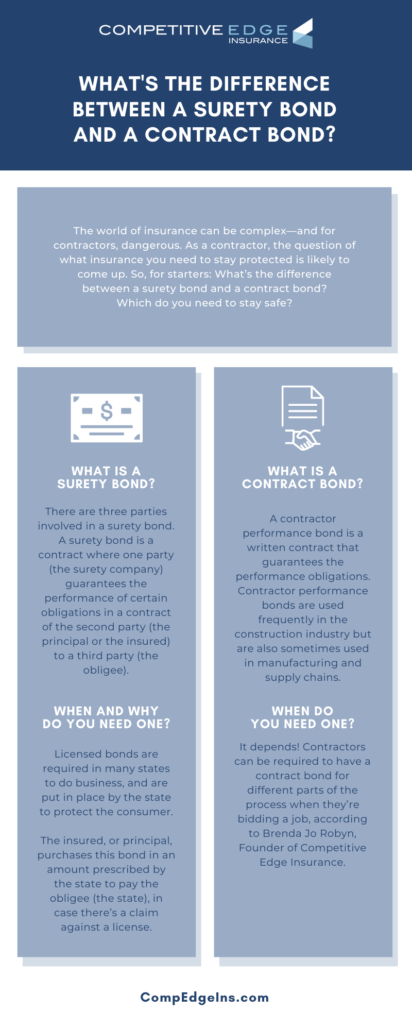
infographic showing the difference between a surety bond and a contract bond

A Final Word

An important note: For all bonds mentioned, if they’re used and there’s a claim on a bond, the contractor who purchased the bond has to pay that back, says Brenda Jo.

This considered, surety companies look for strong financials in a company, including:

  • Assets
  • Lines of credit
  • Letters of credit

Surety companies look for anything that creates a picture that says you’re worthy of having a bond put into place—because if the bond is utilized and pays out, they need to know that the purchaser of the bond can pay that money back.

Bring in The Experts

At Competitive Edge Insurance, we work with insurance carriers across the country to place all types of business coverage. We are always seeking out new insurance companies to write hard-to-place and high-risk business insurance.

Don’t let cancellation dissuade you from finding comprehensive coverage. We can help! Learn more by connecting with our team today.

Additionally, for those interested in learning more, choose between our articles on the key differences between general contractors and construction managers and the difference between payment and performance bonds.

https://compedgeins.com/wp-content/uploads/2021/10/Whats-the-Difference-Between-a-Surety-Bond-and-Default-Insurance.png 628 1200 https://compedgeins.com/wp-content/uploads/2020/11/logoweb.png 2021-11-28 07:00:002022-05-27 09:45:25What’s the Difference Between a Surety Bond and a Contract Bond?

What to Expect from Changing Contractor Costs

in Construction, High-Risk Insurance, News, Video

The global pandemic brought many changes to the construction and builders industry. Here’s what to expect in 2021.

Read more
https://compedgeins.com/wp-content/uploads/2021/04/Construction-Feature-Image-scaled.jpg 1706 2560 https://compedgeins.com/wp-content/uploads/2020/11/logoweb.png 2021-11-08 11:25:002021-11-08 11:29:52What to Expect from Changing Contractor Costs

Shock Loss: How to Redefine your Risk Profile in a Post-COVID Market

in Construction, High-Risk Insurance, News
Read more
https://compedgeins.com/wp-content/uploads/2021/05/Copy-of-COMP-EDGE-Feature-Image-Risk_May10.png 924 1640 https://compedgeins.com/wp-content/uploads/2020/11/logoweb.png 2021-11-01 16:41:002021-11-01 16:41:01Shock Loss: How to Redefine your Risk Profile in a Post-COVID Market
Page 1 of 212

CATEGORIES

RECENT POSTS

  • Cyber Security Image by Anderson Piza at Envato Elements | Licensed
    6 Current Cyber Threats Companies Face: How to Stay Safe
  • Insurance Form Image by rfaizal707 at Envato ElementsEnvato Elements by rfaizal707
    Understanding the Hard Insurance Market and Its Impact on You
  • Black and White Photo of a man writing a contract
    EPLI: Does Your Construction Business Need It?

CONNECT WITH US

VIDEO POSTS

  • City view of commercial buildings, including skyscrapers surrounded by trees
    How to COPE in an Inflationary Environment
  • Coronado bridge aerial view
    Get to Know Our Founder: Her Rotary Involvement
  • Insurtech holographic image with man using ipad
    The Coverage Pitfalls of Insurtech
LET’S TALK

WANT TO KNOW HOW MUCH YOU COULD BE SAVING ON YOUR INSURANCE COSTS?

WANT TO KNOW HOW MUCH YOU COULD BE SAVING ON YOUR INSURANCE COSTS?

LET’S TALK

Connect With Us

Competitive Edge Insurance

LIC #0H31982

P: 619-259-5459
F: 619-377-0144

830 Orange Ave Suite L Coronado, CA 92118

Privacy Policy

Hours of Operation

Monday – Friday 8:00AM – 5:00PM

Saturday Closed

Sunday Closed

© Copyright 2021- Competitive Edge Insurance

site design by digitalstoryteller.io

© Copyright 2021- Competitive Edge Insurance
site design by digitalstoryteller.io

Scroll to top

This site uses cookies. By continuing to browse the site, you are agreeing to our use of cookies.

Accept settings

Cookie and Privacy Settings


How we use cookies

We may request cookies to be set on your device. We use cookies to let us know when you visit our websites, how you interact with us, to enrich your user experience, and to customize your relationship with our website.

Click on the different category headings to find out more. You can also change some of your preferences. Note that blocking some types of cookies may impact your experience on our websites and the services we are able to offer.

Essential Website Cookies

These cookies are strictly necessary to provide you with services available through our website and to use some of its features.

Because these cookies are strictly necessary to deliver the website, refusing them will have impact how our site functions. You always can block or delete cookies by changing your browser settings and force blocking all cookies on this website. But this will always prompt you to accept/refuse cookies when revisiting our site.

We fully respect if you want to refuse cookies but to avoid asking you again and again kindly allow us to store a cookie for that. You are free to opt out any time or opt in for other cookies to get a better experience. If you refuse cookies we will remove all set cookies in our domain.

We provide you with a list of stored cookies on your computer in our domain so you can check what we stored. Due to security reasons we are not able to show or modify cookies from other domains. You can check these in your browser security settings.

Google Analytics Cookies

These cookies collect information that is used either in aggregate form to help us understand how our website is being used or how effective our marketing campaigns are, or to help us customize our website and application for you in order to enhance your experience.

If you do not want that we track your visit to our site you can disable tracking in your browser here:

Other external services

We also use different external services like Google Webfonts, Google Maps, and external Video providers. Since these providers may collect personal data like your IP address we allow you to block them here. Please be aware that this might heavily reduce the functionality and appearance of our site. Changes will take effect once you reload the page.

Google Webfont Settings:

Google Map Settings:

Google reCaptcha Settings:

Vimeo and Youtube video embeds:

Other cookies

The following cookies are also needed - You can choose if you want to allow them:

Privacy Policy

You can read about our cookies and privacy settings in detail on our Privacy Policy Page.

Privacy Policy
Accept settings