Competitive Edge Insurance
  • Construction
  • Business
    • Health and Wellness Insurance
    • Cyber Liability
    • Bonding
    • General Business Insurance
    • EIDL Insurance Requirements
  • Personal Lines
    • Auto Insurance
    • Boat Insurance
    • Homeowners Insurance
  • About Us
  • Resources
    • Articles and Insights
    • Trusted Advisors
  • Contact
  • Menu Menu
  • LinkedIn
  • Instagram
  • Facebook
  • Youtube

Four Types of Insurance Coverage for your Business

in Bonding, Construction, Cyber Insurance, General Business Insurance, Health & Wellness, News

There are so many options for insurance that it can be overwhelming to know which research steps to take as a business. At Competitive Edge, we help you navigate what coverage best fits you and your business. 

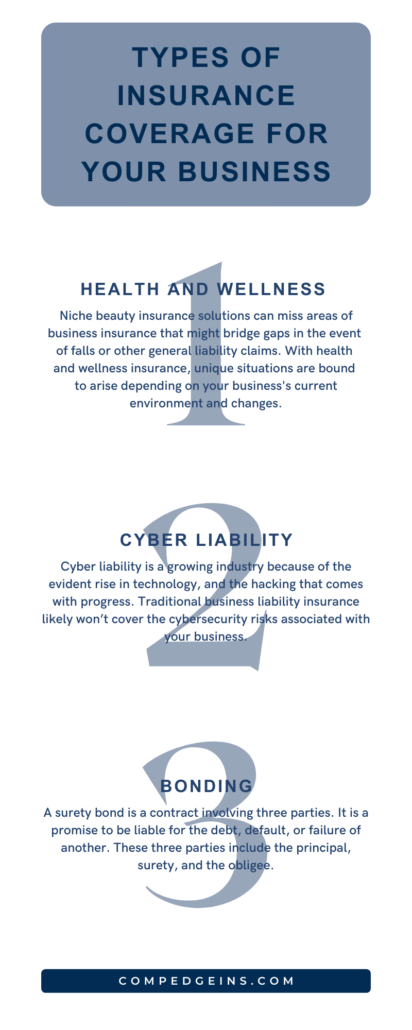
Health and Wellness 

Niche beauty insurance solutions can miss areas of business insurance that might bridge gaps in the event of falls or other general liability claims. With health and wellness insurance, unique situations are bound to arise depending on your business’s current environment and changes. 

The various Health and Wellness sectors that Competitive Edge caters to include: 

  • Beauty 
  • Spa Owners
  • Hair Salon Owners
  • Nail Salon Owners
  • Fitness
  • Yoga Studio Owners
  • Pilates Studio Owners
  • Dance, BarreFit, and Additional Exercise Studio Owners
  • Martial Arts Studio Owners
  • Health
  • Naturopathy Practices
  • Audiologists
  • Speech and Occupational Therapy Centers
  • Alternative Therapy Centers
  • Acupuncturists

To provide you with the right coverage from the right carrier, we need to know about your business. It’s not enough to put all cosmetology companies in one box, all spas in another, and all beauty product companies in yet another pre-planned box.

Cyber Liability

Cyber liability is a growing industry because of the evident rise in technology, and the hacking that comes with progress.

Does this sound like news to you? Don’t worry—we already wrote an article here for you to read about reducing cybersecurity risk. 

It’s important to understand what might be covered under your cyber insurance policy. 

  • Data Breaches
  • Intellectual Property Rights
  • System Failure
  • Damages to a Third-Party System
  • Cyber Extortion
  • Business Interruption

Traditional business liability insurance likely won’t cover any cyver risks associated with your business. 

Bonding

Surety bonds offer an important secondary level of coverage. 

A surety bond is a contract involving three parties. It is a promise to be liable for the debt, default, or failure of another.  These three parties include:

  • The Principal: The party that purchases the bond and undertakes the obligation to perform the act as promised.
  • The Surety: An insurance company that guarantees the obligation to be performed. If the principal fails to perform the act as promised, the surety has a contractual obligation for the losses.
  • The Obligee: The party who requires and receives the benefit of the surety bond.

There are two categories of surety bonds: contract surety bonds and commercial surety bonds.

Contract surety bonds are typically written for construction projects. If a contractor defaults, the surety company is obligated to find another contractor to complete the contract. Another option for the surety company is to compensate the project owner for the financial loss incurred. There are a few bond types of contract surety bonds.

Contract sureties are required during a federal construction contract valued at $150,000 or more. State and municipal governments have similar regulations. Note that contract sureties may also be used with a private owner.

Commercial surety bonds, on the other hand, cover a broader range of surety bonds. These are required of individuals and businesses by federal, state, and local governments.

These bonds can be required by the government to obtain a license. For example, mortgage brokers, contractors, and auto dealers may be required to obtain a license or permit bond. These bonds can also be required to protect various statutes, regulations, ordinances, and other government entities.

General Business Insurance

General business insurance covers areas such as property damage, bodily injury, product liability, libel, slander, and copyright infringement.

Hindsight is no place for general business insurance conversations as lawsuits are a sad reality for many businesses. Just one bodily injury or property damage claim can take away everything you’ve worked so hard to build. General liability insurance provides businesses with coverage for most damages, injuries, medical costs, legal fees, and settlements in the case that you’re being sued.

Construction Insurance

Shock losses from large claims can make it difficult to get affordable insurance in the high-risk field of construction. If your insurance was canceled or non-renewed, we can help. 

Our depth of experience and exemplary reputation with the carriers we work with can find a home for your hard-to-place and high-risk clients can find the right coverage. The fact is, every business can find coverage, you just have to take the time and know where to look. 

The businesses we work with include: 

  • Roofing
  • Construction
  • Commercial Property
  • Commercial Real Estate
  • General Liability (CGL)

Errors and Omissions Insurance

In the CRE industry, agents are at higher risk of being accused of failing to meet a client’s expectations, failing to document decisions or actions, or failing to act in a customer’s best interest. This could be an error on a title or an oversight in a property listing, which could lead to a costly lawsuit. 

Errors and Omissions (E&O) insurance covers against financial losses from lawsuits filed as a result of an agent’s work in the real estate profession. These policies cover liability related to the following issues:

The client may claim that you made an error that led to financial loss. In a lawsuit regarding professional mistakes, you may be at risk of losing big, considering the size of commercial property transactions.

An example of this is when a real estate agent misstates the square footage of a property. If the agent has Errors and Omissions Insurance, however, they may be covered for attorney’s fees, court costs, settlements, judgments, and fines. 

Potential E&O Exclusions

While it’s important to know what E&O insurance covers, it’s also important to understand potential exclusions. Some common exclusions in E&O coverage include claims resulting from dishonest or criminal acts. As well as claims associated with a polluted property. If any agent causes bodily harm or death to another person, or the agent causes damage to someone’s property, their claims will not be covered under E&O insurance. 

In the CRE industry, it’s more common to face a lawsuit related to errors and omissions so it’s best to be covered before you need it. Roger J. Stewart is an expert in providing coverage for real estate professionals and has helped various CRE investors and agents avoid risk and save money throughout the years.

At Competitive Edge Insurance, we work with insurance carriers across the country to place all types of business coverage. We are always seeking out new insurance companies to write hard-to-place and high-risk business insurance. 

Don’t let cancellation dissuade you from finding comprehensive coverage, we can help! 

Contact us today at Competitive Edge to find out more information.
https://compedgeins.com/wp-content/uploads/2021/08/iStock-1263838446.jpg 1414 2119 https://compedgeins.com/wp-content/uploads/2026/08/Comp-Edge-ONLY-Color-Logo-300x59.jpg 2021-09-19 14:08:002021-11-01 16:08:08Four Types of Insurance Coverage for your Business

BEWARE: Workers’ Comp Insurance for Independent Contractors

in Construction, General Business Insurance, High-Risk Insurance, News, Workers' Compensation

As you may know, most states require employers to have workers’ compensation insurance. These insurance policies can help recover most of your employee’s lost wages while they recover from a work-related injury or illness.

It also helps to cover your employee’s medical expenses as it provides their family with death benefits if they, unfortunately, pass away.

What is Workers’ Compensation Insurance?

Workers’ compensation insurance are policies that provide medical benefits and wage compensation to workers injured on the job, in exchange for eliminating their right to file a lawsuit against their employer’s negligence.

Workers’ compensation benefits are designed to help employees if they are unable to work, cover medical expenses, as well as other expenses and rehabilitation costs associated with disability or illness. As you look to explore workers’ compensation options, it’s important to look for one that provides adequate coverage and compensation for your employees.

When you invest in a properly designed policy, it ensures you and your employees remain financially secure. It’s also important to look at the specific benefits that are offered within your policy. Typical workers’ compensation insurance policies cover medical benefits.

What is Covered with Workers’ Compensation Insurance?

Specific workers’ compensation laws vary depending on your state; however, the most common compensation states that require workplace injury insurance include the following:

  • Payment for lost wages
  • Vocational rehabilitation
  • Permanent disability
  • Temporary disability
  • Medical costs and treatment 

How to Prepare for Employee Claims

Accidents happen. It’s part of life. It doesn’t matter how safe your business is, there’s always the chance an employee will get sick or injured on the job. For this reason, nearly every state requires business owners to have coverage for their employees. Different states, however, have various regulations. 

Ensure you have an expert on your team to help understand what your specific business needs are. For example, if your business is in California, you are required to obtain workers’ compensation insurance even if your business is as small as just one employee. In Florida, however, you need this coverage if you have at least four employees. 

Signing up for workers’ compensation depends on the location of your business. Typically, states recommend you purchase workers’ compensation insurance through a private insurance company, while others may require you to buy it through a state-run insurance fund.

It’s also important to understand the cost associated with investing in workers’ compensation insurance. The risk associated with your specific business will determine the cost of your insurance payments. This all sounds pricey, but remember: the costs associated with not having workers’ compensation insurance might be the motivation you need to start considering your options.

Without workers’ compensation insurance, you put yourself and your business at risk of fines, and could even face potential jail time for not complying with regulations. If an employee runs into a problem that would have been covered by workers’ compensation insurance, you may be responsible for covering their expenses, and you may also open yourself up to litigation.

What You Need to Know About Workers’ Compensation as an Independent Contractor

Every contractor needs general liability insurance. While the law does not require it, it is considered best practice to ensure against the kinds of injuries and lawsuits general liability is targeted to.

Large contractors may own commercial buildings that require property insurance, where smaller contractors or those with a specialty may need different coverage. 

At Competitive Edge, we don’t claim to know your needs until we talk to you. What’s right for one company may not be a choice that meets your needs. Even if you have suffered a shock loss, large claim, or lawsuit, and find that your options have narrowed, we can work with you.

The first step is to show us under the hood so we can help you find the right carrier and coverage to protect your business today and always. Contact Competitive Edge Insurance today for more information about high-risk coverage today!

https://compedgeins.com/wp-content/uploads/2021/08/iStock-157191789-1-scaled.jpg 1649 2560 https://compedgeins.com/wp-content/uploads/2026/08/Comp-Edge-ONLY-Color-Logo-300x59.jpg 2021-09-06 10:31:002021-11-01 16:09:04BEWARE: Workers’ Comp Insurance for Independent Contractors

The Key Differences between General Contractors and Construction Managers

in Construction, High-Risk Insurance, News

Hard to place insurance is not impossible to place. 

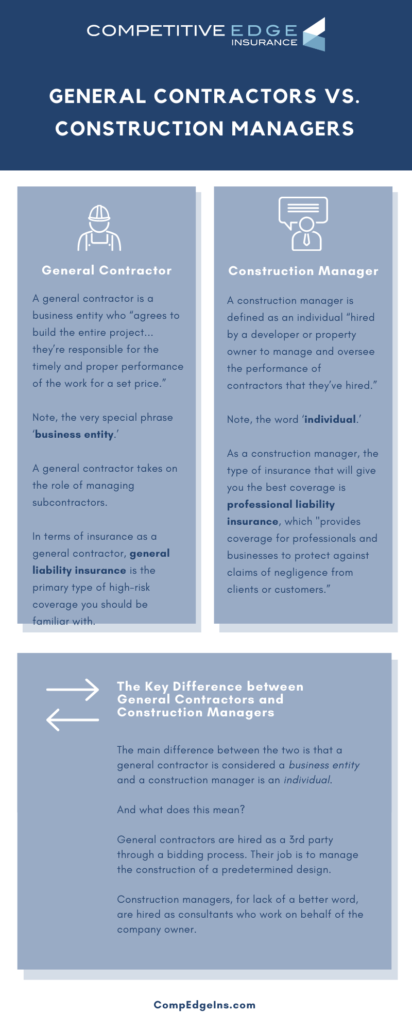
Although being a General Contractor (GC) and Construction Manager (CM) may sound like the same type of position, the difference is often overlooked in the industry. The difference between positions equates to a difference between the type of construction insurance needed.

General Contractor

A General Contractor “agrees to build the entire project—they’re the party ultimately responsible for the timely and proper performance of the work for a set price.”

The general contractor isn’t doing the manual labor at the job site, but instead managing the subcontractors who do.

In terms of insurance as a general contractor, general liability insurance is the type of high-risk coverage you should be looking toward. With construction coverage, there are specific risks to be made aware of, including: 

  • Canceled or non-renewed insurance coverage
  • Repeated rejection from multiple carriers within a short time period
  • Shock losses
  • The high volume of small claims
  • High risk of property damage, illness, injury, or death

Construction Manager

On the other hand, a Construction Manager, “is a consultant hired by a developer or property owner to manage and oversee the performance of contractors that they’ve hired. The developer, owner, etc. hire each of these contractors directly.”

When you’re a construction manager, the type of insurance that will give you the best coverage is professional liability insurance. 

The main difference between a GC and CM is the legality behind their hiring process, including coverage. The CM is hired, for lack of a better word, as a consultant whereas a GC is given a distinct payment with the job fully in their hands. The construction business needs to be protected with high-risk coverage, and Competitive Edge specialized in construction coverage.

At Competitive Edge Insurance, we work with insurance carriers across the country to place all types of business coverage. We are always seeking out new insurance companies to write hard-to-place and high-risk business insurance.

Don’t let cancellation dissuade you from finding comprehensive coverage. We can help! Learn more by connecting with Competitive Edge Insurance today.

https://compedgeins.com/wp-content/uploads/2021/08/The-Key-Differences-between-General-Contractors-and-Construction-Managers-1.png 628 1200 https://compedgeins.com/wp-content/uploads/2026/08/Comp-Edge-ONLY-Color-Logo-300x59.jpg 2021-08-29 11:55:002022-02-25 11:03:19The Key Differences between General Contractors and Construction Managers

Why Bondability Is Important for General Contractors

in Bonding, Construction, News

Congrats! You have bondability, or at least we hope you do as a general contractor… When it comes to the construction industry, there is a high risk involved. When a general contractor has bondability, it means they’re capable of passing an insurance company’s background check of sorts, so a bond can be issued.

Although a client might save a chunk of change by choosing a contractor who isn’t bondable, choosing a general contractor who is bondable is key to their project’s success and safety. The bottom line: Choosing a contractor with bondability is something that clients do to protect themselves during construction.

At Competitive Edge, we understand bondability. We build your case to the carrier to ensure that you get the right coverage at the best price based on your real-world conditions. So, here are three reasons why it’s important for you, as a general contractor, to be bondable. 

Bondability Shows Clients That You’re a Safe Option

Whether or not a general contractor has bondability tells you a lot about them. Having bondability shows clients that you’re a safe option to work with! If you don’t have bondability or if your bonding capacity is minimal (typically under $250,000), many clients might view this as an indication of problems you might have faced in the past.

Contractors who are not bondable can give off the impression that they’re inept at finishing a project, keeping up with their finances, or that they take on too many projects at once. It isn’t typical for a client to jump into work with a contractor whose background they aren’t familiar with.

When a contractor has bondability, it gives off the impression that you’re serious about your work, as a surety company must thoroughly investigate, review, and consider a contractor’s relevant information before bonding them.

Bondability Protects a Client’s Financial Investments

As a contractor, you should be bondable to give yourself and your clients financial peace. Picture this: You’re a client who has hired a non-bonded contractor. Fast forward months or years down the road, and your contractor has decided to not complete their work on your project. For you, a client whose contractor is not bondable, your financial investment is torn. A client can be out millions depending on the size of the project if they decide to choose a contractor who isn’t bondable.

General contractors have bondability because it gives clients financial protection—on the off chance that you don’t finish your work. Contractors, in large projects especially, are typically bonded so if their work does not get completed, the bonding company can step in to pay to complete the project.

As a good general contractor, you want to prioritize bondability to protect your clients as well as your reputation.

Bondability Demonstrates Professionalism

When a contractor takes the necessary steps to achieve bondability, it demonstrates that they take their work seriously. Being bondable also shows that a contractor values their clients and has their interests at heart as well.

Mike Lechner, a bonding agent at Guy Hurley, says, “Bonding capacity is an indicator of a contractor’s character, experience, and financial viability underwritten by a professional third party.”

Needless to say, a contractor who does not pursue bondability often lacks the skills to efficiently complete a project. Even if a client’s project does not need a bond cost-wise, be prepared to be asked if you are bondable. Bondability, in fact, is a quick and easy pre-qualification tool that many clients use. And, of course, you don’t want to miss out on work as a result!

Simply put: Clients want to work with professionals who yield low risk. Our team at Competitive Edge can help you be that contractor if you’re not already. If you are a general contractor who is considering bondability, contact us today at Competitive Edge to learn more.

https://compedgeins.com/wp-content/uploads/2021/05/iStock-157191789-scaled.jpg 1649 2560 https://compedgeins.com/wp-content/uploads/2026/08/Comp-Edge-ONLY-Color-Logo-300x59.jpg 2021-06-13 14:58:002021-11-01 16:25:52Why Bondability Is Important for General Contractors
Page 2 of 212

CATEGORIES

RECENT POSTS

  • Cyber Security Image by Anderson Piza at Envato Elements | Licensed
    6 Current Cyber Threats Companies Face: How to Stay Safe
  • Insurance Form Image by rfaizal707 at Envato ElementsEnvato Elements by rfaizal707
    Understanding the Hard Insurance Market and Its Impact on You
  • Black and White Photo of a man writing a contract
    EPLI: Does Your Construction Business Need It?

CONNECT WITH US

VIDEO POSTS

  • City view of commercial buildings, including skyscrapers surrounded by trees
    How to COPE in an Inflationary Environment
  • Coronado bridge aerial view
    Get to Know Our Founder: Her Rotary Involvement
  • Insurtech holographic image with man using ipad
    The Coverage Pitfalls of Insurtech
LET’S TALK

WANT TO KNOW HOW MUCH YOU COULD BE SAVING ON YOUR INSURANCE COSTS?

WANT TO KNOW HOW MUCH YOU COULD BE SAVING ON YOUR INSURANCE COSTS?

LET’S TALK

Connect With Us

Competitive Edge Insurance

LIC #0H31982

P: 619-259-5459
F: 619-377-0144

830 Orange Ave Suite L Coronado, CA 92118

Privacy Policy

Hours of Operation

Monday – Friday 8:00AM – 5:00PM

Saturday Closed

Sunday Closed

© Copyright 2021- Competitive Edge Insurance Services

site design by digitalstoryteller.io

© Copyright 2021- Competitive Edge Insurance Services
site design by digitalstoryteller.io

Scroll to top

This site uses cookies. By continuing to browse the site, you are agreeing to our use of cookies.

Accept settings

Cookie and Privacy Settings


How we use cookies

We may request cookies to be set on your device. We use cookies to let us know when you visit our websites, how you interact with us, to enrich your user experience, and to customize your relationship with our website.

Click on the different category headings to find out more. You can also change some of your preferences. Note that blocking some types of cookies may impact your experience on our websites and the services we are able to offer.

Essential Website Cookies

These cookies are strictly necessary to provide you with services available through our website and to use some of its features.

Because these cookies are strictly necessary to deliver the website, refusing them will have impact how our site functions. You always can block or delete cookies by changing your browser settings and force blocking all cookies on this website. But this will always prompt you to accept/refuse cookies when revisiting our site.

We fully respect if you want to refuse cookies but to avoid asking you again and again kindly allow us to store a cookie for that. You are free to opt out any time or opt in for other cookies to get a better experience. If you refuse cookies we will remove all set cookies in our domain.

We provide you with a list of stored cookies on your computer in our domain so you can check what we stored. Due to security reasons we are not able to show or modify cookies from other domains. You can check these in your browser security settings.

Google Analytics Cookies

These cookies collect information that is used either in aggregate form to help us understand how our website is being used or how effective our marketing campaigns are, or to help us customize our website and application for you in order to enhance your experience.

If you do not want that we track your visit to our site you can disable tracking in your browser here:

Other external services

We also use different external services like Google Webfonts, Google Maps, and external Video providers. Since these providers may collect personal data like your IP address we allow you to block them here. Please be aware that this might heavily reduce the functionality and appearance of our site. Changes will take effect once you reload the page.

Google Webfont Settings:

Google Map Settings:

Google reCaptcha Settings:

Vimeo and Youtube video embeds:

Other cookies

The following cookies are also needed - You can choose if you want to allow them:

Privacy Policy

You can read about our cookies and privacy settings in detail on our Privacy Policy Page.

Privacy Policy
Accept settings