
Tel: 619-259-5459
Competitive Edge Insurance
  • Construction
  • Business
    • Health and Wellness Insurance
    • Cyber Liability
    • Bonding
    • General Business Insurance
    • EIDL Insurance Requirements
  • Personal Lines
    • Auto Insurance
    • Boat Insurance
    • Homeowners Insurance
  • About Us
  • Resources
    • Articles and Insights
    • Trusted Advisors
  • Contact
  • Menu Menu
  • LinkedIn
  • Instagram
  • Facebook
  • Youtube

Tag Archive for: workers comp

Understanding Classifications for Workers’ Comp Dual Wage

in Construction, News, Workers' Compensation

What is happening with workers’ compensation insurance coverage in the construction industry today?

Well, according to Brenda Jo Robyn, founder of Competitive Edge Insurance, workers’ compensation rates are increasing in the construction industry.

Although rates vary by class, dual wage thresholds are going up—and what does this mean for employers? As dual wage thresholds increase, employers will be forced to pay their workers more to get them out of the higher-rated classes and into the lower-rated classes.

Interested in learning more? Click the video below to learn how to understand classifications for workers’ comp dual wage.

What is a Dual Wage Classification?

There are several classifications in The Workers’ Compensation Insurance Rating Bureau of California® (WCIRB) for workers’ compensation.

These tiers classify employees within a category into two levels. Either:

  • An apprentice, or
  • A journeyman

An apprentice is essentially a beginner in the field whereas a journeyman knows their trade.

Using actuarial data for losses, the WCIRB found that journeymen, those who know their trade, have fewer injuries—so they give them credits.

The Apprentice Classification

The apprentice wage, or lower wage, pays more per hundred dollars than the journeyman for workers’ compensation because lower-wage workers have the most claims.

Why? Simply put, they have less experience. An apprentice is more likely to hit their finger with a hammer than someone a journeyman who has been in the role for 20 years, for instance.

The Journeyman Classification

Journeyman wages, or the high wage, receive credits and therefore, pay less per hundred dollars for workers’ compensation coverage.

Why Was Dual Wage Classification Created?

The dual wage system was created, in the highest risk classes of construction, in order to avoid penalizing the entire group of construction.

Workers who are experienced journeymen are charged less for workers’ compensation per every hundred dollars than workers who are newer to the industry.

In short, the dual wage is based on their wages.

Dual Wage is Increasing

The WCIRB has suggested levels over time on where the split is that delineates who’s an apprentice vs. a journeyman. 

These levels have gone up over the years. In fact, most dual wage will increase by dollar $2 every two years.

There are 16 classes in the construction area which move back and forth. Some of them haven’t moved since 2018. For instance, for roofing, their split level is at $27 and has been that way since 2018.

Others move every couple of years. Carpentry, for example, was $35 in 2021. Now, in 2022, it’s increased to $39.

That’s a big jump! That’s $4 to move someone into the journeyman wage.

How Does a Business Owner Save Money on Their Workers’ Compensation Insurance?

So, how do you combat these raises? Risk mitigation. This includes:

  • Managing your experience modification rating (essentially the number that the WCIRB gives you to grade you for losses)
  • Maintaining a safe workplace
  • Supporting mental health awareness to reduce burnout
  • Emphasizing  proper employee training
  • Developing and distributing an employee handbook and code of ethics policy
  • Implementing a handbook auditing procedure

Interested in learning more? Read on in our article “Insurance Trends in 2022: What to Watch For.”
https://compedgeins.com/wp-content/uploads/2022/09/Understanding-Classifications-for-Workers-Comp-Dual-Wage.png 628 1200 https://compedgeins.com/wp-content/uploads/2020/11/logoweb.png 2022-09-25 07:00:002024-01-02 17:55:52Understanding Classifications for Workers’ Comp Dual Wage

Workers’ Compensation and EPLI Claims Are Rising: What Does This Mean?

in News

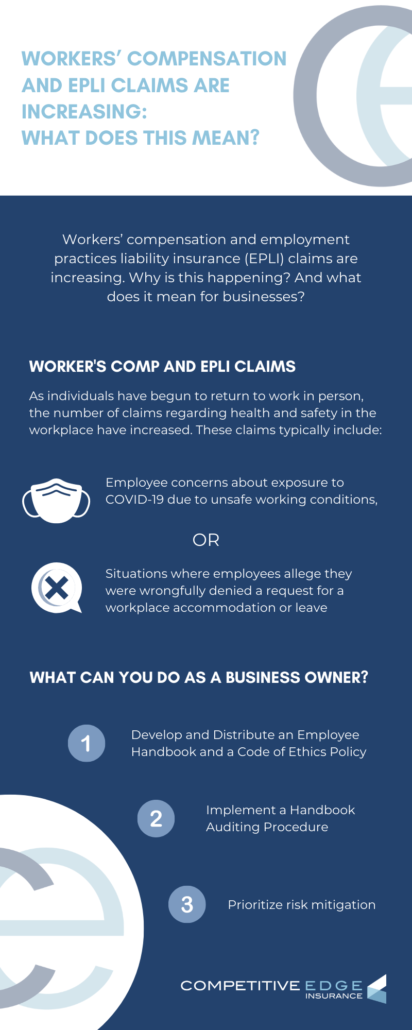
Workers’ compensation and employment practices liability insurance (EPLI) claims are increasing across the board. Why is this happening? And what does it mean for businesses?

Let’s discuss.

Workers’ Compensation and EPLI: Defined

Briefly, before diving in, we want to make sure that readers are familiar with both workers’ compensation and EPLI. Below is an abbreviated definition of each.

Workers’ Compensation Insurance

Workers’ compensation is insurance, paid by an employer. This coverage provides wage replacement and medical benefits to employees who are injured during while working for the insured. 

Wages and benefits are provided in exchange for eliminating the employee’s right to file a lawsuit against their employer’s negligence, and can help pay for:

  • Lost wages
  • Medical expenses
  • Rehabilitation costs
  • And more

Read on to understand the basics of workers’ compensation.

Employment Practices Liability Insurance

Employment practices liability insurance (EPLI) “provides coverage to employers against claims made by employees.” Policies typically extend coverage to the following:

  • Wrongful Termination
  • Sexual Harassment
  • Wage-Related Claims
  • Claims of Unequal or Unfair Pay
  • Discrimination Claims (i.e. age, race, gender, sexual orientation)
  • Third-Party Claims

For more information, read our EPLI article.

A Background on Workers’ Compensation and EPLI Claims

Over the past two years, the number of both workers’ compensation and EPLI claims have increased. In fact, research from the Equal Employment Opportunity Commission (EEOC) shows that EPLI claims have increased annually since 2003, with 37,632 workplace retaliation claims filed in 2020.

Moreover, as individuals have begun to return to work in person, the number of claims regarding health and safety in the workplace have increased as well. These claims typically include:

  1. Employee concerns about exposure to COVID-19 due to unsafe working conditions, or
  2. Situations where employees allege they were wrongfully denied a request for a workplace accommodation or leave

What Can You Do as a Business Owner?

So, with this rise in claims, what can you do to protect yourself as a business owner? You can prevent workers’ comp and EPLI claims by:

  • Developing and Distributing an Employee Handbook
  • Developing and Distributing a Code of Ethics Policy
  • Implementing a Handbook Auditing Procedure
  • Prioritizing risk mitigation

Interested in learning more about risk mitigation? Read on in our article “Risk Mitigation: What Is It and How Can You Do It?”

https://compedgeins.com/wp-content/uploads/2022/06/Workers-Compensation-and-EPLI-Claims-Are-Rising-What-Does-This-Mean.png 628 1200 https://compedgeins.com/wp-content/uploads/2020/11/logoweb.png 2022-07-03 07:00:002024-01-02 17:57:54Workers’ Compensation and EPLI Claims Are Rising: What Does This Mean?

How does Workers’ Compensation Insurance Work?

in General Business Insurance, High-Risk Insurance, News, Workers' Compensation

Picture this scenario: You’re at a construction site and a worker falls off the roof and falls and breaks their leg onto floor tiles, also breaking the tiles. What would be covered in that situation, the leg or the tiles? 

What is Workers’ Compensation Insurance?

Workers’ compensation insurance are policies that provide medical benefits and wage compensation to workers injured on the job, in exchange for eliminating their right to file a lawsuit against their employer’s negligence.

Workers’ compensation benefits are designed to help employees if they are unable to work, cover medical expenses, as well as other expenses and rehabilitation costs associated with disability or illness. As you look to explore workers’ compensation options, it’s important to look for one that provides adequate coverage and compensation for your employees.

When you invest in a properly designed policy, it ensures you and your employees remain financially secure. It’s also important to look at the specific benefits that are offered within your policy. Typical workers’ compensation insurance policies cover medical benefits.

So, the worker’s comp covers the worker’s injury for falling off the roof. 

What is Covered with Workers’ Compensation Insurance?

Specific workers’ compensation laws vary depending on your state; however, the most common compensation states that require workplace injury insurance include the following:

  • Payment for lost wages
  • Vocational rehabilitation
  • Permanent disability
  • Temporary disability
  • Medical costs and treatment 

Bonds 

One helpful way to understand this scenario is knowing the difference between performance and payment bonds.

Payment Bonds

In simple terms, a payment bond enforces that everything must be paid once a project is completed. Payment bonds are also surety bonds and are required for most state projects based on the Miller Act. 

The Miller Act was passed by the U.S. General Services Administration Public Buildings Service (GSA) with the intention to explain how payment bonds protect subcontractors and suppliers.

The GSA responds to any reports of nonpayment, following the legal action needed and protected by the Miller Act. The GSA states that “the Miller Act requires that prime contractors for the construction, alteration, or repair of Federal buildings furnish a payment bond for contracts in excess of $100,000.” 

Payment bonds additionally play a major role in construction. As an insurance company, we have relationships with carriers who understand the specifics of construction risk and can provide better solutions, better prices, and more comprehensive coverage—even for hard-to-place and high-risk companies.

Performance Bonds 

The main differentiator between payment and performance bonds is that a performance bond ensures the employer is satisfied with the job. While both are surety bonds, performance bonds can be helpful in industries apart from construction. 

A performance bond, according to Investopedia, “ensures the completion of a project. Setting these two together provides the proper incentives for laborers to provide a quality finish for the client.” 

Any type of bonding will cover e tiles or building materials that were broken.

Overview

If an employee falls off the roof and hurts their leg and breaks the tile, the  Workers comp covers the worker’s injury for falling off the roof. Bonding covers the broken tiles from his attempt not to fall off the roof. 

The first step is to show us under the hood so we can help you find the right carrier and coverage to protect your business today and always.

Read about Worker’s Compensation for Independent Contractors here. 

https://compedgeins.com/wp-content/uploads/2021/09/iStock-1202975142.jpg 1414 2120 https://compedgeins.com/wp-content/uploads/2020/11/logoweb.png 2021-10-24 17:06:002021-11-01 16:05:45How does Workers’ Compensation Insurance Work?

CATEGORIES

RECENT POSTS

  • Cyber Security Image by Anderson Piza at Envato Elements | Licensed
    6 Current Cyber Threats Companies Face: How to Stay Safe
  • Insurance Form Image by rfaizal707 at Envato ElementsEnvato Elements by rfaizal707
    Understanding the Hard Insurance Market and Its Impact on You
  • Black and White Photo of a man writing a contract
    EPLI: Does Your Construction Business Need It?

CONNECT WITH US

VIDEO POSTS

  • City view of commercial buildings, including skyscrapers surrounded by trees
    How to COPE in an Inflationary Environment
  • Coronado bridge aerial view
    Get to Know Our Founder: Her Rotary Involvement
  • Insurtech holographic image with man using ipad
    The Coverage Pitfalls of Insurtech
LET’S TALK

WANT TO KNOW HOW MUCH YOU COULD BE SAVING ON YOUR INSURANCE COSTS?

WANT TO KNOW HOW MUCH YOU COULD BE SAVING ON YOUR INSURANCE COSTS?

LET’S TALK

Connect With Us

Competitive Edge Insurance

LIC #0H31982

P: 619-259-5459
F: 619-377-0144

830 Orange Ave Suite L Coronado, CA 92118

Privacy Policy

Hours of Operation

Monday – Friday 8:00AM – 5:00PM

Saturday Closed

Sunday Closed

© Copyright 2021- Competitive Edge Insurance

site design by digitalstoryteller.io

© Copyright 2021- Competitive Edge Insurance
site design by digitalstoryteller.io

Scroll to top

This site uses cookies. By continuing to browse the site, you are agreeing to our use of cookies.

Accept settings

Cookie and Privacy Settings


How we use cookies

We may request cookies to be set on your device. We use cookies to let us know when you visit our websites, how you interact with us, to enrich your user experience, and to customize your relationship with our website.

Click on the different category headings to find out more. You can also change some of your preferences. Note that blocking some types of cookies may impact your experience on our websites and the services we are able to offer.

Essential Website Cookies

These cookies are strictly necessary to provide you with services available through our website and to use some of its features.

Because these cookies are strictly necessary to deliver the website, refusing them will have impact how our site functions. You always can block or delete cookies by changing your browser settings and force blocking all cookies on this website. But this will always prompt you to accept/refuse cookies when revisiting our site.

We fully respect if you want to refuse cookies but to avoid asking you again and again kindly allow us to store a cookie for that. You are free to opt out any time or opt in for other cookies to get a better experience. If you refuse cookies we will remove all set cookies in our domain.

We provide you with a list of stored cookies on your computer in our domain so you can check what we stored. Due to security reasons we are not able to show or modify cookies from other domains. You can check these in your browser security settings.

Google Analytics Cookies

These cookies collect information that is used either in aggregate form to help us understand how our website is being used or how effective our marketing campaigns are, or to help us customize our website and application for you in order to enhance your experience.

If you do not want that we track your visit to our site you can disable tracking in your browser here:

Other external services

We also use different external services like Google Webfonts, Google Maps, and external Video providers. Since these providers may collect personal data like your IP address we allow you to block them here. Please be aware that this might heavily reduce the functionality and appearance of our site. Changes will take effect once you reload the page.

Google Webfont Settings:

Google Map Settings:

Google reCaptcha Settings:

Vimeo and Youtube video embeds:

Other cookies

The following cookies are also needed - You can choose if you want to allow them:

Privacy Policy

You can read about our cookies and privacy settings in detail on our Privacy Policy Page.

Privacy Policy
Accept settings