Competitive Edge Insurance
  • Construction
  • Business
    • Health and Wellness Insurance
    • Cyber Liability
    • Bonding
    • General Business Insurance
    • EIDL Insurance Requirements
  • Personal Lines
    • Auto Insurance
    • Boat Insurance
    • Homeowners Insurance
  • About Us
  • Resources
    • Articles and Insights
    • Trusted Advisors
  • Contact
  • Menu Menu
  • LinkedIn
  • Instagram
  • Facebook
  • Youtube

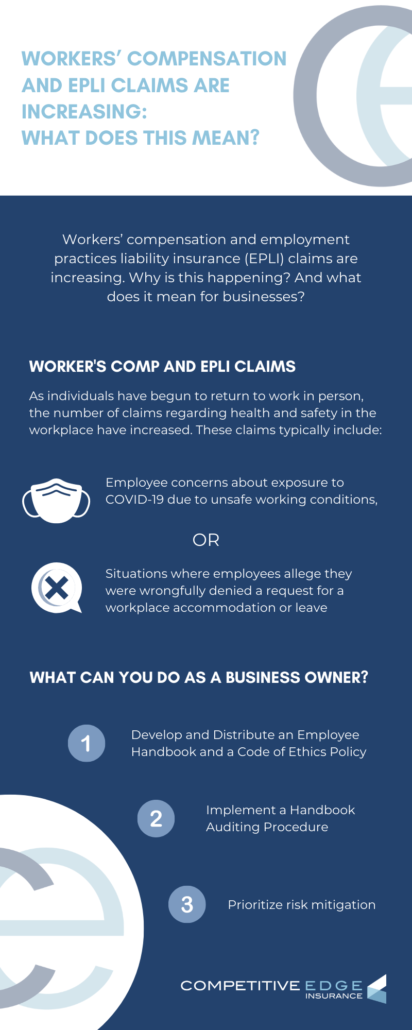
Workers’ Compensation and EPLI Claims Are Rising: What Does This Mean?

in News

Workers’ compensation and employment practices liability insurance (EPLI) claims are increasing across the board. Why is this happening? And what does it mean for businesses?

Let’s discuss.

Workers’ Compensation and EPLI: Defined

Briefly, before diving in, we want to make sure that readers are familiar with both workers’ compensation and EPLI. Below is an abbreviated definition of each.

Workers’ Compensation Insurance

Workers’ compensation is insurance, paid by an employer. This coverage provides wage replacement and medical benefits to employees who are injured during while working for the insured. 

Wages and benefits are provided in exchange for eliminating the employee’s right to file a lawsuit against their employer’s negligence, and can help pay for:

  • Lost wages
  • Medical expenses
  • Rehabilitation costs
  • And more

Read on to understand the basics of workers’ compensation.

Employment Practices Liability Insurance

Employment practices liability insurance (EPLI) “provides coverage to employers against claims made by employees.” Policies typically extend coverage to the following:

  • Wrongful Termination
  • Sexual Harassment
  • Wage-Related Claims
  • Claims of Unequal or Unfair Pay
  • Discrimination Claims (i.e. age, race, gender, sexual orientation)
  • Third-Party Claims

For more information, read our EPLI article.

A Background on Workers’ Compensation and EPLI Claims

Over the past two years, the number of both workers’ compensation and EPLI claims have increased. In fact, research from the Equal Employment Opportunity Commission (EEOC) shows that EPLI claims have increased annually since 2003, with 37,632 workplace retaliation claims filed in 2020.

Moreover, as individuals have begun to return to work in person, the number of claims regarding health and safety in the workplace have increased as well. These claims typically include:

  1. Employee concerns about exposure to COVID-19 due to unsafe working conditions, or
  2. Situations where employees allege they were wrongfully denied a request for a workplace accommodation or leave

What Can You Do as a Business Owner?

So, with this rise in claims, what can you do to protect yourself as a business owner? You can prevent workers’ comp and EPLI claims by:

  • Developing and Distributing an Employee Handbook
  • Developing and Distributing a Code of Ethics Policy
  • Implementing a Handbook Auditing Procedure
  • Prioritizing risk mitigation

Interested in learning more about risk mitigation? Read on in our article “Risk Mitigation: What Is It and How Can You Do It?”

https://compedgeins.com/wp-content/uploads/2022/06/Workers-Compensation-and-EPLI-Claims-Are-Rising-What-Does-This-Mean.png 628 1200 https://compedgeins.com/wp-content/uploads/2026/08/Comp-Edge-ONLY-Color-Logo-300x59.jpg 2022-07-03 07:00:002024-01-02 17:57:54Workers’ Compensation and EPLI Claims Are Rising: What Does This Mean?

Insurance Requirements for Business Owners

in EIDL, General Business Insurance, News

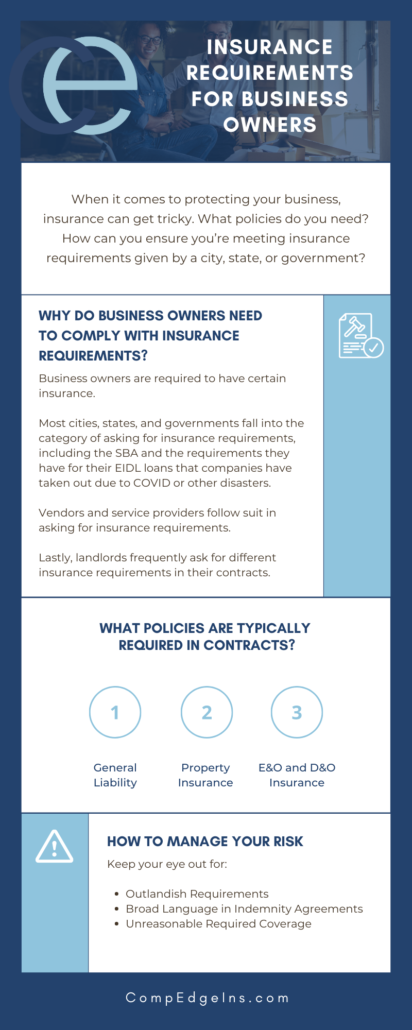
When it comes to protecting your business, insurance can get tricky. What policies do you need? How can you ensure you’re meeting insurance requirements given by a city, state, or government?

Don’t worry—Here we have Brenda Jo Robyn, Founder of Competitive Edge Insurance, on camera to discuss standard insurance requirements for business owners. Let’s dive in!

Why Do Business Owners Need to Comply with Insurance Requirements?

Business owners are required to have certain insurance.

Most cities, states, and governments fall into the category of asking for insurance requirements, including the SBA and the requirements they have for their EIDL loans that companies have taken out due to COVID or other disasters.

Vendors and service providers follow suit in asking for insurance requirements.

Lastly, as you might imagine, landlords frequently ask for different insurance requirements in their contracts. Anytime real property is part of a professional relationship, these requirements ensue.

What Policies Are Typically Required in Contracts?

Below is a general list of four policies you might see in a contract in terms of insurance requirements.

General Liability

The number one policy that’s required is general liability.

This type of insurance policy protects a third party in the event that there’s a bodily injury or property damage claim to your products or services that you provide for them.

General liability, for example, would also include this scenario: Let’s say you have someone come into your office (you’re either renting a space or the whole building). Then, this someone trips on your carpet and falls as they’re coming in. 

General liability would be the number one policy to make sure that you have your requirements buttoned up.

Property Insurance

The next policy would be property insurance. If someone is renting their property to you, they want to ensure that it’s covered in case of a loss.

If you’re a restaurant, for example, you could imagine you’re in someone else’s building. You need to make sure not only that you have the safety elements in place (i.e. fire suppression) but also insurance for the owner of the building, should something happen.

Professional Errors and Omissions (E&O) Insurance

Professional errors and omission (E&O) insurance come into play when there’s a failure in services or technology that you might be providing. The policy will provide the company with a way to make the client whole after an error that results from this mishap or financial loss occurs.

Directors and Officers (D&O) Liability Insurance

Directors and officers (D&O) liability insurance might come into play for a business owner as well.

This type of policy is typically required by investors before they fund, and before becoming a board member. Remember, when you’re working with investors and funding, there’s a contract involved—so you’ll probably see this there.

How to Manage Your Risk as a Business Owner

So, now what do you do? Here comes the risk mitigation part.

A lot of times, you will see that most contracts ask for reasonable requirements—and it only makes sense they should have these protections in place.

We recommend, however, that you keep your eye out for these elements in order to best manage risk.

Outlandish Requirements

There are times, however, that you see outlandish requirements. Brenda Jo reminds us that these need to come up as a big red flag for you. An example of an outlandish requirement would be an unusually high minimum occurrence or aggregate limits or policies that are unrelated to the scope of the contract.

Broad Language in Indemnity Agreements

Look at broad language within the indemnity agreement that works in their favor, and not in yours. Moreover, there is such a thing as being too broad.

Remember, indemnity agreement language should always be reviewed by your attorney.

Unreasonable Required Coverage

This is a big one!

If you’re the party in the contract that the insurance requirements are being imposed upon—in construction, typically the contractor or subcontractor—it’s important to confirm that the required coverage terms are either included in your current insurance program or can be purchased at a reasonable price.

Ideally, you’ve had your broker review the contract before you sign it so that they can let you know what might be remiss in the requirements that are being put in front of you, and what you might need to purchase.

Then, is the purchase of new insurance more than what would be justified for this amount of a contract? For instance, if your contract is $25,000, and you’re required to purchase additional insurance for $5,000, does that make sense? Is this something that you can write out of the contract? Or, do you need to rework your bid?

Then, what level of insurance is necessary for each of the different policies? Do the policies make sense regarding the contract or the scope of work? For any new requirements or endorsements that need to be added, are they reasonable, and are they reasonably priced?

Interested in learning more? Read on to learn about complying with insurance requirements for construction, manufacturing, and tech start-ups.

https://compedgeins.com/wp-content/uploads/2022/05/Insurance-Requirements-for-Business-Owners.png 628 1200 https://compedgeins.com/wp-content/uploads/2026/08/Comp-Edge-ONLY-Color-Logo-300x59.jpg 2022-06-12 07:00:002024-01-02 17:57:55Insurance Requirements for Business Owners

Property Owners: What Commercial Insurance Do You Need?

in General Business Insurance, News

As a commercial property owner, do you know what types of commercial insurance you need to keep yourself and your building protected? Let’s discuss the five types of coverage you should consider.

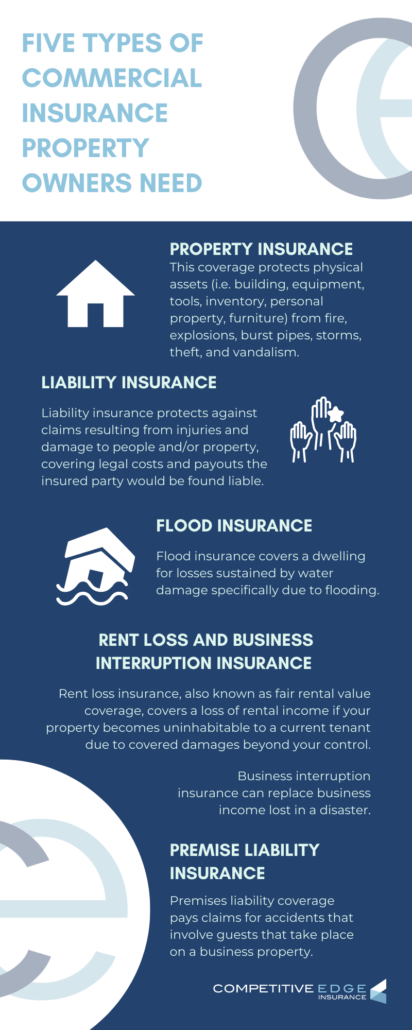
Five Types of Commercial Insurance Property Owners Need

At the minimum, there are five types of commercial insurance a property owner should be carrying. 

Property Insurance

This one most likely came up as a no-brainer.

Commercial property insurance, according to Nationwide, protects “physical assets [i.e. building, equipment, tools, inventory, personal property, furniture] from fire, explosions, burst pipes, storms, theft, and vandalism.”

It’s good to note that natural disasters like earthquakes and floods aren’t typically included in commercial property insurance policies; however, they can be added to a policy.

So, how much will property insurance cost you? It depends. Some factors that might contribute to the premium you pay include:

  • Location
  • Building materials used to construct your property
  • Industry
  • Your building’s level of theft and fire protection

Liability Insurance

As a property owner, you also need liability insurance. This type of coverage protects against “claims resulting from injuries and damage to people and/or property [and] covers legal costs and payouts for which the insured party would be found liable,” according to Investopedia. Intentional damage, contractual liabilities, and criminal prosecution are not covered by liability insurance coverage.

Rent Loss Insurance and/or Business Interruption Insurance

Rent loss insurance, also known as fair rental value coverage, is for landlords and “covers a loss of rental income if your property becomes uninhabitable to a current tenant due to covered damages beyond your control.”

An example of this damage might include perhaps a tree falling on the roof of your property or a burst pipe.

Business interruption insurance, on the other hand, is coverage that can replace “business income lost in a disaster.” This disaster might include a fire or natural disaster.

Business interruption insurance, however, is sold as an add-on; not as a standalone policy.

Flood Insurance

Heavy or prolonged rain, melting snow, coastal storm surges, blocked storm drainage systems, or levee dam failure… Oh my! All of these scenarios can cause flooding in your commercial property.

(And secret’s out… Water damage isn’t as cheap to repair as you think it is! Water damage can cost a business owner anywhere from $5,000 to $50,000…)

The solution? Flood insurance is a type of property insurance “that covers a dwelling for losses sustained by water damage specifically due to flooding,” according to Investopedia.

Premises Liability Insurance

Premises liability coverage pays claims for accidents that involve guests that take place on a business property. Regardless, a property owner, by law, is responsible to make appropriate efforts to ensure those visiting their property are entering a safe environment.

Of course, this is not a comprehensive list of all the commercial insurance you might need as a property owner. The coverage necessary will vary depending on your industry, location, etc.

What Happens If You’re Underinsured?

So, what happens if your coverage doesn’t cover what you need? Well, here Brenda Jo Robyn, Founder of Competitive Edge Insurance provides an example.

[Insert Video: https://drive.google.com/file/d/1MV72vxmwmHykFSiALeteiCjp_wjkbqrT/view?usp=sharing]

According to Brenda Jo, some individuals are having difficulty placing property coverage for a building. Why? Because many buildings today now have solar panels.

Interestingly enough in some of these cases, the property inside the building is actually worth more than the building itself.

“So, now you have solar panels, which introduces a possibility of a leak. The panels may be installed perfectly; but in California, you have earth movement and water can intrude over time. 

“I see many companies approaching California building owners who have flat roofs, selling them solar panels because then they can self-generate electricity for the building and gather back income.

If you have a manufacturing unit inside a building that has property that’s worth more than the building itself, that’s now an issue in California because of the potential for earth movement and therefore, weather intrusion.”

This weather intrusion poses an issue for a building owner looking to get insured. It’s important to consult your broker prior to investing in commercial property, or commercial property enhancements, as it could lead to greater issues down the line. 

Want to find out if you need to up your coverage? Read on in “How Does a Business Owner Know If They Are Underinsured?”

https://compedgeins.com/wp-content/uploads/2022/05/Property-Owners-What-Commercial-Insurance-Do-You-Need-1.png 628 1200 https://compedgeins.com/wp-content/uploads/2026/08/Comp-Edge-ONLY-Color-Logo-300x59.jpg 2022-05-29 07:00:002024-01-02 17:57:55Property Owners: What Commercial Insurance Do You Need?

Complying with Insurance Requirements: Construction, Manufacturing, Tech Start-Ups

in Construction, News

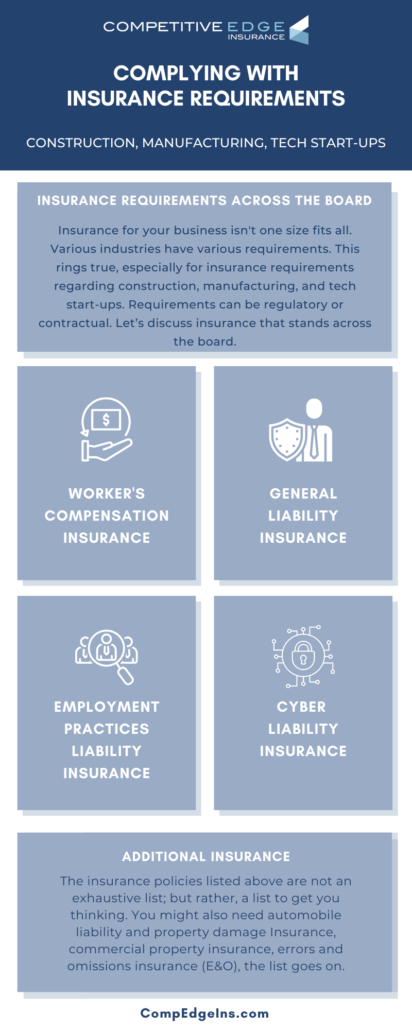
Insurance for your business isn’t one size fits all. As we’ve well learned, various industries have different requirements. This rings true, especially for insurance requirements regarding construction, manufacturing, and even tech start-ups.

Requirements can be regulatory or contractual. Moreover, depending on your industry you might need varying levels and types of insurance. Let’s discuss some aspects that stand across the board.

Workers’ Compensation Insurance

Workers’ compensation insurance, purchased by employers, is insurance that covers the medical costs and lost wages for employees who are injured during the course of work for the insured.

Workers’ compensation benefits and wages are provided in exchange for eliminating the employee’s right to file a lawsuit against their employer’s negligence.

Workers’ compensation insurance is required by law in California, and can help pay for:

  • Immediate medical costs (i.e. emergency room expenses)
  • Ongoing medical costs (i.e. physical therapy)
  • Partial lost wages while the employee is unable to work

Lack of proper coverage can result in fines and even criminal exposure. 

Workers’ compensation insurance is extra important in the construction and manufacturing settings, where accidents are more likely to occur. This considered, businesses within the construction and manufacturing industries might opt for higher levels of workers’ compensation to keep their employees and business safe.

General Liability Insurance

General liability insurance (GLI), also known as business liability insurance or commercial general liability insurance, “helps protect your business from claims of bodily injury or property damage that can come up during normal business operations.”

This is important for construction and manufacturing businesses where hands-on work is occurring but also for tech start-ups. According to Insureon, general liability insurance covers “the cost of legal fees and settlements if your company is sued for:

  • Client injuries
  • Client property damage
  • Advertising injuries, like copyright infringement, libel, and slander

General liability insurance is often required as part of a property lease, mortgage, or client contract.” Moreover, the cost of your GLI will depend on the level of risk your company faces.

If you don’t have GLI, medical expenses and property damages will need to be paid for out of pocket. Depending on the injury or event, not investing in general liability insurance could cost you your business.

Employment Practices Liability Insurance

Employment Practices Liability Insurance (EPLI) is insurance that “provides coverage to employers against claims made by employees.”

Claims can be made for an assortment of reasons, including:

  • Wrongful Termination
  • Sexual Harassment
  • Wage-Related Claims
  • Claims of Unequal or Unfair Pay Discrimination Claims (i.e. age, race, gender, sexual orientation)
  • Third-Party Claims
  • And more

The primary industries that are susceptible to EPLI claims include healthcare, professional services, restaurant, food services, retail, and manufacturing and construction.

Read on to find out if your construction business needs EPLI.

Cyber Liability Insurance

In our digital age today, more businesses than ever are falling victim to cyber-attacks. Having a cyber liability policy in place, for any business, is crucial to keeping your business and your clients safe. This stands even more true for tech start-ups that manage sensitive information and high volumes of data.

There is both first and third-party coverage available. Implementing a quality cyber liability policy can help pay for regulatory fines and penalties, credit and fraud monitoring services, crisis management and public relations, finding and addressing the security defect, and more.

Complying with Insurance Requirements

Complying with Insurance Requirements: Things to Note

The insurance policies listed above are not, of course, an exhaustive list of insurance requirements all construction, manufacturing, and tech start-ups need to meet; but rather, a list to get you thinking about insuring your business.

You might also need automobile liability and property damage Insurance, commercial property insurance, errors and omissions insurance (E&O), the list goes on.

Regardless, there are additional elements to consider regarding insuring any one of these three businesses. Let’s discuss some final things to note.

Occupational Safety and Health Administration

The Occupational Safety and Health Administration, also known as OSHA, has particular requirements regarding insurance as well as health and safety practices for a variety of industries.

Visit the OSHA website for additional information.

Certificates of Insurance

In any project, it’s important to make sure you have the proper insurance to protect yourself and all parties involved.

Every contract with a vendor or a customer will have an indemnity or insurance section of what they want to see from you as far as insurance is concerned. This includes documents that extend your policy to cover them. Those requirements are contractually driven, which means a certificate is necessary.

A Certificate of Insurance (COI) gives a summary of what coverages someone has, whether it be general liability, workers’ compensation, or property. A COI can also include a description of coverages that might be there or attached; such as additional insured status or waivers of subrogation.

Read on for more on what you need to know about certificates of insurance.

Contract Wording

A written contract is a printed document that is legally binding and details what parties can or cannot do. For this reason, the contractual language is extremely important. Contracts for construction, manufacturing, and tech start-ups might include hold harmless clauses and/or indemnification clauses.

Hold Harmless Clause

What is a hold harmless clause? According to Investopedia, “a hold harmless clause is used to protect a party in a contract from liability for damages or losses. In signing such a clause, the other party accepts responsibility for certain risks involved in contracting for the service. In some states, the use of a hold harmless clause is prohibited in certain construction jobs.”

Indemnification Clause

An indemnification or indemnity clause protects “one party from liability if a third-party or third entity is harmed in any way. It’s a clause that contractually obligates one party to compensate another party for losses or damages that have occurred or could occur in the future.”

For this reason, the wording in such contracts must be crystal clear.

With the influx of remote employees in current and previous years, it’s important to consider how workers’ compensation policies might change. Read on for more information on what workers’ compensation looks like for remote employees.

https://compedgeins.com/wp-content/uploads/2022/04/Complying-with-Insurance-Requirements-Construction-Manufacturing-Tech-Start-Ups.png 628 1200 https://compedgeins.com/wp-content/uploads/2026/08/Comp-Edge-ONLY-Color-Logo-300x59.jpg 2022-05-22 19:00:002024-01-02 17:57:55Complying with Insurance Requirements: Construction, Manufacturing, Tech Start-Ups

How Does a Building Owner Know if They Are Underinsured?

in News

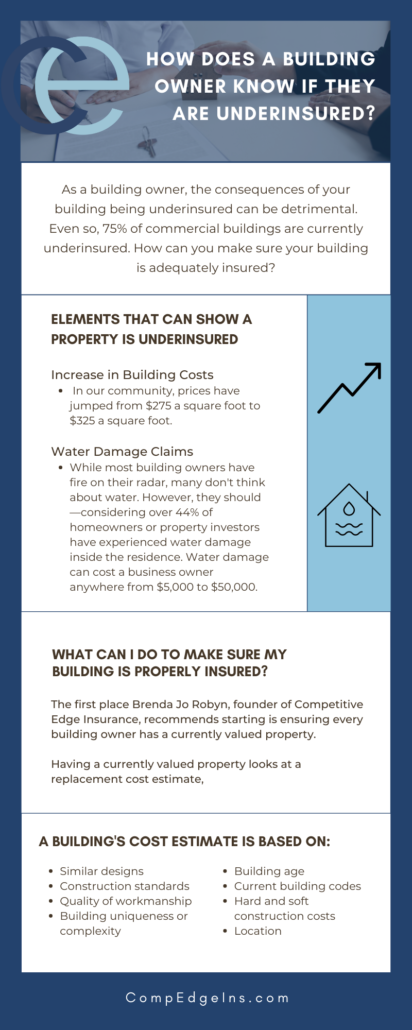
As a building owner, the consequences of your building being underinsured can be detrimental. Even so, 75% of commercial buildings are currently underinsured. As a building owner or property investor, how can you make sure your building is adequately insured?

Today, we have Brenda Jo Robyn, founder of Competitive Edge Insurance, on camera to answer this question. What elements can you look at to identify if you’re underinsured? What steps can you take to stay adequately insured?

Let’s see what she has to say.

Elements That Can Show a Property is Underinsured

Picture this: You have a building, but don’t know the last time it was evaluated in terms of a replacement cost. The building has most likely had some renovations in the last five to 10 years.

This considered, what elements do you need to look at to see if your building is underinsured?

Increase in Building Costs

As many have well noticed, the average cost of buildings has gone up. In our community, where the Competitive Edge office is housed, prices have jumped from $275 a square foot to $325 a square foot.

When you’re insuring your building, it’s really important to take this shift into consideration. Moreover, consider appraising the building for the replacement to rebuild from the ground up (but more on this later).

Water Damage Claims

Secondly, most building owners have little or no protection for water damage claims. Hold on… Don’t roll your eyes yet!

While most building owners have fire on their radar, many don’t think about water. However, they should—considering over 44% of homeowners or property investors have experienced water damage inside the residence.

Water damage can cost a business owner anywhere from $5,000 to $50,000. Today, we’re seeing more $50,000 to $75,000 claims being paid. And why is that? 

There are many ways this can happen. Imagine this scenario: A building owner goes away for the weekend, and there’s been a leak he or she doesn’t know about. Or, maybe it’s in a commercial building and a toilet is leaking into the floor below. Again, the owner is three to four days out, and all of a sudden now there’s mold. It may be in the walls and have to be remediated. It can be quite costly to repair that.

Regardless, many people have a mere $5,000 worth of water damage on their policy. It’s not enough.

What Can I Do to Make Sure My Building Is Properly Insured?

There’s one primary thing a building owner can and should do to ensure that their building is adequately insured.

Property Valuations

The first place Brenda Jo recommends starting is ensuring every building owner has a currently valued property.

Having a currently valued property looks at a replacement cost estimate, which no, it’s not intended to replace the original asset (unless it’s a reproduction), but the valuation is intended that the new building would be able to serve in the same purpose that the old building existed for.

Every building is unique. So, how do you calculate this cost estimate?

A building’s cost estimate is based on:

  • Similar designs
  • Construction standards
  • Quality of workmanship
  • Uniqueness or complexity (i.e. standard building vs. a super custom building)
  • Building age
  • Common elements
  • Current building codes
  • Hard construction costs (i.e. materials)
  • Soft construction costs (i.e. design plans, demolition costs)
  • Location (Is the building in the city or rural?)

Conducting an annual insurance review is also key, and takes little to no time.

It can be difficult to arrive at this figure yourself, which is why our team at Competitive Edge Insurance is here to help.

Now, we’ve talked about water… Let’s chat about protecting your building from fire. Read on to find out why you need fire insurance as a property investor.

https://compedgeins.com/wp-content/uploads/2022/04/How-Does-a-Building-Owner-Know-if-They-Are-Underinsured-2.png 628 1200 https://compedgeins.com/wp-content/uploads/2026/08/Comp-Edge-ONLY-Color-Logo-300x59.jpg 2022-05-08 19:00:002024-01-02 17:57:56How Does a Building Owner Know if They Are Underinsured?

Why Does My Business Need Cyber Insurance?

in Cyber Insurance, News

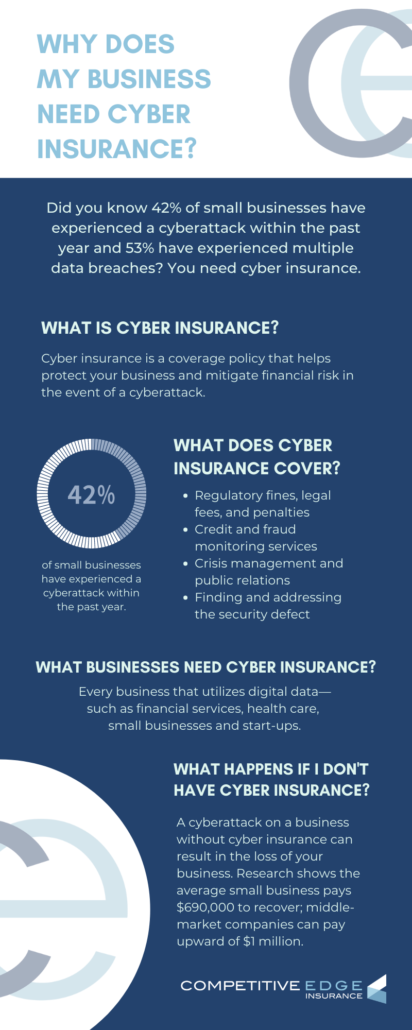
Did you know, according to Advisorsmith and Insurance Journal, 42% of small businesses have experienced a cyberattack within the past year and 53% have experienced multiple data breaches?

Cyberattacks target personally identifiable information, personal health data as well as confidential financial information and can result in significant and often devastating financial loss for your business. In fact, the National Cyber Security Alliance found that 60% of small businesses that fell victim to a cyberattack were forced to close within six months due to the high financial costs necessary to recover.

Read our full guide on why your business needs cyber insurance, as well as how you can protect your business from these risks below.

What is Cyber Insurance?

Cyber insurance is a coverage policy that helps protect your business and mitigate financial risk in the event of a cyberattack. Retrieving your company data and rebuilding your systems is time-consuming and costly. 

In addition, the loss of time and productivity, when a data breach does occur can damage your credit, damage your reputation with customers, cost you in service providers restructuring your security, and prevent further losses and possible penalties for improper handling of sensitive financial data.

What Does Cyber Insurance Cover?

Coverage can vary depending on the policy, however, cyber insurance generally covers: 

  • Regulatory fines, legal fees, and penalties
  • Credit and fraud monitoring services
  • Crisis management and public relations
  • Finding and addressing the security defect
  • Notifying customers of a data breach
  • Restoring personal identities of affected customers
  • Recovering compromised data
  • Repairing damaged computer systems

What Businesses Need Cyber Insurance?

Every business that uses digital data—such as saving client information to your network or cloud—needs cyber insurance. However, some businesses are more heavily targeted by cybercriminals because of their valuable data and resources, such as:

Financial Services

According to Business Insider, financial firms are 300 times more likely to be targeted than other companies. Wow!

Financial services are specifically targeted because of their access to financial accounts and/or services such as allowing customers to pay bills online, transfer funds, and view account balances.

Financial institutions including the Securities and Exchange Commission, Equifax, HSBC, Lloyds Banking Group, JPMorgan as well as many other firms have all experienced cyber breaches and attacks.

Health Care

Health care organizations are responsible for significant amounts of sensitive information and, as a result, could potentially put the private records of millions of patients at risk. HIPAA Journal reports that 89% of healthcare organizations have experienced a data breach.

Small Businesses and Start-Ups

Small businesses are often targeted by cybercriminals because of their limited resources and lack of security expertise. According to the National Cyber Security Alliance, 83% of small businesses have no formal cyber security plan and 69% have no plan at all.

What Happens to My Business If I Don’t Have Cyber Insurance?

A cyberattack on a business without cyber insurance can result in the loss of hundreds of thousands of dollars between:

  • Various legal fees and fines
  • Recovery of compromised data
  • Damaged computer systems
  • And other necessary costs

According to the Ponemon Institute, the average small business pays $690,000 to recover from a cyber-attack, whereas middle-market companies can pay upward of $1 million.

Due to the devastating financial fallout, many businesses that experience a cyberattack without cyber insurance can’t recover and are forced to permanently close their doors. 

Cyber insurance is a rapidly growing space and constantly evolving to fit the needs of any business. With the right policy, you can protect your business from the high costs and destructive effects of a cyberattack.

To learn more, read on for seven steps to avoid cyber security threats.

https://compedgeins.com/wp-content/uploads/2022/04/Why-Does-My-Business-Need-Cyber-Insurance.png 628 1200 https://compedgeins.com/wp-content/uploads/2026/08/Comp-Edge-ONLY-Color-Logo-300x59.jpg 2022-05-01 19:00:002024-01-02 17:57:56Why Does My Business Need Cyber Insurance?

Why Do I Need Fire Insurance as a Property Investor?

in General Business Insurance, News

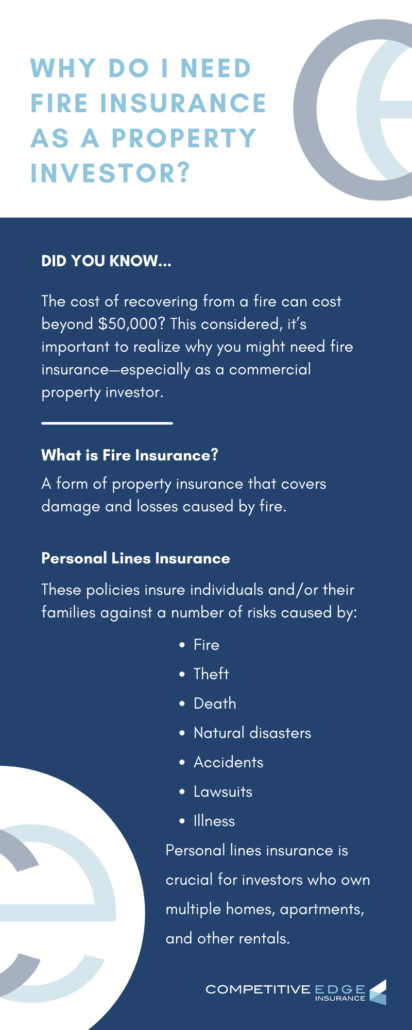
According to The National Fire Protection Association (NFPA), U.S. fire departments responded to about 353,100 house fires from 2014 to 2018. Moreover, the cost of recovering from a fire can range anywhere from $3,000 for a small fire and beyond $50,000 for larger fires.

This considered, it’s important to consider why you might need fire insurance—especially as a commercial property investor. Let’s discuss.

What is Fire Insurance?

Fire insurance is defined as “a form of property insurance that covers damage and losses caused by fire.” Although most homeowners’ policies come with some form of fire protection, additional coverage is often considered in the case that property is lost or damaged due to fire.

The topic of fire insurance is especially important for those who own investment properties. How many investment properties you own, could determine whether or not you’re able to use personal lines of insurance to cover fire-related issues.

Personal Lines Insurance

What is personal lines insurance? Personal lines insurance refers to any insurance that covers against “loss that results from death, injury, or loss of property.” These policies insure individuals and/or their families against a number of personal (and therefore, financial) risks caused by:

  • Fire
  • Theft
  • Death
  • Natural disasters
  • Accidents
  • Lawsuits
  • Illness


Personal lines insurance is especially crucial for investors that may own multiple homes, apartments, and other rentals. Whether it be a wildfire or house fire, consider how much a property investor has to lose when it comes to this type of natural disaster.

As an investor, you need to be sure that your interests are fully insured. We can help you achieve this at Competitive Edge Insurance.

Insuring Your Personal Property

Today, the costs for insurance—fire insurance included—are increasing significantly. Regardless, insuring your property is extremely important. As we’ve mentioned, this is especially true for individuals who own investment properties; both commercial and residential.

There are many insurance options out there. Personal lines include:

  • Single-family homes
  • Individual condominium units
  • Temporary rental properties
  • Multi-family properties from one to four units.

Investment property insurance varies on a property-by-property basis and can be written on either a personal or a commercial policy. If you own fewer than 4 properties, you can use personal insurance policies—even though it’s your business.

Whether you’re an investor yourself, or an attorney or financial planner working with clients who invest in property, you must be sure these investments are fully insured without umbrellas so that the total limits of liability exceeds your property assets. 

Remember: All costs are going up, so property owners must plan accordingly.

This is an especially difficult pill for property owners and landlords to swallow. Although insurance is going up, you can’t increase rent by more than five to seven percent to bridge this gap.

For more information on how to insure your property, contact our team of experts at Competitive Edge Insurance. Until then, read up to find out what your homeowners insurance covers.

https://compedgeins.com/wp-content/uploads/2022/04/Why-Do-I-Need-Fire-Insurance-as-a-Property-Investor-1.png 628 1200 https://compedgeins.com/wp-content/uploads/2026/08/Comp-Edge-ONLY-Color-Logo-300x59.jpg 2022-04-24 07:00:002024-01-02 17:57:56Why Do I Need Fire Insurance as a Property Investor?

How to Protect Your Business From a Fire

in California, General Business Insurance, News

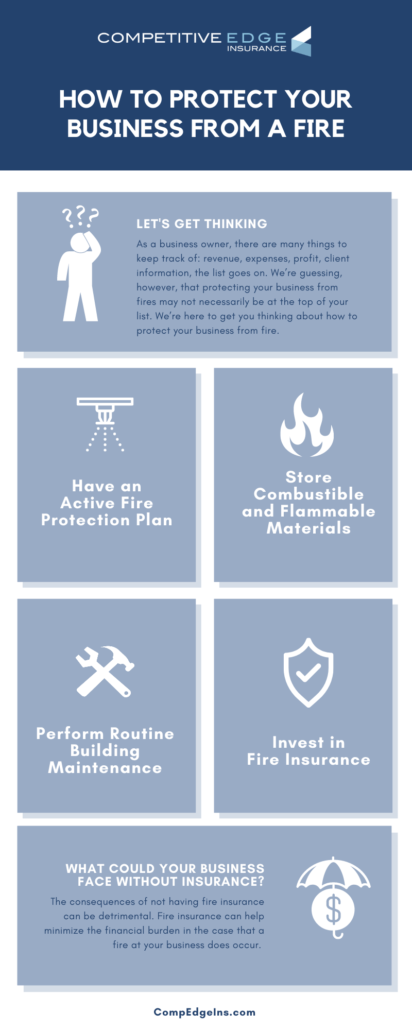
As a business owner, there are many things to keep track of: revenue, expenses, profit, client information, the list goes on. We’re guessing, however, that protecting your business from fire isn’t at the top of your list. We’re here to get you thinking about how to protect your business from fire.

Tips on Protecting Your Business from a Fire

Fire season is right around the corner. So, what can you do to protect your business? At Competitive Edge Insurance, we have a few strategies in mind.

Have an Active Fire Protection Plan

Ensure your business has an active fire protection plan in place. An active fire protection plan includes water spray systems, deluge systems, sprinkler systems, fire water monitors, etc. Make sure that all of these systems are tested and in good working order (functioning with fresh batteries, etc.)

An evacuation plan should be crafted and distributed to all employees. Perform practice drills with your team members to ensure everyone understands their role in the event of an emergency.

Spring Cleaning

Spring cleaning is important! When it comes to fire protection, this might look like:

  • Carefully storing combustible and flammable materials
  • Cleaning the perimeter of your building (i.e. eliminating dry brush and quick-burning foliage)

Read more in this article from VFS Fire & Security Services for everything you need to know on prepping the outside of your commercial building for summer.

Perform Routine Building Maintenance

The last thing you need during an evacuation is a blocked walkway or doorway. Ensure all fire lanes are clear and access to fire hydrants is unobstructed.

Moreover, the address of your building should be visible from the street in the event that emergency personnel are called onto the scene.

Invest in Fire Insurance

Fire insurance is defined as “a form of property insurance that covers damage and losses caused by fire.” Although most homeowners’ policies include some amount of fire protection, additional coverage is often considered in the event that property is lost or damaged due to fire.

What Could Your Business Face Without Fire Insurance?

The consequences of not having fire insurance can be detrimental considering your business is likely one of your largest assets.

Fire insurance can be essential depending on where you live. For example, in California, we’ve seen an uptick in wildfires in recent years, according to the California Air Resources Board. In fact, the area burned by California wildfires has been increasing each year since 1950. Eight of the state’s historical 20 largest wildfires have occurred since 2017.

Fire insurance can help minimize the financial burden in the event that a fire at your business does occur. For more information on how to insure your property, contact our team of experts at Competitive Edge Insurance. Until then, read up on risk mitigation for property investors.

https://compedgeins.com/wp-content/uploads/2022/04/How-to-Protect-Your-Business-From-a-Fire.png 628 1200 https://compedgeins.com/wp-content/uploads/2026/08/Comp-Edge-ONLY-Color-Logo-300x59.jpg 2022-04-03 07:00:002022-07-22 13:13:47How to Protect Your Business From a Fire

OSHA’s Consultation Services: What You Need to Know

in High-Risk Insurance, News

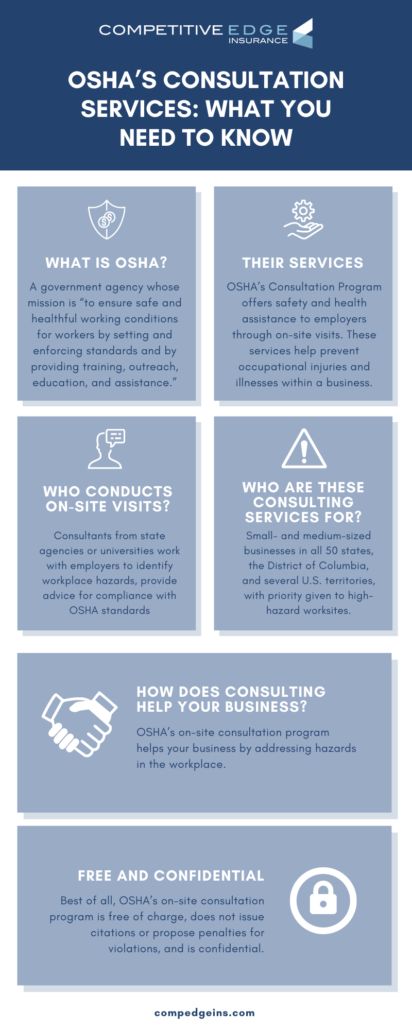
The Occupational Safety and Health Administration (OSHA) is a government agency whose mission is “to ensure safe and healthful working conditions for workers by setting and enforcing standards and by providing training, outreach, education and assistance.”

Congress created OSHA with the Occupational Safety and Health Act of 1970.

Over the years, OSHA has continued to stay dedicated to its mission, which has resulted in the creation of its ‘On-Site Consultation Program.’ Here’s more on OSHA’s consultation services and how these services can help high-risk businesses.

OSHA’s On-Site Consultation Program: What Is It?

OSHA’s Consultation Program offers safety and health assistance to employers through on-site visits. These services help prevent occupational injuries and illnesses within a business.

Who Conducts On-Site Visits?

According to their website, “consultants from state agencies or universities work with employers to identify workplace hazards, provide advice for compliance with OSHA standards, and assist in establishing and improving safety and health programs.”

Who are these Consulting Services Offered to?

According to their website, OSHA “offers no-cost and confidential occupational safety and health services to small- and medium-sized businesses in all 50 states, the District of Columbia, and several U.S. territories, with priority given to high-hazard worksites.”

How Does OSHA Consulting Help Your Business?

OSHA’s on-site consultation program helps your business by addressing hazards in the workplace.

Additionally, during an on-site visit OSHA consultants:

  • “Suggest general approaches or options for solving a safety or health problem
  • Identify kinds of help available if you need further assistance
  • Provide you a written report summarizing findings
  • Assist you to develop or maintain an effective safety and health programs
  • Provide training and education for you and your employees”

These steps help reduce injury and illness rates, lower workers’ compensation costs, improve worker morale, and increase productivity.  As well as helping to identify, analyze, and remove hazards, use safer work practices, improve safety programs, strengthen safety culture, and provide training assistance, according to the California Department of Industrial Relations.

Best of all, OSHA’s on-site consultation program is free of charge. Throughout this consultation, OSHA does not issue citations or propose penalties for violations, and it is confidential. “Your name, your firm’s name, and any information you provide about your workplace, plus any unsafe or unhealthful working conditions that the consultant uncovers, will not be reported routinely to the OSHA inspection staff,” according to OSHA’s site.

What Does a Consultation Include?

On-site visits might include:

  • Hazard Assessments via walkthrough (find and fix hazards)
  • Industrial Hygiene Surveys (i.e. noise surveys, chemical exposure assessments)
  • Safety and Health Program Assessments
  • Workers’ Training and Education
  • And more

Interested in learning more about OSHA’s on-site consultation program? Download their small business handbook, which is chock full of information and self-inspection checklists.

https://compedgeins.com/wp-content/uploads/2022/02/OSHAs-Consultation-Services-What-You-Need-to-Know-1.png 628 1200 https://compedgeins.com/wp-content/uploads/2026/08/Comp-Edge-ONLY-Color-Logo-300x59.jpg 2022-03-20 07:00:002022-02-25 10:58:57OSHA’s Consultation Services: What You Need to Know

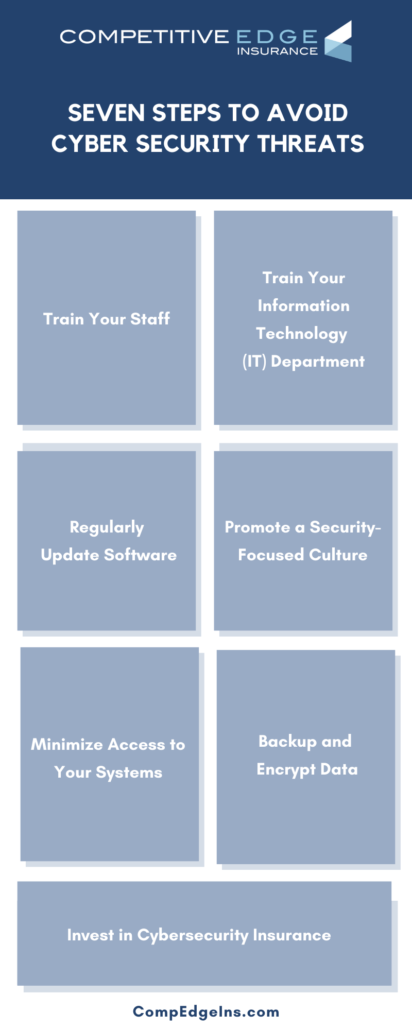
Seven Steps to Avoid Cyber Security Threats

in Cyber Insurance, General Business Insurance, News

Cyber security is more important today than ever before. Many businesses, especially small businesses, are the victims of cyber attacks daily—and the outcome for many is detrimental. In fact, did you know that 60% of small businesses who fall victim to cyber attack close their doors within six months?

The fact of the matter is that cyber threats—whether they be ransomware or phishing—are too grave to ignore the risks. Preparation and prevention are key to keeping your business safe. In this article, we’ll discuss seven steps to avoid cyber security threats.

Train Your Staff

First things first, train your employees. Make the guidelines of your business’s cyber security policy abundantly clear. Apart from training, employees should also be familiarized with and taught how to identify suspicious activity. Lastly, employees should know safe practices for sending and receiving data.

For example, they need to know how not to send excel spreadsheets in an email. Instead, create a zip file or convert the document into a PDF. Why? It is very easy to scrape data from an excel file while in an email.

Train Your IT

Your Information Technology (IT) department should additionally be trained. An IT department, according to Jobs.net, “oversees the installation and maintenance of computer network systems within a company.” They also help businesses maintain their digital infrastructure and provide troubleshooting.

This considered, IT departments need to know what to look for when it comes to cyber security threats.

Regularly Update Software

Firstly, your software should be particularly designed to block ransomware. Secondly, this software should be routinely updated.

To many people’s surprise, cyber attacks often happen when systems and/or software aren’t fully up-to-date, leaving room for weakness. These points of weakness are then exploited by cybercriminals to gain access to your network.

Don’t let it get to this point.

Promote a Security-Focused Culture

Forbes states that “the security culture of an organization is foundational to its ability to protect information, data and employee and customer privacy.”

(“Security culture” being “the ideas, customs and social behaviors of an organization that influence its security”).

According to Maryville University, encouraging a strong security culture within a business might look like:

  • Holding regular training sessions for employees to help them recognize external threats 
  • Teaching employees strategies for minimizing their risk of being hacked

Backup and Encrypt Data

Imagine, your business experiences a cyber attack—and none of your data is backed up. This would result in serious financial loss as well as loss of data, not to mention downtime.

Be sure to back up and encrypt your data instead. We advise you to encrypt:

  • Client and customer information
  • Employee information
  • And all other business data

Minimize Access to Your Systems

When it comes to allowing others access to your data, whether it be passwords, email, or a host of other personal information, some humans can lean a bit too far to the trustworthy side.

Having control over who can access your network is crucial—whether online or in-office. Better safe than sorry!

Invest in Cybersecurity Insurance

Of course, we have to mention the benefit of investing in cyber security insurance.

A cyber liability policy might include:

  • Data Breach Coverage
  • Business Interpretation Loss Reimbursement
  • Cyber Extortion Defense
  • Forensic Support
  • Legal Support
  • Coverage beyond a General Liability Policy

When it comes to cyber risk, there’s nothing worse than being ill-prepared. Read on to learn more about cyber coverage: how necessary is it?

https://compedgeins.com/wp-content/uploads/2022/02/Seven-Steps-to-Avoid-Cyber-Security-Threats-.png 628 1200 https://compedgeins.com/wp-content/uploads/2026/08/Comp-Edge-ONLY-Color-Logo-300x59.jpg 2022-03-13 07:00:002022-02-25 10:52:20Seven Steps to Avoid Cyber Security Threats
Page 3 of 7‹12345›»

CATEGORIES

RECENT POSTS

  • Cyber Security Image by Anderson Piza at Envato Elements | Licensed
    6 Current Cyber Threats Companies Face: How to Stay Safe
  • Insurance Form Image by rfaizal707 at Envato ElementsEnvato Elements by rfaizal707
    Understanding the Hard Insurance Market and Its Impact on You
  • Black and White Photo of a man writing a contract
    EPLI: Does Your Construction Business Need It?

CONNECT WITH US

VIDEO POSTS

  • City view of commercial buildings, including skyscrapers surrounded by trees
    How to COPE in an Inflationary Environment
  • Coronado bridge aerial view
    Get to Know Our Founder: Her Rotary Involvement
  • Insurtech holographic image with man using ipad
    The Coverage Pitfalls of Insurtech
LET’S TALK

WANT TO KNOW HOW MUCH YOU COULD BE SAVING ON YOUR INSURANCE COSTS?

WANT TO KNOW HOW MUCH YOU COULD BE SAVING ON YOUR INSURANCE COSTS?

LET’S TALK

Connect With Us

Competitive Edge Insurance

LIC #0H31982

P: 619-259-5459
F: 619-377-0144

830 Orange Ave Suite L Coronado, CA 92118

Privacy Policy

Hours of Operation

Monday – Friday 8:00AM – 5:00PM

Saturday Closed

Sunday Closed

© Copyright 2021- Competitive Edge Insurance Services

site design by digitalstoryteller.io

© Copyright 2021- Competitive Edge Insurance Services
site design by digitalstoryteller.io

Scroll to top

This site uses cookies. By continuing to browse the site, you are agreeing to our use of cookies.

Accept settings

Cookie and Privacy Settings


How we use cookies

We may request cookies to be set on your device. We use cookies to let us know when you visit our websites, how you interact with us, to enrich your user experience, and to customize your relationship with our website.

Click on the different category headings to find out more. You can also change some of your preferences. Note that blocking some types of cookies may impact your experience on our websites and the services we are able to offer.

Essential Website Cookies

These cookies are strictly necessary to provide you with services available through our website and to use some of its features.

Because these cookies are strictly necessary to deliver the website, refusing them will have impact how our site functions. You always can block or delete cookies by changing your browser settings and force blocking all cookies on this website. But this will always prompt you to accept/refuse cookies when revisiting our site.

We fully respect if you want to refuse cookies but to avoid asking you again and again kindly allow us to store a cookie for that. You are free to opt out any time or opt in for other cookies to get a better experience. If you refuse cookies we will remove all set cookies in our domain.

We provide you with a list of stored cookies on your computer in our domain so you can check what we stored. Due to security reasons we are not able to show or modify cookies from other domains. You can check these in your browser security settings.

Google Analytics Cookies

These cookies collect information that is used either in aggregate form to help us understand how our website is being used or how effective our marketing campaigns are, or to help us customize our website and application for you in order to enhance your experience.

If you do not want that we track your visit to our site you can disable tracking in your browser here:

Other external services

We also use different external services like Google Webfonts, Google Maps, and external Video providers. Since these providers may collect personal data like your IP address we allow you to block them here. Please be aware that this might heavily reduce the functionality and appearance of our site. Changes will take effect once you reload the page.

Google Webfont Settings:

Google Map Settings:

Google reCaptcha Settings:

Vimeo and Youtube video embeds:

Other cookies

The following cookies are also needed - You can choose if you want to allow them:

Privacy Policy

You can read about our cookies and privacy settings in detail on our Privacy Policy Page.

Privacy Policy
Accept settings