Competitive Edge Insurance
  • Construction
  • Business
    • Health and Wellness Insurance
    • Cyber Liability
    • Bonding
    • General Business Insurance
    • EIDL Insurance Requirements
  • Personal Lines
    • Auto Insurance
    • Boat Insurance
    • Homeowners Insurance
  • About Us
  • Resources
    • Articles and Insights
    • Trusted Advisors
  • Contact
  • Menu Menu
  • LinkedIn
  • Instagram
  • Facebook
  • Youtube

Will Homeowners Insurance Cover a Construction Project?

in Construction, News

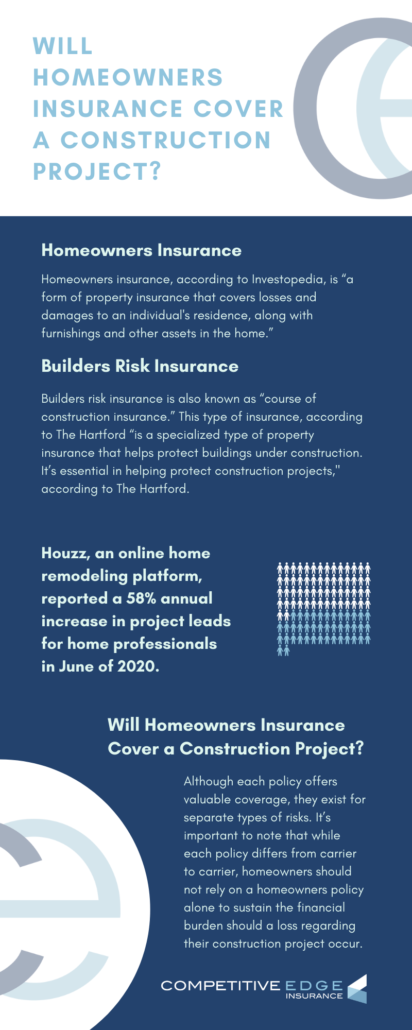
So, you want to do a renovation or some construction on your home. Well, you’re not the only one! According to various studies, home remodeling has been hotter than ever during the COVID-19 pandemic. In fact, Houzz, an online home remodeling platform, reported a 58% annual increase in project leads for home professionals in June of 2020.

We don’t blame any of you homeowners for wanting to spruce things up, especially considering all the extra time many individuals and families have been spending at home the past two years.

When tackling a construction project on your property, however, it’s important to consider the bandwidth of your homeowners insurance. Is it enough? Or, should you consider investing in builders risk insurance as well?

Homeowners Insurance vs. Builders Risk Insurance

First things first, what’s the difference?

Homeowners Insurance

Homeowners insurance is defined as “a form of property insurance that covers losses and damages to an individual’s residence, along with furnishings and other assets in the home.”

It’s important to note that every homeowners insurance policy has a liability limit. This liability limit “determines the amount of coverage the insured has should an unfortunate incident occur.”

Homeowners insurance is typically used to repair or replace your home and its contents in the event of damage.

Builders Risk Insurance

Builders risk insurance, on the other hand, is not quite the same. Builders risk insurance is also known as “course of construction insurance.”

Hence its name, this type of insurance, is a type of property insurance that protects your home, or other buildings that are under construction. This coverage is essential to protecting projects from property damage that occurs due to:

  • Fire
  • Lightning
  • Hail
  • Explosions
  • Theft
  • Vandalism
  • Acts of God, for example, hurricanes

Builders risk insurance is a crucial part of a homeowner’s risk management strategy.

Will Homeowners Insurance Cover a Construction Project?

Is your homeowners insurance enough?

Whether you’re considering a from-the-ground-up construction project, kitchen or bathroom remodeling, or even room addition, there’s nothing more important than making sure you have the proper coverage.

Although each policy offers valuable coverage, they exist for separate types of risks. It’s important to note that while each policy will, of course, differ from carrier to carrier, homeowners should not rely on a homeowners policy alone to sustain the financial burden should a loss regarding their construction project occur.

After all, if homeowners insurance and builders risk insurance both covered the same risks, there would be no need for each to exist.

As a general rule, homeowners insurance covers damage to a property already in tact; builders risk covers damage to a property that is under construction.

Obtain the Coverage You Need

By consulting with an insurance broker prior to beginning a construction project on your home, you can learn all about gaps in homeowners insurance and where you may need additional coverage depending on your unique policy.

If you’re considering a project of your own, read on to learn more about how the California labor shortage is affecting the construction industry, and if there are qualified workers available to you at all.

https://compedgeins.com/wp-content/uploads/2022/02/Will-Homeowners-Insurance-Cover-a-Construction-Project-1200-×-628-px.png 628 1200 https://compedgeins.com/wp-content/uploads/2026/08/Comp-Edge-ONLY-Color-Logo-300x59.jpg 2022-03-06 07:00:002022-02-25 10:52:06Will Homeowners Insurance Cover a Construction Project?

Insurance Trends in 2022: What to Watch For

in General Business Insurance, News

Competitive Edge Insurance is a commercial insurance brokerage that specializes in hard-to-place risks. This includes businesses that are in chaos or crisis with high-risk exposures such as construction and development, property investors and flippers, and those with excess losses or claims.

In 2022, we’re observing a noticeable change in favor of insurance buyers. In turn, we are optimistic for many segments of the commercial lines market in the coming year. Welcome to “Insurance Trends in 2022: What to Watch For.”

Let’s dive in.

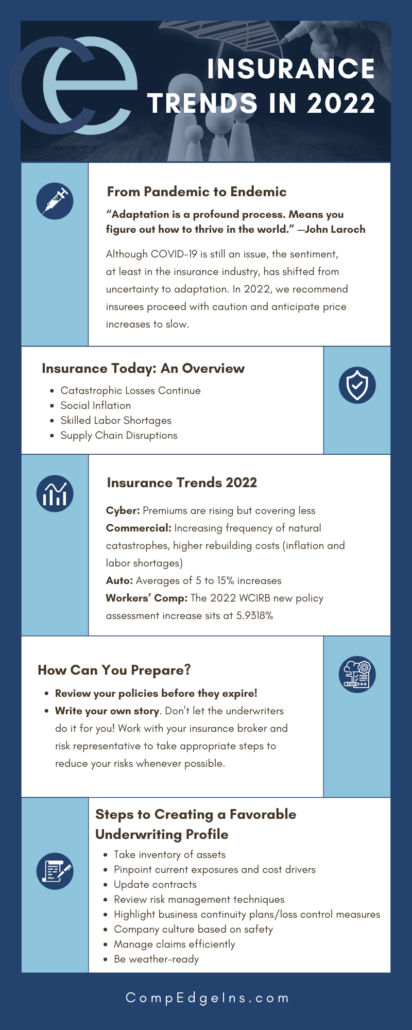
From Pandemic to Endemic

“Adaptation is a profound process.  Means you figure out how to thrive in the world.” —John Laroch

As we well know, COVID-19 is an ongoing issue. In fact, variants have led many to expect that COVID-19 is here to stay.

Regardless, the sentiment, at least in the insurance industry, has shifted from uncertainty to adaptation.

For the past 10 quarters, rate increases have averaged 10%. Capital in the reinsurance market has increased by 30% which provides support against a large loss event, catastrophe, economic turmoil, and/or adverse claims.

In 2022, we recommend insurees proceed with caution. Additionally, we anticipate price increases to slow. Please note, however, the word “slow” in this sentence. Increases are expected to slow, not create a downward trend in pricing.

Today’s World of Insurance: An Overview

As we know, the past 18 months have been nothing short of eventful. This considered, what are we observing in the insurance world today? Here are a few elements.

  • Catastrophic Losses Continue
  • Social Inflation
  • Skilled Labor Shortages
  • Supply Chain Disruptions

Did you know that according to a study from the Society for Human Resource Management, nearly 90% of businesses are having a hard time filling open positions?

Next, let’s dive into each insurance sector a bit deeper: cyber, commercial property, auto, and workers’ compensation.

Cyber Insurance

When it comes to cyber insurance, premiums are rising but covering less.

What’s Causing Insurance to Increase?

  • Cyber extortion jumped by 150% in a year
  • Companies are more likely to rely on outside attorneys to handle cyber response (in order to contain potential lawsuits)
  • Every claims category has increased in the past year; cases of malicious breaches and unintentional disclosure increased by 18%
  • Cyber coverages are expected to rise sharply, 40% to 50% for optimal risks and 50% to 100% or more for less optimal risks, seeing as ransomware attacks continue to crowd the cyber insurance market

Additionally, executives do not have the knowledge to properly insure their companies from cyber risk. Here are some statistics from Munich RE to paint a picture for you:

  • “81% of C-level respondents think their company is not adequately protected against cyberthreats
  • 35% are considering taking out an insurance policy and will very likely do so
  • Only 34% of C-level respondents have been in contact with their insurers
  • One out of four C-level respondents was totally unaware of the opportunities that cyber solutions offer
  • 17% of C-level respondents still do not have an overview of the cyber insurance products on the market”

The bottom line? C-level executives, while they may be concerned about cyber threats, do not have an understanding of what insurance products and services are available to them.

Commercial Property

What Elements Are Driving Rates?

  • Increasing frequency of natural catastrophes, as well as the severity of those events
  • Higher rebuilding costs due to price inflation of materials and labor shortages

Today, however, commercial property markets are stabilizing. Additionally, increased rates are slowing while capacity is increasing.

We can also anticipate more favorable terms for clients who mitigate risk. Property owners who have been working hard to mitigate risk and decrease claims can see more favorable terms and conditions, and possibly lower rates.

This benefits commercial insurance buyers that maintain quality risks with strong data to back them up. However, rates will continue to be impacted by the location of the risk.

Companies in areas at high risk of natural catastrophes, such as tornadoes, hurricanes, hailstorms, and wildfires, are seeing the highest rate increases, as well as non-renewals and even difficulty in securing coverage. For example, in wildfire areas of California and wind zones of Florida, rates have increased by over 20%.

Auto Insurance

Rates have gone up and up. But what’s driving the increase?

What’s Causing Auto Insurance Rates to Increase?

  • An increasing amount of accidents and deaths caused by distracted driving
  • Higher medical costs for accident victims
  • Rapidly climbing repair costs for vehicles exacerbated by the disrupted supply chain for parts and paucity of skilled and trained labor

As a result, we expect to see averages of 5-15% increases in both commercial and personal auto insurance in 2022.

Workers’ Compensation Insurance

Workers’ compensation is a mixed bag.

There’s a base that’s put into play by The Workers’ Compensation Insurance Rating Bureau of California (WCIRB), which is our rating and statistical bureau for data. The WCIRB gives us the trends and where to go.

The state fund has announced rate increases, the 2022 WCIRB new policy assessment increase sits at 5.9318%.

Beginning January 1, 2022, new assessment levels took effect for the six workers’ compensation surcharges administered by the California Department of Industrial Relations (DIR). The six will total 5.9318% in 2022, compared to 3.9590% in 2021.

For more information on rate increases between 2021 and 2022, visit the graph below.

How Can You Prepare?

Let’s talk about risk management.

First things first, review your policies before they expire!

It is estimated that commercial properties were undervalued for underwriting purposes by more than 30% in November 2021 policies annually.

To rectify undervaluation, more frequent, in-depth property risk appraisals—that take into account more extreme weather events, potential supply chain hurdles, and inflation trends—are recommended.

Second, write your own story. Don’t let the underwriters do it for you! Work with your insurance broker and risk representative to take appropriate steps to reduce your risks whenever possible. This will make you more attractive to underwriters.

Below is simply an outline of factors that owners can address to influence the most favorable underwriting profile, which leads to the most favorable terms, conditions, and pricing:

  • Take inventory of assets
  • Pinpoint current exposures and cost drivers
  • Update contracts to the current environment
  • Review existing risk management techniques
  • Highlight business continuity plans and loss control measures in place
  • Build a company culture focused on safety
  • Manage claims efficiently
  • Be weather-ready

Additionally, to reduce negative consequences from supply chain crunches and labor shortages in the aftermath of a catastrophe, “risk managers and property owners should consider entering agreements with builders before an event occurs to ensure the availability of materials and manpower for the restoration job.”

Underwriters are more critical now than ever on property, asking in-depth questions on what you’re doing to control your risks; not only to employees but to tenants and visitors.

Read on for more on how to prepare as well as what to expect from workers’ compensation policy renewals this year.

https://compedgeins.com/wp-content/uploads/2022/02/Insurance-Trends-in-2022-What-to-Watch-For-1.png 628 1200 https://compedgeins.com/wp-content/uploads/2026/08/Comp-Edge-ONLY-Color-Logo-300x59.jpg 2022-02-27 10:34:002022-02-25 10:52:41Insurance Trends in 2022: What to Watch For

Workers’ Compensation Coverage for Independent Contractors

in News

As an employer, you’re likely familiar with workers’ compensation coverage being purchased to protect your employees. When you decide to work with an independent contractor or 1099 worker, however, the question arises of whether or not your current coverage limits will include coverage for your 1099s as well.

Let’s take a look at workers’ compensation coverage for independent contractors.

What is Workers’ Compensation?

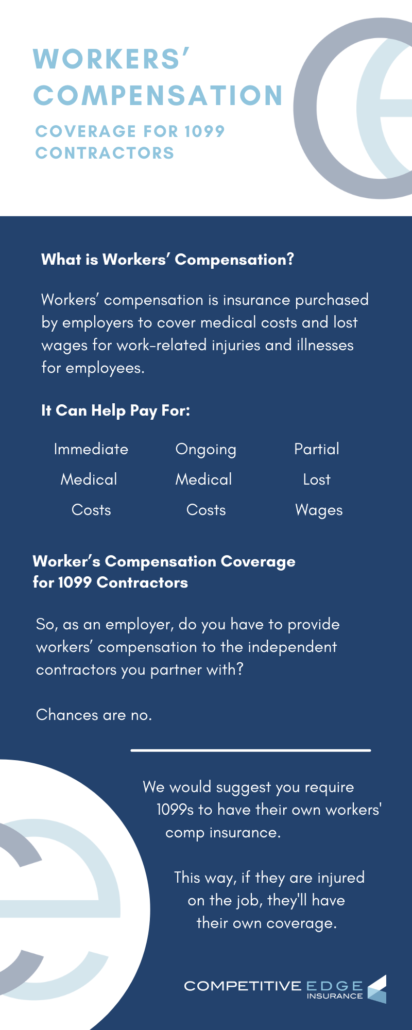
Workers’ compensation coverage is insurance, purchased by employers, to cover medical costs and lost wages for work-related injuries and illnesses for employees. It is required by law in California and lack of proper coverage can result in fines and even criminal exposure. 

Worker’s compensation coverage can help pay for:

  • Immediate medical costs (i.e. emergency room expenses)
  • Ongoing medical costs (i.e. physical therapy)
  • Partial lost wages while the employee is unable to work

Who Needs It?

Laws and requirements regarding workers’ compensation vary on a state-by-state basis. The policy, however, is required in almost every state for businesses with employees.

In California, for example, “all California employers must provide workers’ compensation benefits to their employees under California Labor Code Section 3700,” according to the Department of Industrial Relations.

Who Qualifies as an Independent Contractor?

1099 workers are self-employed independent contractors.

An independent contractor is, in simple terms, “is a self-employed person or entity contracted to perform work for—or provide services to—another entity as a nonemployee,” according to got1099. An independent contractor is also sometimes referred to as a freelancer, a gig worker or an outsourced service provider.  

Unlike traditional employees, independent contractors do not work regularly for an employer but work as required. 

A key part of being classified as an independent contractor, according to the IRS, is that the person who hires an independent contractor can only “control or direct… the result of the work and not what will be done and how it will be done.”

Assembly Bill 5 (AB-5)

Assembly Bill 5, also referred to as AB-5, or the Gig Work Bill, is a federal law that passed in January 2020. AB-5 introduced further regulations for independent contractor classification.  

Under AB-5, the ABC test is used to set the standard for worker classification. All workers are considered W-2 employees unless they meet all three of the following criteria:

  1. “The worker is free from the control and direction of the hiring entity in connection with the performance of the work, both under the contract for the performance of the work and in fact;
  2. The worker performs work that is outside the usual course of the hiring entity’s business; and
  3. The worker is customarily engaged in an independently established trade occupation or business of the same nature that is involved in the work performed.” 

Long story short, employers cannot hold control over independent contractors. The worker has the freedom to work when they choose, and how they choose within the parameters of their contractual agreement.

Worker’s Compensation Coverage for 1099 Contractors

So, as an employer, do you have to provide workers’ compensation to the independent contractors you partner with? Chances are no. 

According to Gusto, you don’t typically have to cover independent contractors under your workers’ compensation policy. “That’s because they’re not technically considered employees of your business. The line separating independent contractors from employees isn’t always clear, though.”

We’d recommend speaking with trusted financial personnel, like an accountant, to determine if the person is a 1099 contractor or a W-2 employee.

Whether or not you have to provide workers’ compensation for independent contractors, however, also depends on where you conduct your business. Remember, each state has its own laws when it comes to workers’ compensation. Be sure to do your research.

Require 1099s to Have Their Own Insurance

In the likely case that you are not required to provide workers’ compensation insurance for the independent contractors that you hire, we would strongly suggest that you require any 1099 workers to prove that they have their own workers’ compensation insurance.

This way, if they are injured on the job, they’ll have their own coverage and will not trigger a claim on your policy and cost you money. 

Working with 1099s Who Don’t Have Their Own Insurance

On the other hand, if an independent contractor doesn’t have their own workers’ compensation insurance, you must account for this financially as an employer. 

Logically, if you hire a 1099 worker who doesn’t have their own workers’ comp insurance, your own insurance carrier may charge you higher rates in order to account for the coverage of these additional workers.  

If your 1099 has not provided proof of Workers’ Compensation coverage and they were to get injured while working for you, your insurance carrier would look at the role tehy perform and assess additional coverage charges based on the fee structures for that category of work.  This can result in a heft upcharge.  So, be sure to check with your 1099s to ensure they have their own coverage (not only Worker’s Compensation but General Liability as well). 

As always, be sure to ask independent contractors for a Certificate of Insurance (COI) when hiring 1099s. Read on to learn more about the importance of COIs.

https://compedgeins.com/wp-content/uploads/2022/01/Workers-Compensation-Coverage-for-Independent-Contractors-.png 628 1200 https://compedgeins.com/wp-content/uploads/2026/08/Comp-Edge-ONLY-Color-Logo-300x59.jpg 2022-02-20 07:00:002022-01-26 12:03:01Workers’ Compensation Coverage for Independent Contractors

How Much Should Business Insurance Cost?

in News

As a business owner, it’s crucial that you know all of your expenses upfront. One of these expenses includes your business’s insurance. As a business owner, how much cash should you prepare to put toward protecting your business? More specifically, how much should business insurance cost? Let’s discuss.

Why Do I Need Insurance?

Insurance is a necessity for all businesses, especially small businesses. But why? Well, the fact of the matter is that accidents happen. As The Hartford puts it, “business insurance helps pay for damages you’d otherwise have to cover out-of-pocket.”

In addition to protecting your business and providing benefits to employees, having business insurance helps reduce stress while saving time and money.

There are many types of insurance to consider as well, including:

  • General Liability Insurance
  • Workers’ Compensation Insurance
  • Cyber Liability Insurance
  • Commercial Property Insurance
  • Business Income Insurance
  • And more

The types of insurance that you must have vary on a state-by-state basis.

Below is what Competitive Edge Insurance founder, Brenda Jo Robyn, considers as “must-haves.”

Insurance ‘Must-Haves’

Employment Practices Liability Insurance (EPLI)

Employers must have Employment Practices Liability Insurance (EPLI). Did you know that non-litigated vs. litigated cases can rack up over $500,000 in costs? EPLI insurance typically pays for litigation if you ever went to court with one of your employees.

General Liability

If you work with cities, federal governments, and/or government agencies, general liability insurance is required for your contracts. It is also required if you are operating a franchise. If you have a lease, it is also typically required by the property owner. 

General liability insurance is typically more contractually required rather than on a federal level.

Commercial Auto Policy

Car accidents are not cheap by any means. In fact, did you know that car accident claims can be as high as $75,000?

If employees are using cars to do their job, a commercial auto policy is necessary. (Yes, this includes tasks as simple as running to the post office!)

If they’re using their own car they also need that coverage.

As a business owner, be sure to set up policies and procedures to check employees’ insurance. Remember, when necessary, employee insurance kicks in first. Your business’s commercial auto policy would kick in on top of that. 

Workers’ Compensation Insurance

ALL California employers are required to provide workers’ comp for all employees. This means whether they’re in the office, out in the field, or in their homes working, workers’ compensation must be provided.

In the case of hiring an independent contractor, Brenda Jo recommends always requiring any 1099 workers to have their own workers’ compensation insurance.

This way, if they are injured on the job, they’ll have their own coverage.

How Much Should Business Insurance Cost?

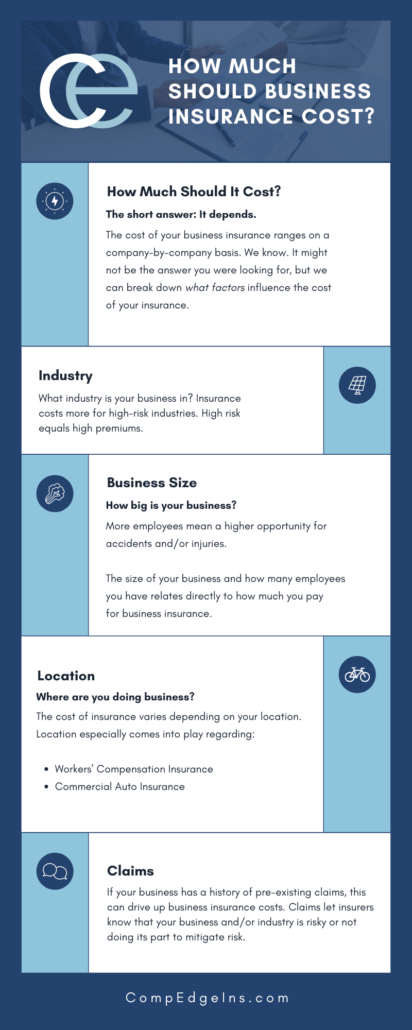
As a business owner, how much should you be spending on business insurance? The cost of your business insurance ranges on a company-by-company basis. The price of insurance depends on the size as well as the nature of a business.

So the short answer is, it depends.

We know. It might not necessarily be the answer you were looking for; however, we can break down what factors influence the cost of your insurance.

Insurance Costs: Factors to Consider

As a general rule of thumb, your business’s insurance costs can cost between 10-30% of your predicted gross sales. However, this is not a hard and fast rule.

Below we’ve listed some factors that influence the costs of your business insurance.

Industry

First things first, what industry is your business in? Simply put, insurance costs more for high-risk industries. High risk equals high premiums.

For example, it would cost more for a construction company to receive the same insurance coverage as a marketing firm.

High-risk insurance addresses companies whose coverage was either terminated because of a claim, those who are new and cannot get coverage because of industry risk, or those who have experienced drops in revenue or industry disruption such that carriers are broadly refusing coverage.

These high-risk areas include:

  • Construction
  • Health and Wellness
  • Cyber Liability Risk
  • Bonding
  • General Liability
  • Workers’ Compensation
  • Cannabis
  • And more

Business Size

How big is your business? Business insurance for a small company, compared to a large company will, of course, be less expensive. More employees mean a higher opportunity for accidents and/or injuries.

The size of your business and how many employees you have directly relates to how much you pay for business insurance.

Location

Where are you doing business? The cost of insurance varies depending on your location. Location especially comes into play with regards to:

  • Workers’ Compensation Insurance
  • Commercial Auto Insurance

Claims

If your business has a history of pre-existing claims, this can drive up your business insurance costs. Claims let insurers know that your business and/or industry is risky or even worse, that your business is not doing its part to mitigate risk.

Sales

Insurers look at your sales to determine the cost of your general liability insurance. The reason is that the more clients or customers that you have, the higher chances that someone will be injured or upset in some manner.

Coverage and Deductibles

A final element to consider is under what circumstances your policy will payout and how much they will pay. This affects overall business insurance costs.

To note, lower deductible equaled increased costs in your business insurance policy.

Here to Help

Business insurance will vary in price from one insurer to the next depending on the factors we’ve listed above. At Competitive Edge, we specialize in insuring high-risk businesses. We build your case to the carrier to ensure that you get the right coverage at the best price based on your real-world conditions.

To learn more about how to protect your business, read our blog post ‘What is Risk Mitigation?’

https://compedgeins.com/wp-content/uploads/2022/01/How-Much-Should-Business-Insurance-Cost-1.png 628 1200 https://compedgeins.com/wp-content/uploads/2026/08/Comp-Edge-ONLY-Color-Logo-300x59.jpg 2022-02-06 07:00:002022-02-22 10:28:20How Much Should Business Insurance Cost?

Risk Mitigation: What Is It and How Can You Do It?

in News

In the world of insurance, you often hear the term ‘risk mitigation.’ But what does it mean? Let’s talk about risk mitigation: What is it and how can you do it well?

There’s no one better to ask than Brenda Jo Robyn, Founder of Competitive Edge Insurance. Here, we hand over the mic as she tells you what you need to know about risk mitigation as a business owner.

What is Risk Mitigation?

In its simplest terms, risk mitigation is anything an employer can do to make sure that they’re low-risk and not high-risk. When we say low-risk here, we mean not likely to result in failure, harm, or injury.

Still not sure about what high-risk is? Check out our blog to learn what classifies high risk.

Common Business Risks

According to American Express, the most common types of risk when it comes to running a business include:

  • Economic Risk
  • Compliance Risk
  • Security and Fraud Risk
  • Financial Risk
  • Reputation Risk
  • Operational Risk
  • Competition (or Comfort) Risk

We know, it sounds scary knowing that there are so many risks out there. But don’t worry—below we’ll explain tangible steps you can take to mitigate your risk.

What Can Business Owners Do to Mitigate Risk?

So, how can you mitigate risk as a business owner? There are many things that you can do to mitigate risk within your company.

Below we are going to list the top five most impactful things you can do to mitigate your risk.

Ensure You Have a Stable Employee Population

Firstly, ensuring that you have a stable employee population is crucial to your risk mitigation strategy. Having a secure and stable employee base also includes having a low turnover rate. 

But how can you achieve this?

Brenda Jo recommends putting incentives and benefits in place to retain your employees. As an employer, you should additionally emphasize training.

Secondly, give your employees accolades when they’re due. Tell them how appreciated they are, and give them more responsibilities as their time with you increases.

“A lot of employees just want to know that they’re wanted,” says Brenda Jo.

Prioritize Safety

The second piece of the puzzle is to make sure that you’ve implemented a strong safety program. Depending on your industry, this might include:

  • Safety Meetings
  • Safety Tests
  • Proper Safety Equipment and Tools (i.e. safety goggles, safety shoes)

The bottom line here is to provide resources and do whatever you can to prevent employees from getting hurt or sick.

Take a non-construction environment for example. You might work in an office building. As an employer, it would then be your responsibility to make sure that carpets are stapled down or secured with sticky tape underneath so that employees don’t trip. Easy!

In general, when it comes to safety, “what I would suggest,” says Brenda Jo, “is that you work on it with your broker starting 90 days out.”

In general, a good rule of thumb to follow is DON’T wait until the last minute to mitigate your risk. (Trust us, it’s not worth it!)

Here are some questions to get you started. Ask yourself:

  • What’s coming?
  • How are things changing?
  • What can we do to save money?
  • What can we do to place ourselves in the best risk?

Invest in Insurance

Making sure your business is properly insured is arguably the best way to mitigate risk. There are many different types of insurance that your business might need or benefit from.

Some types of insurance for businesses include:

  • General Liability Insurance
  • Commercial Property Insurance
  • Workers’ Compensation Insurance
  • Commercial Auto Insurance
  • Cyber Liability Insurance
  • The list goes on!

Insurance requirements vary on a state-by-state basis as well as an industry basis. Be sure to speak with a professional—like our team at Competitive Edge—to learn what you need to protect your business. Read on if you’d like to hear about four types of insurance coverage for your business.

Consider Planning that Can Be Done in Advance

Considering carriers, what kind of planning ahead can you do as an employer? Do you want to partner with a carrier that is going to help you year-round to make you more risk-tolerant?

If so, this carrier might be coming in to do inspections every other month, giving you recommendations on how to improve your site or how to improve your training, and the list goes on. The best part? Brenda Jo says that this type of support is typically free of charge if you get with the right carrier.

Take advantage of the resources available to you!

Implement a Safety-Incentive Program

What is a safety-incentive program?

The Occupational Safety and Health Administration, more commonly known as OSHA, recommends safety-incentive programs, which reward “workers for reporting near-misses or hazards.”

Safety-incentive programs typically reward employees for reporting unsafe conditions, making the workplace safer altogether.

Programs as such “provide positive reinforcement for reporting illnesses and injuries.”

A Final Word

Don’t let risk mitigation slip by the wayside. After all, proper risk mitigation helps to reduce your insurance costs. And let’s face it, who doesn’t want to benefit from lower insurance costs?

Interested in learning more? Read on to learn what to expect in terms of premium increases and risk mitigation this year or about insurance requirements for business owners.

infographic of how business owners can mitigate risk
https://compedgeins.com/wp-content/uploads/2022/01/Risk-Mitigation-What-Is-It-and-How-Can-You-Do-It.png 628 1200 https://compedgeins.com/wp-content/uploads/2026/08/Comp-Edge-ONLY-Color-Logo-300x59.jpg 2022-01-30 07:00:002022-05-27 10:01:23Risk Mitigation: What Is It and How Can You Do It?

What Does Workers’ Comp Look Like for Remote Employees?

in General Business Insurance, News, Video, Workers' Compensation

Due to the COVID-19 pandemic, remote work is more common than ever, but how does workers’ compensation work for remote employees? How can an injury be proved when the individual is not in a corporate setting? What does workers’ comp look like for remote employees, and what does it cover?

Brenda Jo Robyn, founder of Competitive Edge, joins us on video to answer all of these questions.

Are Employers Required to Provide Workers’ Comp Coverage for Remote Employees?

Yes. Employers are required to provide workers’ comp for all employees, whether they’re in the office, out in the field, or in their homes working.

What Does Workers’ Comp Cover for Remote Employees?

“Workers’ comp covers everything the same across all policies and all carriers,” says Brenda Jo. “What’s different are the rates that are charged based on the payroll, the industry, and the number of employees per class code within that industry.”

All of these elements dictate the rates based on which carrier takes the coverage for the employer.

Interesting to note is the new class code that was created when remote work skyrocketed. In California, a new class code was created for telecommuting. With this new class code, you have to be at home working or in a remote workplace 50% of the time or more.

If you are coming into the office for work, you will still be considered an office employee; otherwise, you’ll be in the new class code at a very inexpensive rate. Regardless, all employees will still be covered.

How Can Employers Prevent Claims From Being Made?

It’s tricky. “It’s been a really difficult thing for employers to make sure that all of their employees are set up ergonomically for remote work,” says Brenda Jo.

Setting up ergonomically includes:

  • Ensuring cords are not in the way of tripping
  • Identifying where remote employees are sitting
  • Identifying how remote employees are sitting (as to not strain their necks, etc.)
  • And more

Some employers have hired ergonomic consultants who help remote employees set up their workplace correctly, in an attempt to avoid workers’ compensation claims.

How Can Remote Employees Make Workers’ Compensation Claims?

Things get tricky when it comes to a claim made at an individual’s house or a local cafe, for example.

Let’s say a remote employee is working at a Starbucks when they slip, fall, and get injured. Brenda Jo tells us it’s going to be hard to see where that claim will fall. 

“There’ll be a lot more investigation depending on how severe the injury really ends up being,” says Brenda Jo. “You can make that claim [as a remote employee], valid or not. Then it’s up to the carrier to decide whether the claim is valid through their inspections, investigations, as well as doctor’s reports, etc.” In some cases, it might include an applicant attorney getting involved.

Read on to learn more about what to expect this year from workers’ compensation policy renewals.

https://compedgeins.com/wp-content/uploads/2021/12/What-Does-Workers-Comp-Look-Like-for-Remote-Employees.png 628 1200 https://compedgeins.com/wp-content/uploads/2026/08/Comp-Edge-ONLY-Color-Logo-300x59.jpg 2022-01-23 07:00:002021-12-21 09:24:44What Does Workers’ Comp Look Like for Remote Employees?

Payment and Performance Bonds Explained

in Bonding, Construction, General Business Insurance, High-Risk Insurance, News
Payment and performance bonds

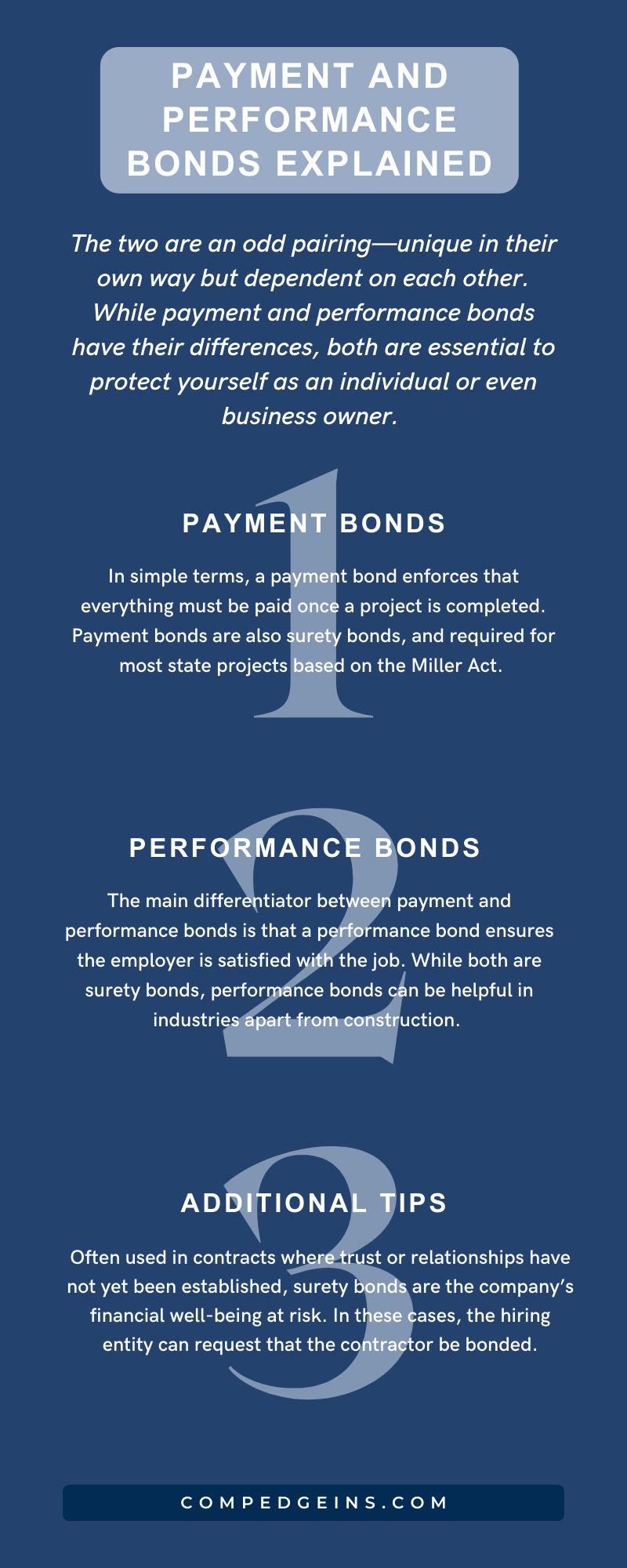
Payment and performance bonds… The two are an odd pairing—unique in their own way yet dependent on each other.

Although payment and performance bonds have their differences, both are essential in protecting yourself in the world of insurance. Let’s explore the differences below.

Payment Bonds

What is a payment bond? Simply put, a payment bond guarantees payment for subcontractors and payment for materials once a project is completed.

Payment bonds are most commonly seen in construction. Payment bonds are a type of surety bond and are required for most state projects based on the Miller Act.

Surety Bonds

What is a surety bond? 

A surety bond is a contract where one party (the surety company) guarantees the performance of certain obligations in a contract of the second party (the principal or the insured) to a third party (the obligee).

When Do You Need a Surety Bond?

Surety bonds are needed for most licenses in the state of California and other states as well. Some examples of who might need a surety bond include:

  • Contractors
  • Real estate companies and agents
  • Financial institutions
  • Janitorial staff

Why Do You Need a Surety Bond?

Licensed bonds are required in many states to do business and are put in place by the state to protect consumers.

The insured, or principal, purchases these bonds in an amount prescribed by the state to pay the obligee (the state), in case there’s a claim against somebody’s license.

The Miller Act

As previously mentioned, surety bonds are required for most state projects based on the Miller Act.

The Miller Act was passed by the U.S. General Services Administration Public Buildings Service (GSA) to explain how payment bonds protect subcontractors and suppliers.

The GSA responds to any reports of nonpayment, following the legal action needed and protected by the Miller Act.

The GSA states that “the Miller Act requires that prime contractors for the construction, alteration, or repair of Federal buildings furnish a payment bond for contracts in excess of $100,000.” 

There are legal consequences for breaking a contract through the Miller Act.

The GSA expands: “Failure by a contractor to pay suppliers and subcontractors gives such suppliers and subcontractors the right to sue the contractor in the U.S. District Court in the name of the United States.”

Performance Bonds

The main difference between payment and performance bonds is that a performance bond ensures that the employer is satisfied with the job.

While both payment and performance bonds are surety bonds, performance bonds are visible in industries outside of construction.

A performance bond, according to Investopedia, “ensures the completion of a project.” A performance bond covers the ability of the contractor to perform and finish the job as per contract requirements.

If the contractor doesn’t perform, the contract bond kicks in and helps to pay for the completion of that performance.

A performance bond involves three parties:

  • The principal: The primary contact in the performance bond; responsible for performing the contract
  • The obligee: The person receiving the obligation
  • The surety: Responsible for making sure each party complies with the performance bond obligations

A Final Note

If these bonds are used and there’s a claim on a bond, the contractor who purchased the bond has to pay that back.

This considered, surety companies look for strong financials in a company, including assets, lines of credit, and letters of credit.For more information, watch this video about surety bonds and contract bonds. There, Brenda Jo Robyn, founder of Competitive Edge, lays it all out on the table in a way that’s easy to understand.

https://compedgeins.com/wp-content/uploads/2021/07/iStock-1209272786.jpg 1414 2121 https://compedgeins.com/wp-content/uploads/2026/08/Comp-Edge-ONLY-Color-Logo-300x59.jpg 2022-01-16 07:00:002022-09-16 13:10:19Payment and Performance Bonds Explained

Workers’ Compensation Policy Renewals: What to Expect

in General Business Insurance, News, Video, Workers' Compensation

January 1st sees the most number of workers’ compensation policy renewals. What does this mean, and what can we expect during the first month of 2022 as a result? Let’s talk about what to expect in terms of premium increases and risk mitigation.

Today, we’re handing over the mic to Brenda Jo Robyn, founder of Competitive Edge Insurance. Here’s what she has to say.

What Does January 1st Mean for Businesses?

January 1st is typically the day when the highest volume of workers’ compensation policies will renew.

Right now, there’s a backlog of quotes, which results in stressed underwriters and quotes coming out late.

According to Brenda Jo, the one thing you can expect is premium increases this year. “There is going to be quite a significant adjustment in several areas in which companies can expect to see,” says Brenda Jo. “Ten to up to 80% increases in their premiums based on the class code.”

Why Is This Increase Important?

People should be talking about this.

“I think for many, it’s going to come as a shock,” says Brenda Jo. “However, if they’re working with their broker, they’ll have already known about this since October and make plans accordingly.”

If your business is going to have that much of an increase, you need to decide how your pricing structure for your services or products will change in the next year to compensate.

“It’s really important to know what you’re walking into,” says Brenda Jo. “The rate increases will start on 01/01 and it’s carrier by carrier.”

What Determines Premium Increases?

There’s a base that’s put into play by The Workers’ Compensation Insurance Rating Bureau of California (WCIRB), which is our rating and statistical bureau for data. The WCIRB gives us the trends and where to go.

It’s important to note, however, that carriers can apply a lot of credits.

Elements that might bring about credits include:

  • Risk mitigation
  • Safety policies in place
  • Safety training
  • Low turnover 

Some carriers can give credits from five to 40%, depending upon the class code.

For those of you who are interested in learning more about changing costs in 2022, check out this video when Brenda Jo speaks about what to expect from changing contractor costs.

https://compedgeins.com/wp-content/uploads/2021/12/Workers-Compensation-Policy-Renewals-What-to-Expect-1.png 628 1200 https://compedgeins.com/wp-content/uploads/2026/08/Comp-Edge-ONLY-Color-Logo-300x59.jpg 2022-01-09 07:00:002022-01-12 10:00:12Workers’ Compensation Policy Renewals: What to Expect

How the California Labor Shortage Is Affecting the Construction Industry

in Construction, News

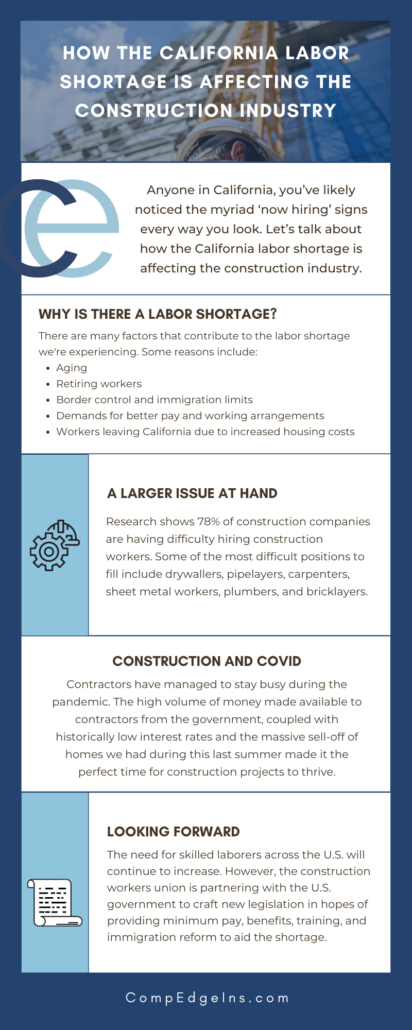
For anyone in California who has taken a stroll around town lately, you’ve likely noticed the myriad ‘now hiring’ signs every way you look. Restaurants and retail stores are experiencing obvious shortages, but the construction industry is especially feeling the deficit of ready labor right now.

Let’s talk about how the California labor shortage is affecting the construction industry.

Why Is There a Labor Shortage in California?

When asked about the California labor shortage, Brenda Jo Robyn, founder of Competitive Edge Insurance, said this:

“You can see labor shortages everywhere,” says Brenda Jo. “The shortage of skilled labor is getting tighter and tighter.”

But why? There are many factors that contribute to the labor shortage we are experiencing as a nation right now. According to economists at CNBC, some reasons include:

  • Aging
  • Retiring workers
  • Border control and immigration limits
  • Demands for better pay and working arrangements
  • Workers leaving California due to increased housing costs
  • And more

The labor shortage in the construction industry specifically, however, is not only a California issue.

A Larger Issue at Hand

According to the Associated General Contractors of America (AGC) and Autodesk, “78% of construction companies are having difficulty hiring construction workers.”

Some of the most difficult positions to fill, according to NBC San Diego, include:

  • Drywallers
  • Pipelayers
  • Carpenters
  • Sheet metal workers
  • Plumbers
  • Bricklayers

Even if a wave of individuals wanted to get into the construction field right now, it takes a great deal of time to become proficient in many of these jobs. Not to mention the time required to receive proper licensure from the California Contractors State License Board (CSLB).

But construction projects need laborers now.

Some companies have even had to turn to out-of-state workers, bringing them in for individual projects to meet demands.

The Construction Industry During COVID and Today

california labor shortage construction industry

Contractors have managed to stay busy during the COVID-19 pandemic. How? It was the perfect time for construction projects to thrive last summer considering a few elements working in combination:

  • The high volume of money made available to contractors from the government
  • Historically low-interest rates
  • The massive sell-off of homes

In fact, as soon as things were deemed “safe enough,” many homeowners and business owners jumped on the opportunity to renovate their properties. Think kitchen remodels, backyard updates, you name it.

But now, the supply can’t meet the high demand.

In an article written by Fox, contractor Michael Wolff was interviewed. “I would pay a ridiculous amount of money to get a qualified person in here. I would hire 15 people today,” said Wolff. He, like many other contractors, acknowledges that many qualified laborers have preferred to stay at home on unemployment or stimulus or work under the table.

Increased Costs

Brenda Jo of Competitive Edge elaborates on the trickle-down effect of the labor shortage. As a result, the construction industry is hiking up costs to complete projects in an efficient manner.

Brenda Jo explains: “When there’s a shortage, that means there’s a competition. When there’s a competition, wages go up in that industry or that skillset.” All in all, projects cost more.

She continues with the two options contractors are faced with. “Either the employer can’t find enough labor so the job takes longer or you contract more laborers, shortening your project time, but increasing costs,” says Brenda Jo. “There’s a fine balance between those.” And, as we’ve observed, it’s a difficult balance to strike.

The Construction Industry: Looking Forward

The need for skilled laborers across the U.S. will continue to increase in the coming years. In fact, there will be an 11% increase between 2016 and 2026, bringing an additional 747,600 industry jobs to fill.

Today, fewer and fewer children are exposed to the construction world—which, in turn, will further drag out the shortage. Only 3% of people ages 18 to 25 wanted to work in construction, according to an article done by Builder in 2017.

Moreover, “for every five workers retiring, [there is] only one coming in,” according to Robin Bartholow, Builders Exchange Workforce Development Director.

The facts considered, the shortage does not appear to be ending anytime soon. 45% of companies surveyed by AGC reported that they anticipate continuing difficulty in hiring craft and salaried workers.

According to The Los Angeles Times, the construction workers union is partnering with the U.S. government to craft new legislation in hopes of providing:

  • Minimum pay
  • Benefits
  • Training

Immigration reform is an additional solution that could allow skilled, out-of-country workers to aid the shortage, according to the San Francisco Chronicle.

For those who are not a part of the construction workers union, a higher emphasis on training and educating younger generations about careers in construction could help solve the labor shortage in the long run.

Read on to learn what to expect from changing contractor costs as a result of both labor shortages and shipping delays from Brenda Jo Robyn, founder of Competitive Edge Insurance herself.

https://compedgeins.com/wp-content/uploads/2021/11/How-the-California-Labor-Shortage-Is-Affecting-the-Construction-Industry.png 628 1200 https://compedgeins.com/wp-content/uploads/2026/08/Comp-Edge-ONLY-Color-Logo-300x59.jpg 2021-12-12 07:00:002022-04-27 12:46:30How the California Labor Shortage Is Affecting the Construction Industry

What Mandating the Vaccine Might Mean for Your Business Insurance

in General Business Insurance, Health & Wellness, News

Business owners have experienced unforeseen challenges as a result of the last nearly two years in a global pandemic.

The conversation surrounding the ethics of requiring vaccines has been floating around the workplace for about just as long.

In September 2021, however, President Joe Biden directed the Occupational Safety and Health Administration (OSHA) to introduce an emergency temporary standard (ETS) that requires companies with 100 or more employees to ensure all employees are:

  • Fully vaccinated
  • Or, that they submit to weekly testing and mandatory masking

*As of November 17th, however, OSHA has paused all vaccine mandates “after a federal appeals court upheld a stay.”

Regardless, it is still top of mind for employees. Here’s what mandating the vaccine might mean for your business insurance along with how you can prepare if the mandate is passed.

Who Would This Mandate Affect?

According to The New York Times, companies with 100 or more employees would “have until Jan. 4 to ensure all their workers are either fully vaccinated or submit to weekly testing and mandatory masking.”

This measure would be enforced to promote workplace health and safety and will affect “some 84 million private-sector workers across the country, including some 31 million who are believed to be unvaccinated.”

If the mandate comes into play, OSHA anticipates the ETS will be in effect for six months depending on COVID-19 statistics.

When Did This Mandate Come About?

“The measure was announced by President Biden in September [2021], and details were released on Nov. 4 by the Labor Department’s Occupational Safety and Health Administration [OSHA],” according to The Times.

COVID, ELP, and EPLI

First things first, what is Employer’s Liability Insurance? This form of insurance “protects your business when an employee sues over a work injury or illness,” according to Insureon. It is especially important, considering “almost one in five small businesses will face employee litigation” at some point.

Equally as important to consider is Employment Practices Liability Insurance (EPLI), which is insurance that “provides coverage to employers against claims made by employees.”

With the potential vaccine mandate, we can anticipate an increase in EPLI claims. As a result, we might see EPLI premiums increase. Kyle Jeziorski, Executive Vice President at Founder Shield offered insight: “I think insurers will try to add COVID-19 exclusions to EPLI policies and potentially offer the coverage for an additional premium.”

It’s definitely something we here at Competitive Edge Insurance will continue to keep a pulse on.

How Responsible Are Businesses for the Spread of COVID?

During the onset of COVID, many employees wondered to what extent businesses and business owners should be held liable if an employee were to contract COVID-19 on the job and suffer sickness or even death as a result.

The answer today is still clear as mud.

There are, however, steps your business can (and should) take to prepare for these newly introduced COVID-19 vaccine mandates.

Steps Your Business Can Take to Prepare

Business Insurance tells us that now is the time that businesses should prepare U.S. Equal Employment Opportunity Commission processes as well as human resources (HR) departments for what lies ahead.

As we well know, there are many employees across the U.S. who will request exemptions from receiving the COVID-19 vaccine due to religious or health reasons. This process, called an ‘interactive process,’ can take weeks or even months.

For businesses, this can be a lot added on their plates—especially if they receive a high number of requested exemptions.

Businesses should know this ahead of time and prepare accordingly.

Erect a Framework in Advance

“Businesses owe it to themselves to put together a framework to manage this,” says Chuck Kable, Chief Legal Officer and Chief Human Resources Officer at Axiom Medical. “You have to have a protocol and a process that you have to administer consistently and over time, and you have to treat everybody equally.” 

If businesses fail to do so, this is when liabilities begin to pop up. 

“Any mishandling of an exemption request can run afoul of anti-discrimination laws,” says Adam Kempe of Kelley Kronenberg. Companies might face various liabilities including:

  • Failure to maintain and keep private workers’ health information
  • Failure to follow steps in Equal Employment Opportunity Commission (EEOC) exemption requests

Consider OSHA Fines

If the headache of one of your employees filing a claim with OSHA as a result of your negligence isn’t enough motivation to get your ducks in a line, consider the hefty OSHA fines you might face.

If a complaint is filed, the first thing OSHA is going to look for is your current OSHA Covid Protection Procedures that are in place, which includes your Injury and Illness Prevention Program (IIPP). All employers are required to have IIPPs in place.

OSHA fines can be especially detrimental to your company’s financials because while OSHA personnel might come in looking for one thing, chances are they will do some digging, which could lead to additional fines or penalties. OSHA, in that sense, is similar to the IRS—except for employers.

Employee Screenings

A final precaution that employers should take, according to Brenda Jo Robyn, founder of Competitive Edge Insurance, is to conduct thorough employee screenings.

Brenda Jo also acknowledges that it may be the case that many people will choose to not work as a result of this mandate.

“You can find out a lot about an employee or potential employee from a screening,” says Brenda Jo. “Be sure to look at their workers’ compensation claims and do reference checks.”

Take advantage of not only their most recent reference but reach out to prior references as well.

A Final Word

With this potential vaccine mandate firing up, it’s especially important for employers to be on their A-game as far as safety procedures and insurance are concerned.

“There’s nothing that prevents a company, especially one not familiar with these issues, from now bringing in appropriate HR personnel, a consultant, or employment counsel to understand what to expect,” says Kempe of Kelley Kronenberg.

On the topic of vaccines, did you know that Brenda Jo Robyn, founder of Competitive Edge, began her career as an Epidemiologist who specialized in immunizations? To hear more about vaccines, specifically, her passion for Polio research, visit this blog post.

https://compedgeins.com/wp-content/uploads/2021/11/What-Mandating-the-Vaccine-Might-Mean-for-Your-Business-Insurance-1.png 628 1200 https://compedgeins.com/wp-content/uploads/2026/08/Comp-Edge-ONLY-Color-Logo-300x59.jpg 2021-12-05 07:00:002021-11-22 16:50:57What Mandating the Vaccine Might Mean for Your Business Insurance
Page 4 of 7«‹23456›»

CATEGORIES

RECENT POSTS

  • Cyber Security Image by Anderson Piza at Envato Elements | Licensed
    6 Current Cyber Threats Companies Face: How to Stay Safe
  • Insurance Form Image by rfaizal707 at Envato ElementsEnvato Elements by rfaizal707
    Understanding the Hard Insurance Market and Its Impact on You
  • Black and White Photo of a man writing a contract
    EPLI: Does Your Construction Business Need It?

CONNECT WITH US

VIDEO POSTS

  • City view of commercial buildings, including skyscrapers surrounded by trees
    How to COPE in an Inflationary Environment
  • Coronado bridge aerial view
    Get to Know Our Founder: Her Rotary Involvement
  • Insurtech holographic image with man using ipad
    The Coverage Pitfalls of Insurtech
LET’S TALK

WANT TO KNOW HOW MUCH YOU COULD BE SAVING ON YOUR INSURANCE COSTS?

WANT TO KNOW HOW MUCH YOU COULD BE SAVING ON YOUR INSURANCE COSTS?

LET’S TALK

Connect With Us

Competitive Edge Insurance

LIC #0H31982

P: 619-259-5459
F: 619-377-0144

830 Orange Ave Suite L Coronado, CA 92118

Privacy Policy

Hours of Operation

Monday – Friday 8:00AM – 5:00PM

Saturday Closed

Sunday Closed

© Copyright 2021- Competitive Edge Insurance Services

site design by digitalstoryteller.io

© Copyright 2021- Competitive Edge Insurance Services
site design by digitalstoryteller.io

Scroll to top

This site uses cookies. By continuing to browse the site, you are agreeing to our use of cookies.

Accept settings

Cookie and Privacy Settings


How we use cookies

We may request cookies to be set on your device. We use cookies to let us know when you visit our websites, how you interact with us, to enrich your user experience, and to customize your relationship with our website.

Click on the different category headings to find out more. You can also change some of your preferences. Note that blocking some types of cookies may impact your experience on our websites and the services we are able to offer.

Essential Website Cookies

These cookies are strictly necessary to provide you with services available through our website and to use some of its features.

Because these cookies are strictly necessary to deliver the website, refusing them will have impact how our site functions. You always can block or delete cookies by changing your browser settings and force blocking all cookies on this website. But this will always prompt you to accept/refuse cookies when revisiting our site.

We fully respect if you want to refuse cookies but to avoid asking you again and again kindly allow us to store a cookie for that. You are free to opt out any time or opt in for other cookies to get a better experience. If you refuse cookies we will remove all set cookies in our domain.

We provide you with a list of stored cookies on your computer in our domain so you can check what we stored. Due to security reasons we are not able to show or modify cookies from other domains. You can check these in your browser security settings.

Google Analytics Cookies

These cookies collect information that is used either in aggregate form to help us understand how our website is being used or how effective our marketing campaigns are, or to help us customize our website and application for you in order to enhance your experience.

If you do not want that we track your visit to our site you can disable tracking in your browser here:

Other external services

We also use different external services like Google Webfonts, Google Maps, and external Video providers. Since these providers may collect personal data like your IP address we allow you to block them here. Please be aware that this might heavily reduce the functionality and appearance of our site. Changes will take effect once you reload the page.

Google Webfont Settings:

Google Map Settings:

Google reCaptcha Settings:

Vimeo and Youtube video embeds:

Other cookies

The following cookies are also needed - You can choose if you want to allow them:

Privacy Policy

You can read about our cookies and privacy settings in detail on our Privacy Policy Page.

Privacy Policy
Accept settings