Competitive Edge Insurance
  • Construction
  • Business
    • Health and Wellness Insurance
    • Cyber Liability
    • Bonding
    • General Business Insurance
    • EIDL Insurance Requirements
  • Personal Lines
    • Auto Insurance
    • Boat Insurance
    • Homeowners Insurance
  • About Us
  • Resources
    • Articles and Insights
    • Trusted Advisors
  • Contact
  • Menu Menu
  • LinkedIn
  • Instagram
  • Facebook
  • Youtube

Tag Archive for: insurance

How Small Businesses Fall Victim to Cyber Attacks

in Cyber Insurance, High-Risk Insurance

Cyber attacks are on the rise—and no business, big or small, is immune to the devastating financial loss that a cyber attack can have. So, let’s discuss a few aspects of cyber attacks to look out for, including:

  • What is phishing?
  • Why is it a problem?
  • Why are small businesses targeted?
  • How can your business prevent becoming the victim of a cyber attack?

Let’s dive in.

What is Phishing?

Phishing is an ever-growing concern defined as the “technique for attempting to acquire sensitive data, such as bank account numbers, through a fraudulent solicitation in email or on a website, in which the perpetrator masquerades as a legitimate business or reputable person.”

According to Brenda Jo Robyn, founder of Competitive Edge Insurance, phishing is “any activity that compromises your organization’s security.”

For more on phishing, read our article: “Why Is Phishing the #1 Thing Killing Small Businesses?”

Why is Phishing a Problem?

Let us provide an example of the dangers of phishing.

On February 5, 2021, according to The Pew Charitable Trusts, “a plant operator for the city of about 15,000 on Florida’s west coast saw his cursor being moved around on his computer screen.”

The cursor continued to move, “opening various software functions that control the water being treated [and boosting] the level of sodium hydroxide—or lye—in the water supply to 100 times higher than normal.”

If you didn’t know, the consequences of this breach could have been deadly if not caught immediately, as lye poisoning can result in:

  • Burns
  • Vomiting
  • Severe pain
  • Bleeding

While most cases might not involve the extremes of lye poisoning, this example shows the severity of phishing today. As a result, governments, states, businesses (big or small), and individuals should act accordingly to strengthen their cybersecurity efforts.

Why Do Data Thieves Focus on Small Businesses?

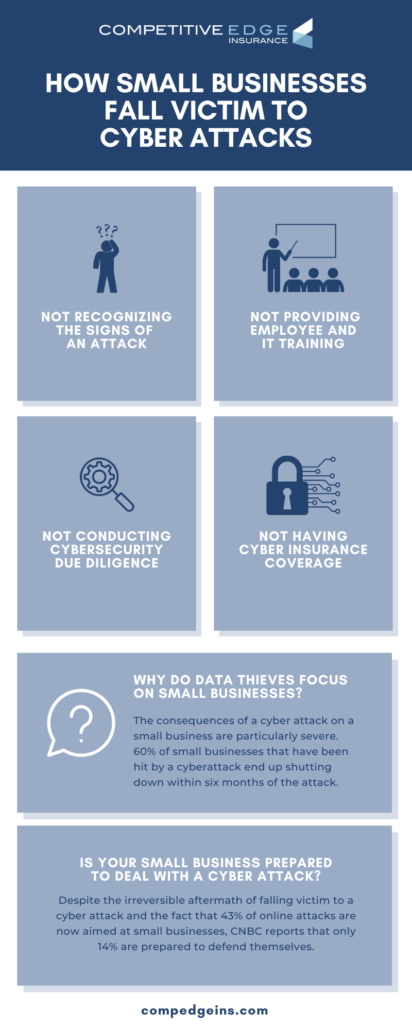
The consequences of a cyber attack on a small business are particularly severe. 60% of small businesses that have been hit by a cyberattack end up shutting down within six months of the attack.

Despite the irreversible aftermath of falling victim to a cyber attack and the fact that 43% of online attacks are now aimed at small businesses, CNBC reports that only 14% are prepared to defend themselves.

Interested in some more statistics?

  • 20% of small businesses have experienced a cyberattack in the last two years. 
  • Last year there was a 424% increase in small business breaches.
  • The median ransomware payment is up 52% to $71,664.
  • On average, businesses experience 22 days of disruption as a result of a ransomware attack.

Cyber attacks are not only extremely expensive to recover from but they also damage your business’s reputation and productivity, and can even be dangerous in the event of personal data being stolen.

This is why it is crucial to protect your small business from cyberattacks. But how can you protect yourself? What can the Florida plant case study teach us?
How Can You Prevent Phishing?

Luckily, there are measures you can take to prevent phishing as a business owner. Let’s discuss some options.

Training

  • Training your employees: To be vigilant; educate them on common phishing traps, email scamming tactics, and how to send data securely (In the Florida case study mentioned earlier, the employee who noticed the breach reported it immediately).
  • Training IT: To know what to look for

Be sure to document your training and review it on a weekly or quarterly basis with employees and staff.

Due Diligence

Ensure your business is conducting thorough, routine cybersecurity due diligence.

According to Security Scorecard, cybersecurity due diligence is “the process of identifying and addressing cyber risks across your network ecosystem.” Doing so provides “insights into potential gaps in network security so that they can be addressed before they are exploited by cybercriminals.”

For those who are interested in seeing where their business is in terms of safety, read on to learn how you can measure your company’s cybersecurity risk.

Have a Planned Crisis Response in Place

When it comes to cyber risk, there’s nothing worse than being ill-prepared. Of course, we couldn’t write about cyberattacks without mention of investing in a cyber liability insurance policy for your business.

A cyber liability policy might include:

  • Data Breach Coverage
  • Business Interpretation Loss Reimbursement
  • Cyber Extortion Defense
  • Forensic Support
  • Legal Support
  • Coverage beyond a General Liability Policy

As a small business, you must be prepared—because the consequences can be insurmountable. Interested in learning more about cyber insurance and why you need it? Read on in our article “Why Does My Business Need Cyber Insurance?”
https://compedgeins.com/wp-content/uploads/2021/12/How-Small-Businesses-Fall-Victim-to-Cyber-Attacks.png 628 1200 https://compedgeins.com/wp-content/uploads/2026/08/Comp-Edge-ONLY-Color-Logo-300x59.jpg 2022-01-02 07:00:002022-07-21 15:07:00How Small Businesses Fall Victim to Cyber Attacks

What to Know About Changes in Cannabis Insurance

in Cannabis, High-Risk Insurance

The cannabis industry continues to grow every day. With this, comes a new space for industry coverage. In this article, we’ll discuss changes in cannabis insurance; including how the industry has evolved, cannabis business insurance challenges, and how to insure your high-risk business properly. Let’s dive in.

How Has the Cannabis Industry Evolved?

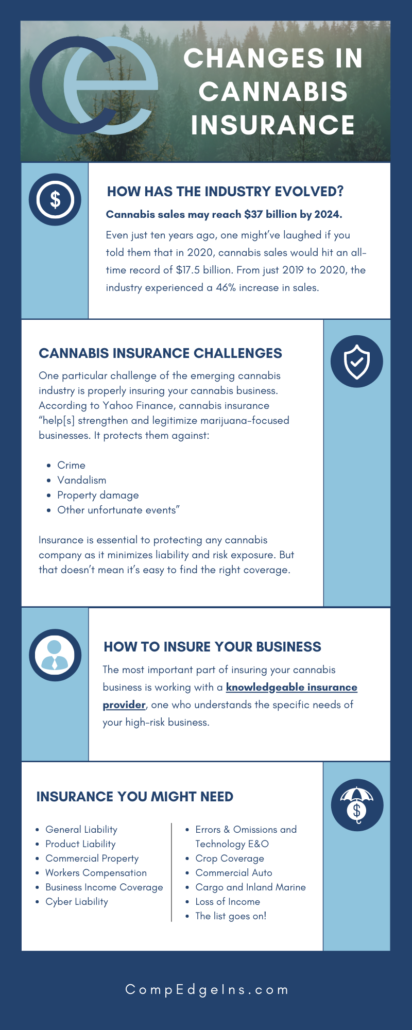
As we previously mentioned, the public’s reaction to cannabis has shifted time and time again throughout history. Even just ten years ago, one might’ve laughed if you told them that in 2020, cannabis sales would hit an all-time record of $17.5 billion. In fact, from just 2019 to 2020, the industry experienced a 46% increase in sales, according to Forbes.

To put things in perspective, according to PropertyCasualty360, cannabis sales may reach up to $37 billion by 2024, which means “the U.S. legal cannabis market would still outpace annual craft beer sales and generate more revenue than toothpaste, hard seltzer, and the NBA combined.”

The decision of many U.S. states to have made cannabis legal today is still controversial on some level. 

While many people turned their noses up at cannabis being made legal, it’s interesting to remember that the drug actually “enjoyed a 5000 year history as a therapeutic agent across many cultures,” until the Marijuana Tax Act of 1937, which prohibited its use and sale.

The cannabis industry continues to evolve every day. 

With the now booming cannabis market, comes a new space for industry coverage. There are unique cannabis business challenges, which we will discuss below. If you’re interested, however, in the difference between cannabis and hemp insurance, read on here.

Cannabis Insurance

Challenges with Cannabis Insurance

One particular challenge of the emerging cannabis industry is properly insuring your cannabis business. According to Yahoo Finance, cannabis insurance “help[s] strengthen and legitimize marijuana-focused businesses. It protects them against:

  • Crime
  • Vandalism
  • Property damage
  • Other unfortunate events”

Insurance is essential to protecting any cannabis company as it minimizes liability and risk exposure. But that doesn’t mean it’s easy to find the right coverage.

“The good news is the cannabis insurance industry has come a long way in a short time,” says Ian Stewart, founder and chair of the national cannabis and hemp law practice at Wilson Elser.

“These days it is not so much about whether companies can obtain coverage, but more about what lines are available and the limits,” says Stewart. “The variety of insurance vehicles is expanding.”

These varieties include:

  • Property and casualty lines
  • General commercial insurance
  • Product liability

As the cannabis industry continues to grow, we gain a better understanding of how it works and it’s loss history.

More difficult coverage types to write for cannabis businesses, according to Stewart, include:

  • Employment
  • Cyber,
  • Errors and Omissions (E&O) policies
  • Specialty lines (i.e. crop coverage)
  • Auto policies (for companies who deliver cannabis products)

How to Insure Your Cannabis Business

Cannabis insurance falls into the realm of high-risk insurance. According to PropertyCasualty360, “insurers that provide coverage to cannabis businesses engaged specifically in selling marijuana can be criminally liable for aiding and abetting in the sale of marijuana or conspiring to violate the CSA — even when the business’s activity is legal under state law. Further, intrastate issues may also cause complications if marijuana is not regulated uniformly within a state.”

For these reasons, it can be more difficult to find proper coverage.


Legal cannabis companies require specific cannabis insurance expertise. Since the industry is still blooming, there are not as many experts as one would yet hope for.

The most important part of insuring your cannabis business is working with a knowledgeable insurance provider, one who understands the specific needs of your high-risk business. 

Depending on whether you’re a dispensary, cannabis manufacturer, cultivator, delivery business, physician, or so on, all of these branches face a different set of challenges, which, in turn, require different cannabis insurance policies.

These insurance policies, according to Embroker, might include:

  • General Liability
  • Product Liability
  • Commercial Property
  • Workers Compensation
  • Business Income Coverage
  • Cyber Liability
  • Errors & Omissions and Technology E&O
  • Crop Coverage
  • Commercial Auto
  • Cargo and Inland Marine
  • Loss of Income
  • The list goes on!

The steps to insuring your cannabis business can seem daunting. That’s why we recommend you enlist a trusted expert who has experience insuring this high-risk industry. This way, you can partner with someone who understands the specific needs of your cannabis business to create an effective risk management strategy.
Contact Brenda Jo and her team at Competitive Edge to learn more.

https://compedgeins.com/wp-content/uploads/2021/11/What-to-Know-About-Changes-in-Cannabis-Insurance.png 628 1200 https://compedgeins.com/wp-content/uploads/2026/08/Comp-Edge-ONLY-Color-Logo-300x59.jpg 2021-12-26 07:00:002021-11-30 14:40:27What to Know About Changes in Cannabis Insurance

What Mandating the Vaccine Might Mean for Your Business Insurance

in General Business Insurance, Health & Wellness, News

Business owners have experienced unforeseen challenges as a result of the last nearly two years in a global pandemic.

The conversation surrounding the ethics of requiring vaccines has been floating around the workplace for about just as long.

In September 2021, however, President Joe Biden directed the Occupational Safety and Health Administration (OSHA) to introduce an emergency temporary standard (ETS) that requires companies with 100 or more employees to ensure all employees are:

  • Fully vaccinated
  • Or, that they submit to weekly testing and mandatory masking

*As of November 17th, however, OSHA has paused all vaccine mandates “after a federal appeals court upheld a stay.”

Regardless, it is still top of mind for employees. Here’s what mandating the vaccine might mean for your business insurance along with how you can prepare if the mandate is passed.

Who Would This Mandate Affect?

According to The New York Times, companies with 100 or more employees would “have until Jan. 4 to ensure all their workers are either fully vaccinated or submit to weekly testing and mandatory masking.”

This measure would be enforced to promote workplace health and safety and will affect “some 84 million private-sector workers across the country, including some 31 million who are believed to be unvaccinated.”

If the mandate comes into play, OSHA anticipates the ETS will be in effect for six months depending on COVID-19 statistics.

When Did This Mandate Come About?

“The measure was announced by President Biden in September [2021], and details were released on Nov. 4 by the Labor Department’s Occupational Safety and Health Administration [OSHA],” according to The Times.

COVID, ELP, and EPLI

First things first, what is Employer’s Liability Insurance? This form of insurance “protects your business when an employee sues over a work injury or illness,” according to Insureon. It is especially important, considering “almost one in five small businesses will face employee litigation” at some point.

Equally as important to consider is Employment Practices Liability Insurance (EPLI), which is insurance that “provides coverage to employers against claims made by employees.”

With the potential vaccine mandate, we can anticipate an increase in EPLI claims. As a result, we might see EPLI premiums increase. Kyle Jeziorski, Executive Vice President at Founder Shield offered insight: “I think insurers will try to add COVID-19 exclusions to EPLI policies and potentially offer the coverage for an additional premium.”

It’s definitely something we here at Competitive Edge Insurance will continue to keep a pulse on.

How Responsible Are Businesses for the Spread of COVID?

During the onset of COVID, many employees wondered to what extent businesses and business owners should be held liable if an employee were to contract COVID-19 on the job and suffer sickness or even death as a result.

The answer today is still clear as mud.

There are, however, steps your business can (and should) take to prepare for these newly introduced COVID-19 vaccine mandates.

Steps Your Business Can Take to Prepare

Business Insurance tells us that now is the time that businesses should prepare U.S. Equal Employment Opportunity Commission processes as well as human resources (HR) departments for what lies ahead.

As we well know, there are many employees across the U.S. who will request exemptions from receiving the COVID-19 vaccine due to religious or health reasons. This process, called an ‘interactive process,’ can take weeks or even months.

For businesses, this can be a lot added on their plates—especially if they receive a high number of requested exemptions.

Businesses should know this ahead of time and prepare accordingly.

Erect a Framework in Advance

“Businesses owe it to themselves to put together a framework to manage this,” says Chuck Kable, Chief Legal Officer and Chief Human Resources Officer at Axiom Medical. “You have to have a protocol and a process that you have to administer consistently and over time, and you have to treat everybody equally.” 

If businesses fail to do so, this is when liabilities begin to pop up. 

“Any mishandling of an exemption request can run afoul of anti-discrimination laws,” says Adam Kempe of Kelley Kronenberg. Companies might face various liabilities including:

  • Failure to maintain and keep private workers’ health information
  • Failure to follow steps in Equal Employment Opportunity Commission (EEOC) exemption requests

Consider OSHA Fines

If the headache of one of your employees filing a claim with OSHA as a result of your negligence isn’t enough motivation to get your ducks in a line, consider the hefty OSHA fines you might face.

If a complaint is filed, the first thing OSHA is going to look for is your current OSHA Covid Protection Procedures that are in place, which includes your Injury and Illness Prevention Program (IIPP). All employers are required to have IIPPs in place.

OSHA fines can be especially detrimental to your company’s financials because while OSHA personnel might come in looking for one thing, chances are they will do some digging, which could lead to additional fines or penalties. OSHA, in that sense, is similar to the IRS—except for employers.

Employee Screenings

A final precaution that employers should take, according to Brenda Jo Robyn, founder of Competitive Edge Insurance, is to conduct thorough employee screenings.

Brenda Jo also acknowledges that it may be the case that many people will choose to not work as a result of this mandate.

“You can find out a lot about an employee or potential employee from a screening,” says Brenda Jo. “Be sure to look at their workers’ compensation claims and do reference checks.”

Take advantage of not only their most recent reference but reach out to prior references as well.

A Final Word

With this potential vaccine mandate firing up, it’s especially important for employers to be on their A-game as far as safety procedures and insurance are concerned.

“There’s nothing that prevents a company, especially one not familiar with these issues, from now bringing in appropriate HR personnel, a consultant, or employment counsel to understand what to expect,” says Kempe of Kelley Kronenberg.

On the topic of vaccines, did you know that Brenda Jo Robyn, founder of Competitive Edge, began her career as an Epidemiologist who specialized in immunizations? To hear more about vaccines, specifically, her passion for Polio research, visit this blog post.

https://compedgeins.com/wp-content/uploads/2021/11/What-Mandating-the-Vaccine-Might-Mean-for-Your-Business-Insurance-1.png 628 1200 https://compedgeins.com/wp-content/uploads/2026/08/Comp-Edge-ONLY-Color-Logo-300x59.jpg 2021-12-05 07:00:002021-11-22 16:50:57What Mandating the Vaccine Might Mean for Your Business Insurance

What’s the Difference Between a Surety Bond and a Contract Bond?

in Bonding, Construction, High-Risk Insurance, News, Video

The world of insurance can be complex—and for contractors, work can be dangerous, too. As a contractor, the question of what insurance you need to stay protected is likely to come up.

So, for starters: What’s the difference between a surety bond and a contract bond? Which do you need to stay safe?

Today, Brenda Jo Robyn, founder of Competitive Edge Insurance, is here on camera to give us the spiel; including the differences, benefits and risks, and what you need. Let’s dive in.

What is a Surety Bond?

There are three parties involved in a surety bond, including:

  • The surety company
  • The principal or the insured
  • The obligee

A surety bond is a contract where one party (the surety company) guarantees the performance of certain obligations in a contract of the second party (the principal or the insured) to a third party (the obligee).

When Do You Need a Surety Bond?

Surety bonds are needed for most licenses in the state of California and other states as well. Some examples of who might need a surety bond include:

  • Contractors
  • Real estate companies and agents
  • Financial institutions
  • Janitorial personnel

Why Do You Need a Surety Bond?

Licensed bonds are required in many states to do business, and are put in place by the state to protect the consumer.

The insured, or principal, purchases this bond in an amount prescribed by the state to pay the obligee (the state at this point), in case there’s a claim against someone’s license.

What is a Contract Bond?

A contractor performance bond is a written contract that guarantees the performance obligations under a contract.

Contractor performance bonds are used frequently in the construction industry but are also sometimes used in manufacturing and supply chains as well.

When Do You Need a Contract Bond?

The short answer: It depends! Contractors can be required to have a contract bond for different parts of the process when they’re bidding for a job, according to Brenda Jo.

What Is a Bid Bond? When Do You Need One?

Oftentimes, a bid bond is required to submit a bid for a project. Typically, these bids are in the public arena for states or cities. For example, the Department of Forestry.

“A bid bond lets this entity know that the contractor can provide a payment and performance bond should the job be awarded to them,” says Brenda Jo.

“If the contractor is awarded the project and the contractor decides that they cannot fulfill the obligation, the bid bond helps to pay for the difference in price that it costs to get a new contractor in.”

This leads to the next kind of bond couplings, which is the payment bond and the performance bond. Let’s discuss.

Payment Bonds and Performance Bonds

What is a payment bond? What about a performance bond?

A payment bond is a bond that guarantees payment for subcontractors and payment for materials.

A performance bond, on the other hand, covers the ability of the contractor to perform and finish the job as per contract requirements. If the contractor doesn’t perform, the contract bond kicks in and helps to pay for the completion of that performance.

infographic showing the difference between a surety bond and a contract bond

A Final Word

An important note: For all bonds mentioned, if they’re used and there’s a claim on a bond, the contractor who purchased the bond has to pay that back, says Brenda Jo.

This considered, surety companies look for strong financials in a company, including:

  • Assets
  • Lines of credit
  • Letters of credit

Surety companies look for anything that creates a picture that says you’re worthy of having a bond put into place—because if the bond is utilized and pays out, they need to know that the purchaser of the bond can pay that money back.

Bring in The Experts

At Competitive Edge Insurance, we work with insurance carriers across the country to place all types of business coverage. We are always seeking out new insurance companies to write hard-to-place and high-risk business insurance.

Don’t let cancellation dissuade you from finding comprehensive coverage. We can help! Learn more by connecting with our team today.

Additionally, for those interested in learning more, choose between our articles on the key differences between general contractors and construction managers and the difference between payment and performance bonds.

https://compedgeins.com/wp-content/uploads/2021/10/Whats-the-Difference-Between-a-Surety-Bond-and-Default-Insurance.png 628 1200 https://compedgeins.com/wp-content/uploads/2026/08/Comp-Edge-ONLY-Color-Logo-300x59.jpg 2021-11-28 07:00:002022-05-27 09:45:25What’s the Difference Between a Surety Bond and a Contract Bond?

Why is Phishing the #1 Thing Killing Small Businesses?

in Cyber Insurance, News, Video

What is phishing? And no, we’re not talking about the activity of catching fish for food or sport. Phishing, spelled with a ‘ph,’ is an ever-growing concern defined as the “technique for attempting to acquire sensitive data, such as bank account numbers, through a fraudulent solicitation in email or on a web site, in which the perpetrator masquerades as a legitimate business or reputable person.”

But why is phishing especially harmful to small businesses? Why are they being targeted? We have all the answers and more, thanks to Brenda Jo Robyn, founder of Competitive Edge Insurance.

So, welcome to ‘Why is Phishing the #1 Thing Killing Small Businesses?’ We hope you stick around to learn something new, including how you might protect yourself as a small business owner.

What is Phishing?

Today, phishing can come in a variety of forms. According to Brenda Jo, phishing is “any activity that compromises your organization’s security… It can come in the way of an email or a text or an application.” These applications that retrieve your data can be on your computer, phone, even your iPad. Scammers target you and ask questions to get your information in really creative ways.

An Example of Phishing

Let’s say you receive an email that you’ve been expecting from Bank of America. Why not just ignore it? Well, because…

“It looks like you really should open it. [After all,] it’s a secure document for the bank you’ve been working with lately,” says Brenda Jo. The culprits know you’ve been waiting for this specific type of document to arrive in your inbox because they’ve been screening your emails. 

“So, now they have captured that you’re working with this bank and now this bank is sending you a secure document that you need to open… You open it out of their Google docs, and all of a sudden, bam, you got a worm or a virus on your computer,” says Brenda Jo.

“That’s going to either start going through all your files and looking for stuff. They’re gonna track your emails or they’re going to track your keystrokes.”

Phishing is huge right now. Brenda Jo continues. “I can’t stress enough how important it is to make sure that your computers and data is secure from others. There are a lot of what are called ‘bad elements’ or ‘bad actors’ out there that are trying to steal your data… Right now data is money. And the more data you have, the more money you can make.”

How Dangerous is Phishing for Small Businesses?

The statistics speak for themselves. Right now, 60% of small companies that have been hit by a cyber attack are closing their doors within six months. The reason? It is very costly to come back from a cyber attack.

Most small businesses don’t have the collateral, backing, or lines of credit to make themselves whole again after an attack of this caliber.

How Can Small Businesses Protect Themselves from Phishing?

Training

Focus on training.

  • Training your employees: (For example, they need to know how not to send excel spreadsheets emails! Instead, create a zip file or convert the document into a PDF. Why? It is very easy to scrape data from an excel file while in an email.)
  • Training IT: They need to know what to look for.

Due Diligence

Due diligence is the bare minimum. Document your training and go over it on a weekly or quarterly basis. Next, ensure your IT systems are multi-layered. This means not only having firewalls on your computers and servers but also helpful, educated IT personnel available.

Develop a Planned Crisis Response

A planned crisis response includes a cyber liability policy. As Brenda Jo says, “one of the things that kills the small business is the lack of PR or response to their clients and/or vendors when a phishing attack occurs and data has been compromised.”

“It’s very expensive to go and let everybody know, ‘Hey, your information was taken and here’s the year’s worth of credit monitoring’”—especially if the data is health-related. 

You might face both federal fines as well as fines from the state government. The costs add up, and that’s where cyber liability comes in to help.

Reach Out to Competitive Edge Today

As you look at your coverage, think of the potential for cybersecurity issues, evaluate your tolerance for risk, and take the time to look at your policies in detail. As experts, we at Competitive Edge can tell you where you are vulnerable and what the risk might cost you. It is then your decision to accept the risk or mitigate it with coverage. You know what we would do.
Interested in learning more about the dangers of ransomware and why the need for cyber liability coverage is increasing? Read on in cyber liability coverage for the new era of ransomware.

https://compedgeins.com/wp-content/uploads/2021/10/Why-is-Phishing-the-1-Thing-Killing-Small-Businesses.png 628 1200 https://compedgeins.com/wp-content/uploads/2026/08/Comp-Edge-ONLY-Color-Logo-300x59.jpg 2021-11-21 07:00:002021-11-08 12:57:17Why is Phishing the #1 Thing Killing Small Businesses?

What to Expect from Changing Contractor Costs

in Construction, High-Risk Insurance, News, Video

The global pandemic brought many changes to the construction and builders industry. Here’s what to expect in 2021.

Read more
https://compedgeins.com/wp-content/uploads/2021/04/Construction-Feature-Image-scaled.jpg 1706 2560 https://compedgeins.com/wp-content/uploads/2026/08/Comp-Edge-ONLY-Color-Logo-300x59.jpg 2021-11-08 11:25:002021-11-08 11:29:52What to Expect from Changing Contractor Costs

Shock Loss: How to Redefine your Risk Profile in a Post-COVID Market

in Construction, High-Risk Insurance, News
Read more
https://compedgeins.com/wp-content/uploads/2021/05/Copy-of-COMP-EDGE-Feature-Image-Risk_May10.png 924 1640 https://compedgeins.com/wp-content/uploads/2026/08/Comp-Edge-ONLY-Color-Logo-300x59.jpg 2021-11-01 16:41:002021-11-01 16:41:01Shock Loss: How to Redefine your Risk Profile in a Post-COVID Market

How does Workers’ Compensation Insurance Work?

in General Business Insurance, High-Risk Insurance, News, Workers' Compensation

Picture this scenario: You’re at a construction site and a worker falls off the roof and falls and breaks their leg onto floor tiles, also breaking the tiles. What would be covered in that situation, the leg or the tiles? 

What is Workers’ Compensation Insurance?

Workers’ compensation insurance are policies that provide medical benefits and wage compensation to workers injured on the job, in exchange for eliminating their right to file a lawsuit against their employer’s negligence.

Workers’ compensation benefits are designed to help employees if they are unable to work, cover medical expenses, as well as other expenses and rehabilitation costs associated with disability or illness. As you look to explore workers’ compensation options, it’s important to look for one that provides adequate coverage and compensation for your employees.

When you invest in a properly designed policy, it ensures you and your employees remain financially secure. It’s also important to look at the specific benefits that are offered within your policy. Typical workers’ compensation insurance policies cover medical benefits.

So, the worker’s comp covers the worker’s injury for falling off the roof. 

What is Covered with Workers’ Compensation Insurance?

Specific workers’ compensation laws vary depending on your state; however, the most common compensation states that require workplace injury insurance include the following:

  • Payment for lost wages
  • Vocational rehabilitation
  • Permanent disability
  • Temporary disability
  • Medical costs and treatment 

Bonds 

One helpful way to understand this scenario is knowing the difference between performance and payment bonds.

Payment Bonds

In simple terms, a payment bond enforces that everything must be paid once a project is completed. Payment bonds are also surety bonds and are required for most state projects based on the Miller Act. 

The Miller Act was passed by the U.S. General Services Administration Public Buildings Service (GSA) with the intention to explain how payment bonds protect subcontractors and suppliers.

The GSA responds to any reports of nonpayment, following the legal action needed and protected by the Miller Act. The GSA states that “the Miller Act requires that prime contractors for the construction, alteration, or repair of Federal buildings furnish a payment bond for contracts in excess of $100,000.” 

Payment bonds additionally play a major role in construction. As an insurance company, we have relationships with carriers who understand the specifics of construction risk and can provide better solutions, better prices, and more comprehensive coverage—even for hard-to-place and high-risk companies.

Performance Bonds 

The main differentiator between payment and performance bonds is that a performance bond ensures the employer is satisfied with the job. While both are surety bonds, performance bonds can be helpful in industries apart from construction. 

A performance bond, according to Investopedia, “ensures the completion of a project. Setting these two together provides the proper incentives for laborers to provide a quality finish for the client.” 

Any type of bonding will cover e tiles or building materials that were broken.

Overview

If an employee falls off the roof and hurts their leg and breaks the tile, the  Workers comp covers the worker’s injury for falling off the roof. Bonding covers the broken tiles from his attempt not to fall off the roof. 

The first step is to show us under the hood so we can help you find the right carrier and coverage to protect your business today and always.

Read about Worker’s Compensation for Independent Contractors here. 

https://compedgeins.com/wp-content/uploads/2021/09/iStock-1202975142.jpg 1414 2120 https://compedgeins.com/wp-content/uploads/2026/08/Comp-Edge-ONLY-Color-Logo-300x59.jpg 2021-10-24 17:06:002021-11-01 16:05:45How does Workers’ Compensation Insurance Work?

World Polio Day

in Health & Wellness, News, Personal Lines, Video

Competitive Edge’s very own CEO, Brenda Jo Robyn has a passion for charitable giving. Because of Brenda Jo’s previous career as an Epidemiologist who specialized in immunizations, she places special attention on Polio research. As October 24 is World Polio Day,  we wanted to get Brenda Jo’s insight into what World Polio Day really means to her. 

What World Polio Day Means to Brenda Jo:

“I belong to the rotary club of Coronado and one of the things that I specifically work on is a fundraiser called End Polio Now, which raises funds to immunize children across the globe. 

Over the last few years, we have raised $2.1 billion to protect over 3 billion children and 122 countries from Wild Polio Viruses, two have been eradicated, and one is still active. And the only countries in which Polio exists in the wild are Pakistan and Afghanistan. This year, we only had two reported cases in January. However, between 2018 and 2020, there hasn’t been as much access to services for families and children. And in those two countries in 2020, there was a three-month break from providing immunizations due to COVID-19. 

They couldn’t go around and go from town to town and, and tried to tribe. Due to recent events, it has become increasingly challenging in Afghanistan and the immunization locations have been closed down. There’s a big concern right now on how this will play out and affect the future. 

Currently, there’s an estimate of 3 million children that remain, un-immunized. And why is this a concern? Well, it can lead to an outbreak. Refugees are being accepted in countries all over the world, and we don’t know who is immunized and who is not immunized as they come. We really have to focus on those children as they’re coming in and treat them all as if they are not immunized.”

Understanding World Polio Day

World Polio Day is an effort to draw attention to the End Polio Now organization working to eradicate the wild poliovirus in both Afghanistan and Pakistan, as well as increase immunizations in countries that are at greater risk, like Africa. 

In order to eradicate the wild poliovirus, high-quality immunization campaigns must be carried out to polio-affected and high-risk countries. Rotary has played a huge role in contributing to Polio eradication. 

What is Rotary?

Brenda Jo is a part of the Rotary Club, which provides her with various opportunities to connect and give back to the community at large. 

“Rotary is a global network of 1.2 million neighbors, friends, leaders, and problem-solvers who see a world where people unite and take action to create lasting change–– across the globe, in our communities, and in ourselves.”The main goal of Rotary is to serve others in the form of charitable works, giving, and time. Brenda Jo loves being a part of Rotary as it gives her the opportunity to make a real difference in the world. If she can impact just one life in a positive way, it is all worth it.

https://compedgeins.com/wp-content/uploads/2020/08/acupuncture-2277444_1280.jpg 847 1280 https://compedgeins.com/wp-content/uploads/2026/08/Comp-Edge-ONLY-Color-Logo-300x59.jpg 2021-10-17 07:00:002021-10-26 15:11:38World Polio Day

What Factors Reduce My Commercial Insurance Premiums?

in General Business Insurance, News

Do you know the in’s and out’s of commercial insurance? Test your premium knowledge by taking the quiz below!

Which of these will reduce my Commercial insurance premiums?

Need some more help after taking that quiz? Read more about the four types of insurance you should have for your business here!

https://compedgeins.com/wp-content/uploads/2021/09/iStock-605742718.jpg 1414 2119 https://compedgeins.com/wp-content/uploads/2026/08/Comp-Edge-ONLY-Color-Logo-300x59.jpg 2021-10-10 16:49:002021-11-01 16:19:51What Factors Reduce My Commercial Insurance Premiums?
Page 3 of 512345

CATEGORIES

RECENT POSTS

  • Cyber Security Image by Anderson Piza at Envato Elements | Licensed
    6 Current Cyber Threats Companies Face: How to Stay Safe
  • Insurance Form Image by rfaizal707 at Envato ElementsEnvato Elements by rfaizal707
    Understanding the Hard Insurance Market and Its Impact on You
  • Black and White Photo of a man writing a contract
    EPLI: Does Your Construction Business Need It?

CONNECT WITH US

VIDEO POSTS

  • City view of commercial buildings, including skyscrapers surrounded by trees
    How to COPE in an Inflationary Environment
  • Coronado bridge aerial view
    Get to Know Our Founder: Her Rotary Involvement
  • Insurtech holographic image with man using ipad
    The Coverage Pitfalls of Insurtech
LET’S TALK

WANT TO KNOW HOW MUCH YOU COULD BE SAVING ON YOUR INSURANCE COSTS?

WANT TO KNOW HOW MUCH YOU COULD BE SAVING ON YOUR INSURANCE COSTS?

LET’S TALK

Connect With Us

Competitive Edge Insurance

LIC #0H31982

P: 619-259-5459
F: 619-377-0144

830 Orange Ave Suite L Coronado, CA 92118

Privacy Policy

Hours of Operation

Monday – Friday 8:00AM – 5:00PM

Saturday Closed

Sunday Closed

© Copyright 2021- Competitive Edge Insurance Services

site design by digitalstoryteller.io

© Copyright 2021- Competitive Edge Insurance Services
site design by digitalstoryteller.io

Scroll to top

This site uses cookies. By continuing to browse the site, you are agreeing to our use of cookies.

Accept settings

Cookie and Privacy Settings


How we use cookies

We may request cookies to be set on your device. We use cookies to let us know when you visit our websites, how you interact with us, to enrich your user experience, and to customize your relationship with our website.

Click on the different category headings to find out more. You can also change some of your preferences. Note that blocking some types of cookies may impact your experience on our websites and the services we are able to offer.

Essential Website Cookies

These cookies are strictly necessary to provide you with services available through our website and to use some of its features.

Because these cookies are strictly necessary to deliver the website, refusing them will have impact how our site functions. You always can block or delete cookies by changing your browser settings and force blocking all cookies on this website. But this will always prompt you to accept/refuse cookies when revisiting our site.

We fully respect if you want to refuse cookies but to avoid asking you again and again kindly allow us to store a cookie for that. You are free to opt out any time or opt in for other cookies to get a better experience. If you refuse cookies we will remove all set cookies in our domain.

We provide you with a list of stored cookies on your computer in our domain so you can check what we stored. Due to security reasons we are not able to show or modify cookies from other domains. You can check these in your browser security settings.

Google Analytics Cookies

These cookies collect information that is used either in aggregate form to help us understand how our website is being used or how effective our marketing campaigns are, or to help us customize our website and application for you in order to enhance your experience.

If you do not want that we track your visit to our site you can disable tracking in your browser here:

Other external services

We also use different external services like Google Webfonts, Google Maps, and external Video providers. Since these providers may collect personal data like your IP address we allow you to block them here. Please be aware that this might heavily reduce the functionality and appearance of our site. Changes will take effect once you reload the page.

Google Webfont Settings:

Google Map Settings:

Google reCaptcha Settings:

Vimeo and Youtube video embeds:

Other cookies

The following cookies are also needed - You can choose if you want to allow them:

Privacy Policy

You can read about our cookies and privacy settings in detail on our Privacy Policy Page.

Privacy Policy
Accept settings